Candraketu, Chandraketu: 8 definitions
Introduction:
Candraketu means something in Hinduism, Sanskrit, the history of ancient India. If you want to know the exact meaning, history, etymology or English translation of this term then check out the descriptions on this page. Add your comment or reference to a book if you want to contribute to this summary article.
Alternative spellings of this word include Candraketu.
Images (photo gallery)
In Hinduism
Purana and Itihasa (epic history)
1) Candraketu (चन्द्रकेतु).—A son of Śatrughna, brother of Śrī Rāma. Śatrughna had two sons. Aṅgada and Candraketu by his wife Śrutakīrti (Uttara Rāmāyaṇa).
2) Candraketu (चन्द्रकेतु).—A vidyādhara King. See Muktāphalaketu).
1a) Candraketu (चन्द्रकेतु).—A son of Lakṣmaṇa; capital, Candracakra (Candravaktra, Vāyu-purāṇa).*
- * Brahmāṇḍa-purāṇa III. 63. 188; Vāyu-purāṇa 88. 187-8; Viṣṇu-purāṇa IV. 4. 104.
1b) A Gandharva.*
- * Vāyu-purāṇa 69. 26.

The Purana (पुराण, purāṇas) refers to Sanskrit literature preserving ancient India’s vast cultural history, including historical legends, religious ceremonies, various arts and sciences. The eighteen mahapuranas total over 400,000 shlokas (metrical couplets) and date to at least several centuries BCE.
Kavya (poetry)
Candraketu (चन्द्रकेतु) is the name of an ancient Vidyādhara king, according to the Kathāsaritsāgara, chapter 115. Accordingly, “... Indra, the ruler of the gods’ world, heard of his coming, and kept guard in heaven, and when he drew near marched out to meet him, eager for battle, accompanied by his friend Candraketu, the king of the Vidyādharas, and by the supreme lord of the Gandharvas, named Padmaśekhara”.
The Kathāsaritsāgara (‘ocean of streams of story’), mentioning Candraketu, is a famous Sanskrit epic story revolving around prince Naravāhanadatta and his quest to become the emperor of the vidyādharas (celestial beings). The work is said to have been an adaptation of Guṇāḍhya’s Bṛhatkathā consisting of 100,000 verses, which in turn is part of a larger work containing 700,000 verses.
Kavya (काव्य, kavya) refers to Sanskrit poetry, a popular ancient Indian tradition of literature. There have been many Sanskrit poets over the ages, hailing from ancient India and beyond. This topic includes mahakavya, or ‘epic poetry’ and natya, or ‘dramatic poetry’.
General definition (in Hinduism)
Candraketu (चन्द्रकेतु): A devotee of Manasā
India history and geography
Chandraketu (=Chandraketudeva) is the name of an ancient Raja (king of Nepal) from the Thakuri (or Rajput) dynasty, mentioned in the list of “Rajas of Nepal from the time of Ne Muni”, as extracted from the translation of the Vanshavali or Bansawali (“history and genealogical accounts of Nepal”).—Note: This list has been carefully revised and collated with the original manuscript, and gives the most correct forms of the royal names (e.g., Chandraketu-deva). The reader should compare it with the list in Thomas’s edition of Prinsep’s Essays on Indian Antiquities, Vol. II., pp. 268-271.
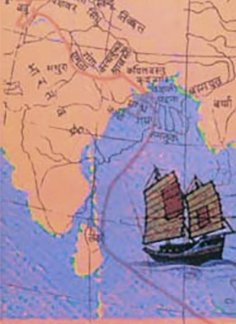
The history of India traces the identification of countries, villages, towns and other regions of India, as well as mythology, zoology, royal dynasties, rulers, tribes, local festivities and traditions and regional languages. Ancient India enjoyed religious freedom and encourages the path of Dharma, a concept common to Buddhism, Hinduism, and Jainism.
Languages of India and abroad
Sanskrit dictionary
1) Candraketu (चन्द्रकेतु):—[=candra-ketu] [from candra > cand] m. Name of a son of Lakṣmaṇa, [Rāmāyaṇa vii, 102, 2; Raghuvaṃśa xv, 90]
2) [v.s. ...] of several other men, [Mahābhārata vii, 1899; Viṣṇu-purāṇa]
3) [v.s. ...] of a Vidyādhara, [Kathāsaritsāgara cxv, 24]
4) [v.s. ...] of a prince of Cakora (slain by an emissary of king Śūdraka), [Harṣacarita vi]
5) [v.s. ...] of a prince (emissary of king Śūdrika), [Vīracarita xviii, 41 f.]
6) [v.s. ...] of a hero of Kālikā, [xxx.]
Candraketu (चन्द्रकेतु):—(ca + ke) m. Nomen proprium eines Mannes [Mahābhārata 7, 1899.] eines Sohnes des Lakṣmaṇa [Raghuvaṃśa 15, 90.] [Viṣṇupurāṇa 385.]
--- OR ---
Candraketu (चन्द्रकेतु):—ein Sohn Lakṣmaṇa’s [Rāmāyaṇa 7, 102, 2.] ein Vidyādhara [Kathāsaritsāgara 115, 24.]
Candraketu (चन्द्रकेतु):—m. Nomen proprium —
1) verschiedener Männer [VP.².] —
2) eines Vidyādhara. —
3) eines Helden der Kālikā [Indische studien von Weber 14.]
Sanskrit, also spelled संस्कृतम् (saṃskṛtam), is an ancient language of India commonly seen as the grandmother of the Indo-European language family (even English!). Closely allied with Prakrit and Pali, Sanskrit is more exhaustive in both grammar and terms and has the most extensive collection of literature in the world, greatly surpassing its sister-languages Greek and Latin.
See also (Relevant definitions)
Partial matches (+0): Candra, Ketu.
Starts with (+0): Candraketudeva.
Full-text (+0): Muktavali, Candraketudeva, Candravakta, Candracakra, Malla, Muktaphalaketu, Angada, Takshaka, Padmashekhara, Savitra, Shiva, Candrikadevi, Nikasa, Lakshmana, Padmavati.
Relevant text
Search found 21 books and stories containing Candraketu, Chandraketu, Candra-ketu, Chandra-ketu; (plurals include: Candraketus, Chandraketus, ketus). You can also click to the full overview containing English textual excerpts. Below are direct links for the most relevant articles:
Kathasaritsagara [Sanskrit/English] (by C. H. Tawney)
Ramayana of Valmiki (Shastri) (by Hari Prasad Shastri)
Chapter 102 - Rama bestows Kingdoms on Lakshmana’s Sons < [Book 7 - Uttara-kanda]
Puranic encyclopaedia (by Vettam Mani)
Tilakamanjari of Dhanapala (study) (by Shri N. M. Kansara)
Appendix 16 - Index of characters in the Tilakamanjari
2. The by-plot of the Tilakamanjari < [Chapter 8 - The Plot and the Motifs]
4.3. Character description of Samaraketu (son of Candraketu) < [Chapter 16 - The Tilakamanjari as a Sanskrit novel]
Kathasaritsagara (the Ocean of Story) (by Somadeva)
Chapter CXV < [Book XVII - Padmāvatī]
Chapter CXVI < [Book XVII - Padmāvatī]
Chapter CXIX < [Book XVII - Padmāvatī]
Kuntaka’s evaluation of Sanskrit literature (by Nikitha. M)
4. Uttararāmacarita in Kuntaka’s treatment < [Chapter 4 - Kuntaka’s evaluation of Sanskrit Plays of other Poets]
3.8 (e): Contextual figurativeness or prakaraṇa-vakratā < [Chapter 1 - Vakroktijīvita: A Synoptic Survey]