Prahrada, Prahrāda: 10 definitions
Introduction:
Prahrada means something in Hinduism, Sanskrit. If you want to know the exact meaning, history, etymology or English translation of this term then check out the descriptions on this page. Add your comment or reference to a book if you want to contribute to this summary article.
In Hinduism
Pancaratra (worship of Nārāyaṇa)
Prāhrāda (प्राह्राद) or Prāhrādasaṃhitā is the name of an ancient Pāñcarātra Saṃhitā mentioned in the Hayaśīrṣasaṃhitā: a large Pāñcarātra Āgama consisting of roughly 6500 verses dealing primarily with architecture, temple-building and consecration rituals and iconography.—The passage listing these titles concludes by saying that originally there were only these twenty-five. Later on, however, saṃhitā-works multiplied in numbers. But all of them are to be understood to be derived from the ones named above.
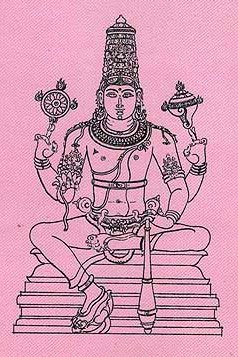
Pancaratra (पाञ्चरात्र, pāñcarātra) represents a tradition of Hinduism where Narayana is revered and worshipped. Closeley related to Vaishnavism, the Pancaratra literature includes various Agamas and tantras incorporating many Vaishnava philosophies.
Languages of India and abroad
Sanskrit dictionary
Prahrāda (प्रह्राद).—
1) Great joy, pleasure, delight, happiness.
2) Sound.
3) A species of rice.
4) Name of a son of the demon Hiraṇya-Kaśipu. [According to the Padma Purāṇa, he was a Brāhmaṇa in his previous existence, and when born as son of Hiraṇya-Kaśipu, he still retained his ardent devotion to Viṣṇu. His father, of course, did not like that his own son should be such a devout worshipper of his mortal enemies, the gods, and with the object of getting rid of him, he subjected him to a variety of cruelties; but Prahlāda, by the favour of Viṣṇu, was quite unscathed, and began to preach with even greater earnestness than before the doctrine that Viṣṇu filled all space and was omni-present, omni-scient, omni-potent. HiraṇyaKaśipu in a fit of exasperation asked him "If Viṣṇu is omni-present how do I not see him in the pillar of this hall?" Whereupon Prahlāda struck the pillar with his fist (according to another account, HiraṇyaKaśipu himself angrily kicked the pillar to convince his son of the absurdity of his faith), when Viṣṇu came out half-man and half-lion, and tore HiraṇyaKaśipu to pieces. Prahlāda succeeded his father, and reigned wisely and righteously.]
Derivable forms: prahrādaḥ (प्रह्रादः).
See also (synonyms): prahlāda.
Prahrāda (प्रह्राद).—m.
(-daḥ) A prince: see prahlāda. E. la changed to ra .
Prahrāda (प्रह्राद).—[masculine] [Name] of the chief of the Asuras.
Prahrāda (प्रह्राद) as mentioned in Aufrecht’s Catalogus Catalogorum:—Prabodhacandrodayahastāmalaka.
1) Prahrāda (प्रह्राद):—[=pra-hrāda] m. (√hrād) Name of the chief of the Asuras (with the [patronymic] Kāyādhava. and father of Virocana), [Taittirīya-brāhmaṇa]
2) [v.s. ...] of a son of Hiraṇyakaśipu (he was an enemy of Indra and friend of Viṣṇu), [Mahābhārata; Harivaṃśa; Bhāgavata-purāṇa] (cf. pra-hlāda).
Prahrāda (प्रह्राद):—[pra-hrāda] (daḥ) 1. m. A prince.
Prahrāda (प्रह्राद):—(von hrād mit pra) m. Nomen proprium des Obersten der Asura, mit dem patron. Kāyādhava und Vaters des Virokana, [Taittirīyabrāhmaṇa 1, 5, 9, 1.] eines Sohnes des Hiraṇyakaśipu, Feindes des Indra und Freundes des Viṣṇu, [Mahābhārata 1, 2439. 5, 1202. fgg. 12, 3662. 4568. fgg. 6654. fgg. 8023. fgg.] [Harivaṃśa 187. 261. 2283. 12459. 12695. 12711. fgg. 12914. 12990. fgg. 13191. 13214. 13971. 14022. 14249. fgg. 14284.] [Bhāgavatapurāṇa 1, 3, 11. 12, 25. 5, 18, 7. 6, 18, 9. 12. 7, 13, 11. fgg. 9, 17, 14.] — Vgl. prahlāda .
--- OR ---
Prāhrāda (प्राह्राद):—(von prahrāda) m. patron. des Virocana [Mahābhārata 5, 1195], wo prāhrādedaṃ aber auch eine unregelmässige Zusammenziehung von prāhrāda (d. i. prāhrāde) idaṃ sein könnte.
--- OR ---
Prahrāda (प्रह्राद):—[Āpastamba 1, 32, 24.]
Prahrāda (प्रह्राद):—m. Nomen proprium des Hauptes der Asura.
--- OR ---
Prāhrāda (प्राह्राद):—scheinbar [Mahābhārata 5,1195,] da prāhrāde tevarāsanas die richtige Lesart ist.
Prahrāda (in Sanskrit) can be associated with the following Chinese terms:
1) 歡喜 [huān xǐ]: “bliss”; “delight”; “happiness”.
Sanskrit, also spelled संस्कृतम् (saṃskṛtam), is an ancient language of India commonly seen as the grandmother of the Indo-European language family (even English!). Closely allied with Prakrit and Pali, Sanskrit is more exhaustive in both grammar and terms and has the most extensive collection of literature in the world, greatly surpassing its sister-languages Greek and Latin.
See also (Relevant definitions)
Partial matches (+0): Hrada, Pra.
Starts with (+0): Prahradana, Prahradasamhita.
Full-text (+0): Kayadhava, Prahlada, Prahradi, Kujambha, Anuhrada, Prahradasamhita, Prabodhacandrodayahastamalaka, Aprameyanubhava, Virocana, Durlabhanarayana, Hiranyakashipu, Hrad, Huan xi, Hlad, Jambha, Nivatakavaca, Path, Abhisheka.
Relevant text
Search found 17 books and stories containing Prahrada, Pra-hrada, Pra-hrāda, Prahrāda, Prāhrāda; (plurals include: Prahradas, hradas, hrādas, Prahrādas, Prāhrādas). You can also click to the full overview containing English textual excerpts. Below are direct links for the most relevant articles:
Brahma Purana (critical study) (by Surabhi H. Trivedi)
39. Description of the Demons < [Mythology]
3. Nature of Kingship < [Chapter 11 - Political Structure]
Brihad Bhagavatamrita (commentary) (by Śrī Śrīmad Bhaktivedānta Nārāyana Gosvāmī Mahārāja)
Verse 1.3.85 < [Chapter 3 - Prapañcātīta (beyond the Material Plane)]
Verse 1.3.81 < [Chapter 3 - Prapañcātīta (beyond the Material Plane)]
Verse 1.4.16 < [Chapter 4 - Bhakta (the devotee)]
Agni Purana (by N. Gangadharan)
Narasimha Purana (study and introduction) (by Siddheswar Jena)
Part 3.2 - Second account of Vamsa < [Chapter 3 - Five characteristics of the Narasimha Purana]
Mahabharata (English) (by Kisari Mohan Ganguli)
Section CLXX < [Tirtha-yatra Parva]
Section CCLXXXVII < [Draupadi-harana Parva]
Section XCIX < [Tirtha-yatra Parva]
Puranic encyclopaedia (by Vettam Mani)