Antarakalpa, Antara-kalpa: 4 definitions
Introduction:
Antarakalpa means something in Buddhism, Pali, Hinduism, Sanskrit. If you want to know the exact meaning, history, etymology or English translation of this term then check out the descriptions on this page. Add your comment or reference to a book if you want to contribute to this summary article.
In Buddhism
Mahayana (major branch of Buddhism)
Antarakalpa (अन्तरकल्प) refers to “internal aeons”, according to the Gaganagañjaparipṛcchā: the eighth chapter of the Mahāsaṃnipāta (a collection of Mahāyāna Buddhist Sūtras).—Accordingly: “[...] At that time, the king Sarvadevābhiṣeka had paid homage and respect to the Lord for forty internal aeons (antarakalpa), making offerings of a heap of jewels (ratnarāśi), as much as Mount Sumeru, every single day. By the firmness of his merits (puṇya), the king, his sons, his village’s people and retinues generated the thought of incomparable complete awakening. [...]”.
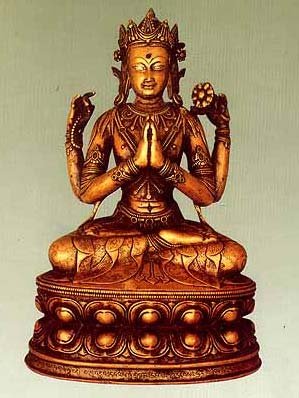
Mahayana (महायान, mahāyāna) is a major branch of Buddhism focusing on the path of a Bodhisattva (spiritual aspirants/ enlightened beings). Extant literature is vast and primarely composed in the Sanskrit language. There are many sūtras of which some of the earliest are the various Prajñāpāramitā sūtras.
General definition (in Buddhism)
Antarakalpa (अन्तरकल्प) refers to an “intervalic aeon” and represents one of the “four aeons” (kalpa) as defined in the Dharma-saṃgraha (section 87). The Dharma-samgraha (Dharmasangraha) is an extensive glossary of Buddhist technical terms in Sanskrit (e.g., antara-kalpa). The work is attributed to Nagarjuna who lived around the 2nd century A.D.
Languages of India and abroad
Sanskrit dictionary
Antarakalpa (अन्तरकल्प).—m. (= Pali °kappa), internal (sub-division of a) kalpa or aeon, or intermediate kalpa (period between major kalpas). In Abhidharmakośa iii.181 the var. antaḥkalpa is recorded, along with this; it seems to point to the first definition above, and La Vallée Poussin, ad loc., considers this the only correct definition; there are 80 in a mahākalpa, op. cit. 187 (in Pali 64, Critical Pali Dictionary). On the other hand Mahāvyutpatti 8281 renders antara-(kalpa) by Tibetan bar gyi, intermediate, and similarly śastrāntara-, rogāntara-, durbhikṣāntara-k° 8282—4; these suggest that antara- kalpas are periods of destruction or disaster for people, compare Critical Pali Dictionary s.v. °kappa, a (short) intermediate period (of destruction of mankind). Critical Pali Dictionary recognizes both the above meanings, and this seems provisionally probable. It is often not clear which appears in specific cases; in Gaṇḍavyūha 325.15 perhaps the second: dvādaśānām antarakalpānām atyayena Saddharmapuṇḍarīka 67.1; prabhāṣate taj jina agradharmān… antarakalpaṣaṣṭim Saddharmapuṇḍarīka 25.8; compare Dharmasaṃgraha 87 (see s.v. kalpa 4); Saddharmapuṇḍarīka 159.3 ff.; (Ārya-)Mañjuśrīmūlakalpa 295.9 (°paṃ jīvati). In Saddharmapuṇḍarīka 68.10 text manujānam abhyantara-kalpa (= antara°), but probably read °jān’ apī antara° (see WT).
Antarakalpa (in Sanskrit) can be associated with the following Chinese terms:
1) 中劫 [zhōng jié]: “medium-length eon”.
2) 別劫 [bié jié]: “lesser eons”.
Note: antarakalpa can be alternatively written as: antara-kalpa.
2) Antarākalpa (in Sanskrit) can be associated with the following Chinese terms:
1) 小劫 [xiǎo jié]: “minor kalpa”.
Note: antarākalpa can be alternatively written as: antarā-kalpa.
Sanskrit, also spelled संस्कृतम् (saṃskṛtam), is an ancient language of India commonly seen as the grandmother of the Indo-European language family (even English!). Closely allied with Prakrit and Pali, Sanskrit is more exhaustive in both grammar and terms and has the most extensive collection of literature in the world, greatly surpassing its sister-languages Greek and Latin.
See also (Relevant definitions)
Partial matches (+0): Antara, Kalpa.
Full-text (+0): Bie jie, Xiao jie, Kalpa, Second Antarakalpa, Four Aeons, First Antarakalpa, Purna, Temporal Cosmology, Shi er xiao jie, Jie shu, Ratnarashi, Mahakalpa, Rashi, Zhong jie, Jie bo.
Relevant text
Search found 7 books and stories containing Antarakalpa, Antara-kalpa, Antarākalpa, Antarā-kalpa; (plurals include: Antarakalpas, kalpas, Antarākalpas). You can also click to the full overview containing English textual excerpts. Below are direct links for the most relevant articles:
Notices of Sanskrit Manuscripts (by Rajendralala Mitra)
Page 269 < [Volume 2 (1872)]
Maha Prajnaparamita Sastra (by Gelongma Karma Migme Chödrön)
Bodhisattva quality 25: an infinite number of buddha-fields < [Chapter XIII - The Buddha-fields]
Appendix 1 - The damned remain in Avīci hell for one kalpa < [Chapter XIII - The Buddha-fields]
Appendix 2 - Kalpa and Mahākalpa < [Chapter XLVI - Venerating with the Roots of Good]
Cosmogony in Indian Philosophy (study) (by Rashmi Rekha Goswami)
Part 13 - Cosmogony in Bauddha philosophy < [Chapter 6 - Cosmogony in Nāstika schools of Indian philosophy]
Digha Nikaya (Long Discourses)
5. When People Live for Ten Years < [Discourse 26: The Wheel-Turning Monarch]
3.2. The Doctrine of the Bamboo-staffed Ascetic Gosāla < [Discourse 2: The Fruits of the Ascetic Life]
Samyuta Nikaya (Linked Discourses)
Discourse 24.8: Mahādiṭṭhi-sutta < [24.1. Sotāpatti-vagga: Stream-Entry]
A Dictionary Of Chinese Buddhist Terms (by William Edward Soothill)