Anakshara, Anakṣara: 14 definitions
Introduction:
Anakshara means something in Buddhism, Pali, Jainism, Prakrit, Hinduism, Sanskrit, Marathi. If you want to know the exact meaning, history, etymology or English translation of this term then check out the descriptions on this page. Add your comment or reference to a book if you want to contribute to this summary article.
The Sanskrit term Anakṣara can be transliterated into English as Anaksara or Anakshara, using the IAST transliteration scheme (?).
In Buddhism
Mahayana (major branch of Buddhism)
Anakṣara (अनक्षर) refers to the “absence of letters”, according to the Gaganagañjaparipṛcchā: the eighth chapter of the Mahāsaṃnipāta (a collection of Mahāyāna Buddhist Sūtras).—Accordingly, “[...] Ratnaśrī said: ‘Son of good family, how is ‘matter of dispute (adhikaraṇa)’ explained?’ Gaganagañja said: ‘Son of good family, ‘matter of dispute’ is a word for imputing. One who does not impute anything to any dharma does not makes any matter of dispute concerning any dharma, therefore [...] a word for the incomparable is a word for the absence of words; a word for the absence of words is a word for the absence of letters (anakṣara); a word for the absence of letters is a word for the absence of information; a word for the absence of information, in which there is no activity of thoughts or mind, is a word for the absence of activity. [...]’”.
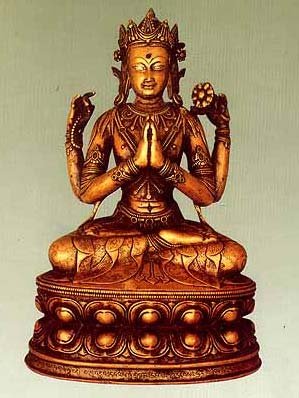
Mahayana (महायान, mahāyāna) is a major branch of Buddhism focusing on the path of a Bodhisattva (spiritual aspirants/ enlightened beings). Extant literature is vast and primarely composed in the Sanskrit language. There are many sūtras of which some of the earliest are the various Prajñāpāramitā sūtras.
In Jainism
General definition (in Jainism)
Anakṣara (अनक्षर) refers to “unexpressed sound” and represents one of the two types of bhāṣātmaka according to the 2nd-century Tattvārthasūtra 5.24.—What is unexpressed sound (anakṣara)? The sound created by living beings with two or more senses without alphabets /language to understand each other is called unexpressed sound.
How many types of unexpressed sound (anakṣara) are there? There are two types namely contrived (prāyogika) and natural (vaisrasika).

Jainism is an Indian religion of Dharma whose doctrine revolves around harmlessness (ahimsa) towards every living being. The two major branches (Digambara and Svetambara) of Jainism stimulate self-control (or, shramana, ‘self-reliance’) and spiritual development through a path of peace for the soul to progess to the ultimate goal.
Languages of India and abroad
Marathi-English dictionary
anakṣara (अनक्षर).—a (S) Unlettered, unlearned, boorish.
anakṣara (अनक्षर).—a Unlettered, unlearned, boorish.
Marathi is an Indo-European language having over 70 million native speakers people in (predominantly) Maharashtra India. Marathi, like many other Indo-Aryan languages, evolved from early forms of Prakrit, which itself is a subset of Sanskrit, one of the most ancient languages of the world.
Sanskrit dictionary
Anakṣara (अनक्षर).—a. [na. ba.]
1) Unable to speak, mute, dumb, unlettered; मुखमनक्षरं स्वाकृतेः (mukhamanakṣaraṃ svākṛteḥ) Bhartṛhari 2.56.
2) Unfit to be uttered.
-ram [apraśastānyakṣarāṇi yatra] Abusive language, foul or abusive words, censure. -adv. Without the use of words, not expressed by words, mutely, dumbly; °रं पप्रच्छ (raṃ papraccha) K.219,143; °व्यञ्जितदौर्हृदेन (vyañjitadaurhṛdena) R.14.26.
Anakṣara (अनक्षर).—n.
(-raṃ) 1. Blamable discourse, what is unfit to be uttered. 2. Abuse. E. an neg. and akṣara a letter.
Anakṣara (अनक्षर).—adj. one who utters what ought not to be said.
Anakṣara is a Sanskrit compound consisting of the terms an and akṣara (अक्षर).
1) Anakṣara (अनक्षर):—[=an-akṣara] mfn. unfit to be uttered
2) [v.s. ...] unable to articulate a syllable.
Anakṣara (अनक्षर):—[bahuvrihi compound] I. m. f. n.
(-raḥ-rā-ram) Containing, utter-ing &c. what is blamable or what aught not to be said. Ii. n.
(-ram) Blamable or improper speech. E. a deter. and akṣara.
Anakṣara (अनक्षर):—[ana+kṣara] (raṃ) 1. n. Blameable language or discourse.
Anakṣara (अनक्षर):—(3. a + akṣara) adj.
1) lautlos, stumm: mukham [Bhartṛhari 2, 46.] —
2) nicht geeignet ausgesprochen zu werden (Rede) [Amarakoṣa 1, 1, 5, 21.] [Hemacandra’s Abhidhānacintāmaṇi 266.]
Anakṣara (अनक्षर):—Adj. —
1) lautlos , stumm [Indische sprüche 6434.] m Adv. ohne Worte [Kād. (1872) 161.] —
2) *was nicht gesagt werden dürfte.
Anakṣara (अनक्षर) in the Sanskrit language is related to the Prakrit word: Aṇakkhara.
Sanskrit, also spelled संस्कृतम् (saṃskṛtam), is an ancient language of India commonly seen as the grandmother of the Indo-European language family (even English!). Closely allied with Prakrit and Pali, Sanskrit is more exhaustive in both grammar and terms and has the most extensive collection of literature in the world, greatly surpassing its sister-languages Greek and Latin.
Kannada-English dictionary
Anakṣara (ಅನಕ್ಷರ):—
1) [adjective] that ought not to be said; not fit to be pronounced.
2) [adjective] that cannot be identified as a letter in the alphabet (as in the sound of a thunder, roar).
3) [adjective] not knowing how to read or write; uneducated; illiterate.
--- OR ---
Anakṣara (ಅನಕ್ಷರ):—
1) [noun] = ಅನಕ್ಷರಸ್ಥ [anaksharastha]; 2) that which is ought not to be said or not fit to be pronounced.
2) [noun] that which cannot be identified as a letter in the alphabet (as in the sound of a thunder, roar) .
Kannada is a Dravidian language (as opposed to the Indo-European language family) mainly spoken in the southwestern region of India.
See also (Relevant definitions)
Partial matches (+0): Akshara, An.
Starts with (+0): Anaksharadhvani, Anaksharajathara, Anaksharalapa, Anaksharapatita, Anaksharastha, Anaksharate, Anaksharatva.
Full-text (+0): Anaksharapatita, Anakkhara, Jvalamalinika, Duti, Bhashatmaka, Nitya, Vo tu bao khiep kinh, Bu duo wen zi, Wu zi bao qie jing, Shabda, Prayogika, Vaisrasika, Da cheng li wen zi pu guang ming cang jing, Vidarbhita, Vidarbhana, Shoshana, Shosha, A.
Relevant text
Search found 18 books and stories containing Anakshara, An-akṣara, An-aksara, An-akshara, Anakṣara, Anaksara; (plurals include: Anaksharas, akṣaras, aksaras, aksharas, Anakṣaras, Anaksaras). You can also click to the full overview containing English textual excerpts. Below are direct links for the most relevant articles:
Kathasaritsagara [Sanskrit/English] (by C. H. Tawney)
Verse 7.6.22 < [Chapter 6]
A Descriptive Catalogue of the Sanskrit Manuscripts, Madras (by M. Seshagiri Sastri)
Page 105 < [Volume 29 (1942)]
Sahitya-kaumudi by Baladeva Vidyabhushana (by Gaurapada Dāsa)
Text 10.164 < [Chapter 10 - Ornaments of Meaning]
The Cult of Jagannatha (by K. C. Mishra)
Bhagavati-sutra (Viyaha-pannatti) (by K. C. Lalwani)
Part 3 - Types of knowledge < [Chapter 2]
Maha Prajnaparamita Sastra (by Gelongma Karma Migme Chödrön)
Act 1.2: The Buddha smiles a first time with his whole body < [Chapter XIV - Emission of rays]
Emptiness 12: Emptiness of essences (prakṛtiśūnyatā) < [Chapter XLVIII - The Eighteen Emptinesses]