Matara, Mātara, Mataṟā: 8 definitions
Introduction:
Matara means something in Buddhism, Pali, Hinduism, Sanskrit, the history of ancient India, Hindi, Tamil. If you want to know the exact meaning, history, etymology or English translation of this term then check out the descriptions on this page. Add your comment or reference to a book if you want to contribute to this summary article.
Images (photo gallery)

In Hinduism
Purana and Itihasa (epic history)
Mātara (मातर).—Mother Goddesses present in Varuṇa's sacrifice; nine in number; Lakṣmī, Sarasvatī, Gaurī, Caṇḍikā, Tripurāmbikā, Bhairavā, Kālī, Mahāśāstri; use of liquor in the worship of the deities;1 consorts of;2 Mātras: also kīrti (fame), lakṣmī (riches), dhṛtī (courage), medhā (wisdom), puṣṭi (strength), śraddha (faith), kriyā (action), mati (Knowledge), buddhi (intelligence), lajjā (modesty), vapu (body), śānti (peace), tuṣṭi (contentment) and kānti (beauty) invoked in Gṛahabali.3 A list of mātaras created by Rudra to vanquish the Andhaka Asuras; the mother-goddess felt hungry and thirsty and asked Śiva for food; the pangs of hunger were so keen that they ate of the worldly beings; Śiva then thought of Nṛsimha and praised Him; he created a number of mother-goddesses to overpower them; then all of them were blessed to be divine beings and help people to tide over difficulties when they would remember and pray to them; seven mothers.4
- 1) Brahmāṇḍa-purāṇa III. 1. 28; IV. 7. 72; 14. 6; 20. 46; 44. 111-12.
- 2) Ib. II. 25. 69.
- 3) Matsya-purāṇa 93. 53.
- 4) Ib. 179. 9-32, 41-89.

The Purana (पुराण, purāṇas) refers to Sanskrit literature preserving ancient India’s vast cultural history, including historical legends, religious ceremonies, various arts and sciences. The eighteen mahapuranas total over 400,000 shlokas (metrical couplets) and date to at least several centuries BCE.
In Buddhism
Tibetan Buddhism (Vajrayana or tantric Buddhism)
Mātara (मातर) (the “deity of invoking and dispatching”) is known in Tibetan as ma mo rbod gtong; and refers to one of the Eight Central Heruka deities of the Nyingma Mahāyoga scriptural tradition.—The details of these deities are found in the treasure collection discovered by Nyangrel Nyima Özer entitled the “Assembly of the Sugatas of the Eight Proclamations” (bka' brgyad bde gshegs 'dus pa; Buddhist Digital Resource Center: W22247).
Mātara (मातर) refers to a cycle of teachings (associated with Dhanasaṃskṛta); and represent one of the “Eight Transmitted Precepts” [bka-brgyad] who are each represented by the “Eight Awareness-holders”.—These Eight Awareness-holders bestowed Tantras upon Nyangrel Nyima Özer—an important Nyingma tertön (a revealer of terma treasure texts in Tibetan Buddhism).—Mātara is known in Tibetan as ma mo rbod gtong.
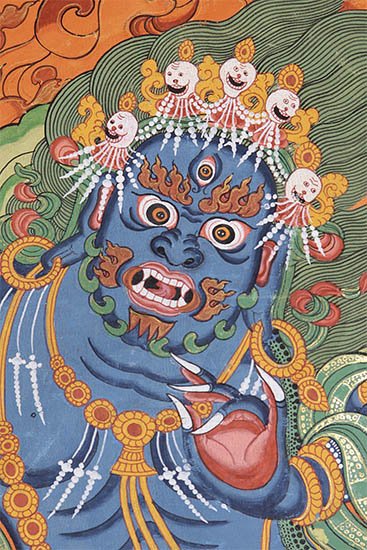
Tibetan Buddhism includes schools such as Nyingma, Kadampa, Kagyu and Gelug. Their primary canon of literature is divided in two broad categories: The Kangyur, which consists of Buddha’s words, and the Tengyur, which includes commentaries from various sources. Esotericism and tantra techniques (vajrayāna) are collected indepently.
India history and geography
Mātara (मातर) is the name of a village mentioned as lying on the western boundary of Ki-icchitā, according to the “Prince of wales museum plates of Mummuṇirāja”. Accordingly, “... the village Ki-icchitā comprised in the viṣaya of Mandaraja, together with all hamlets and together with orchards, areca-nut trees and minerals, and with examption from taxes,—the boundaries of which are as follows: On the east, the boundary of (the village) Pāṇīvāḍa of the Śrīnera hill ; on the north, the boundary of the village Nīmbā; on the west, the boundary of the village Mātara; on the south, the boundary of the Sāmbina river”.
These copper plates (mentioing Mātara) were handed over to the Curator (Archaeological Section, Prince of Wales Museum, Bombay) by one Hasan Razak. Its object is to record the grant, by Mammuṇirāja, of the village Ki-icchitā (Mandaraja-viṣaya) to twelve Brāhmaṇas residing in the agrahāra of Brahmapurī. The grant was made on the occasion of a lunar eclipse which occurred on the fifteenth tithi of the bright fortnight of Bhādrapada in the Śaka year 971, the cyclic year being Virodhin.

The history of India traces the identification of countries, villages, towns and other regions of India, as well as mythology, zoology, royal dynasties, rulers, tribes, local festivities and traditions and regional languages. Ancient India enjoyed religious freedom and encourages the path of Dharma, a concept common to Buddhism, Hinduism, and Jainism.
Languages of India and abroad
Hindi dictionary
Maṭara (मटर) [Also spelled matar]:—(nf) pea.
...
Kannada-English dictionary
Mātara (ಮಾತರ):—[noun] a woman as related to her children; a mother.
Kannada is a Dravidian language (as opposed to the Indo-European language family) mainly spoken in the southwestern region of India.
Tamil dictionary
Mataṟā (மதறா) noun < Urdu mazrā. Hamlet. See மஜரா. [majara.] (C. G.)
Tamil is an ancient language of India from the Dravidian family spoken by roughly 250 million people mainly in southern India and Sri Lanka.
Nepali dictionary
Maṭara (मटर):—n. 1. Bot. common pea; pea; 2. motor (vehicle);
Nepali is the primary language of the Nepalese people counting almost 20 million native speakers. The country of Nepal is situated in the Himalaya mountain range to the north of India.
See also (Relevant definitions)
Starts with (+0): Mataragashta, Matarah, Mataraja, Matarakan, Mataral, Mataralaki, Mataram, Mataran, Matarani, Matarapanni, Matarapannicceti, Matarapitarau, Matarapitri, Matarappanni, Mathara.
Full-text (+79): Mathara, Matarapitarau, Matarapitri, Agnimathara, Matar, Madarakantha, Matarah, Madararajya, Matharavana, Mamo Botong, Madhara, Madaras-nelli, Matri, Matrigana, Mataram, Madari, Patniy, Matthara, Yantragola, Matay.
Relevant text
Search found 139 books and stories containing Matara, Madara, Madhara, Mātara, Maṭara, Mataṟā, Mathara, Matharaa; (plurals include: Mataras, Madaras, Madharas, Mātaras, Maṭaras, Mataṟās, Matharas, Matharaas). You can also click to the full overview containing English textual excerpts. Below are direct links for the most relevant articles:
Inscriptions of Orissa (Rajaguru) (by Shri Satyanarayana Rajguru)
Historical note: Chronology of Early Kalinga Dynasties < [Section 1 - South-Orissa—The Matharas and the Sri Rama-Kasyapas]
Appendix 1 - Chronological table of the Matharas of Kalinga < [Section 1 - South-Orissa—The Matharas and the Sri Rama-Kasyapas]
Part 5 - Andhavaram Plates of Anantasakti < [Section 1 - South-Orissa—The Matharas and the Sri Rama-Kasyapas]
Shiva Purana [sanskrit/english]
Chandogya Upanishad (Madhva commentary) (by Srisa Chandra Vasu)
Sidelights on History and Culture Of Orissa (by Manmath Nath Das)
Chapter 3.2 - The history of Kalinga < [Part 1 - Land, People and History]
Chapter 30 - Rise and growth of Vaishnavism in Orissa < [Part 2 - Religious Developments]
Chapter 8 - Ancient and Medieval Empires and Kingdoms < [Part 1 - Land, People and History]
Dhammapada (Illustrated) (by Ven. Weagoda Sarada Maha Thero)
Verse 294-295 - The Story of Venerable Bhaddiya < [Chapter 21 - Pakiṇṇaka Vagga (Miscellaneous)]
Stupas in Orissa (Study) (by Meenakshi Chauley)
During Kharavela’s Reign < [Chapter 2]
From the Middle of the fourth Century < [Chapter 2]