Vasikara, Vāsikāra, Vashikara: 6 definitions
Introduction:
Vasikara means something in Hinduism, Sanskrit, the history of ancient India. If you want to know the exact meaning, history, etymology or English translation of this term then check out the descriptions on this page. Add your comment or reference to a book if you want to contribute to this summary article.
In Hinduism
Shaiva philosophy
Vaśīkāra (वशीकार) refers to the “subjection (of souls) to the control (of Śiva)”, according to Bhaṭṭa Rāmakaṇṭha’s 10th-century Tattvatrayanirṇayavivṛti—a commentary on the 7th-century Tattvatrayanirṇaya by Sadyojyoti which discusses philosophical aspects of Śiva including the theories of Puruṣas (souls), Māyā (primal matter) and Mala (the innate impurity afflicting souls).—Accordingly, [verses 7-9] “These [souls] are therefore powerless (anīśa), [in other words] nescient [and] inactive, [being] without any revelation of their powers. And they [i.e., souls] are not able by themselves each to make their own [innately unlimited] abilities devoid of impurity [and thus] all-encompassing. Because of their being blocked by impurity, accordingly they are subject to the uncreated control of Śiva: therefore they belong to the Lord [as creatures] requiring to be blocked, to be bound, to be purified and to be awakened”.—[commentary]: “Just as their impotence and so forth, being caused by impurity, are beginningless, in just the same way their subjection to the control (vaśīkāra) of Śiva, [in other words] their state of being governed, is beginningless. And because of this same fact of being conjoined with impurity they are the Lord’s to be blocked by [His power known as] Vāmā, through her presiding over impurity, and [further] bound by the bonds that derive from primal matter, and purified by initiation, and awakened by knowledge and the others”
Shaiva philosophy is a spritiual tradition within Hinduism that includes theories such as the relationship between the Atman (individual soul) and Siva, the nature of liberation (moksha), and the concepts of maya (illusion) and shakti (divine energy). Saiva philosophy teaches that union with Shiva can be achieved through knowledge, devotion, and spiritual practice. It encompasses major branches like Shaiva Siddhanta and Kashmir Shaivism.
India history and geography
Vāsikāra is the name of a person from Śrīpurī, the house of which was exempted from tax, according to the “Cintra stone inscription of Aparāditya I”.
These stone inscriptions (mentioning Vāsikāra) were in the vicinity of the Jogeśvarī Cave to the north of Bombay in the Sālsette island. It is dated on the twelfth tithi of the bright fortnight of Caitra in the Śaka year 1059, the cyclic year being Piṅgala.
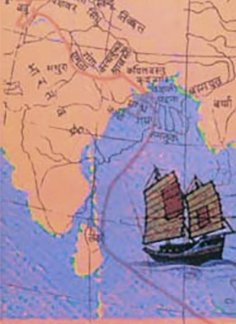
The history of India traces the identification of countries, villages, towns and other regions of India, as well as mythology, zoology, royal dynasties, rulers, tribes, local festivities and traditions and regional languages. Ancient India enjoyed religious freedom and encourages the path of Dharma, a concept common to Buddhism, Hinduism, and Jainism.
Languages of India and abroad
Sanskrit dictionary
Vaśīkāra (वशीकार).—[masculine] vaśīkṛti & vaśīkriyā [feminine] the same.
1) Vaśīkara (वशीकर):—[=vaśī-kara] [from vaśī > vaś] mfn. bringing into subjection, subjugating, (ifc.) making any one subject to one’s will, [Mahābhārata; Pañcarātra]
2) Vaśīkāra (वशीकार):—[=vaśī-kāra] [from vaśī > vaś] m. idem, [Yoga-sūtra; Kathāsaritsāgara etc.]
Vaśīkara (वशीकर):—adj. in die Gewalt bekommend, bezwingend, sich unterthan machend [Mahābhārata 13, 1195.] jagattraya [PAÑCAR. 3, 15, 35.]
--- OR ---
Vaśīkāra (वशीकार):—m. dass. [Yogasūtra 1, 15. 40.] [Kathāsaritsāgara 12, 134.] [SARVADARŚANAS. 169, 4.] nṛpa [ŚUK. ed. Bomb. S. 24.]
Sanskrit, also spelled संस्कृतम् (saṃskṛtam), is an ancient language of India commonly seen as the grandmother of the Indo-European language family (even English!). Closely allied with Prakrit and Pali, Sanskrit is more exhaustive in both grammar and terms and has the most extensive collection of literature in the world, greatly surpassing its sister-languages Greek and Latin.
Kannada-English dictionary
Vaśīkāra (ವಶೀಕಾರ):—[noun] = ವಶೀಕರಣ [vashikarana].
Kannada is a Dravidian language (as opposed to the Indo-European language family) mainly spoken in the southwestern region of India.
See also (Relevant definitions)
Partial matches (+0): Vasi, Vaci, Kara.
Starts with (+0): Vacikaracakti, Vacikaram, Vacikaramaruntu, Vacikaran, Vacikaranam, Vacikaranittirai, Vashikarana, Vashikaranadividhi, Vashikaranartha, Vashikaranastotra, Vashikaranatantra, Vashikaranaushadha, Vashikaranavarahimantra, Vashikarani, Vashikaraprakarana, Vashikaravarahi, Vasikaranamanta, Vasikaranapanaka, Vasikaranapanakasamutthitaroga.
Full-text (+0): Vashikaraprakarana, Vashikaravarahi, Vacikaracakti, Vacikaram, Svamivashikarastotra, Vacikaran, Vacikaranittirai, Vacikaramaruntu, Samvadana, Samjna.
Relevant text
Search found 11 books and stories containing Vasikara, Vāsikāra, Vashikara, Vaśīkāra, Vaśīkara, Vashi-kara, Vaśī-kara, Vasi-kara, Vaśī-kāra, Vaśikara; (plurals include: Vasikaras, Vāsikāras, Vashikaras, Vaśīkāras, Vaśīkaras, karas, kāras, Vaśikaras). You can also click to the full overview containing English textual excerpts. Below are direct links for the most relevant articles:
Yoga-sutras (with Bhoja’s Rajamartanda) (by Rajendralala Mitra)
Sūtra 1.40 < [First Chapter (Samadhi Pada)]
Sūtra 3.49 < [Third Chapter (Vibhuti Pada)]
Sūtra 1.15 < [First Chapter (Samadhi Pada)]
Yoga-sutras (with Vyasa and Vachaspati Mishra) (by Rama Prasada)
Jainism and Patanjali Yoga (Comparative Study) (by Deepak bagadia)
Part 4.4 - Yogic techniques for control of Vrttis (3): Abhyasa and Vairagya < [Chapter 2 - Yoga philosophy and practices]
Part 4.8 - Doctrine of karma < [Chapter 2 - Yoga philosophy and practices]
Notices of Sanskrit Manuscripts (by Rajendralala Mitra)
Page 201 < [Volume 9 (1888)]
Yoga-sutras (Vedanta Commentaries)
Jivanandana of Anandaraya Makhin (Study) (by G. D. Jayalakshmi)
Āyurvedic aspects of Act I < [Chapter 4 - Āyurvedic principles in Jīvanandana Nāṭaka]