Shravakasamgha, Śrāvakasaṃgha, Shravaka-samgha: 2 definitions
Introduction:
Shravakasamgha means something in Buddhism, Pali, Hinduism, Sanskrit. If you want to know the exact meaning, history, etymology or English translation of this term then check out the descriptions on this page. Add your comment or reference to a book if you want to contribute to this summary article.
The Sanskrit term Śrāvakasaṃgha can be transliterated into English as Sravakasamgha or Shravakasamgha, using the IAST transliteration scheme (?).
In Buddhism
Mahayana (major branch of Buddhism)
Śrāvakasaṃgha (श्रावकसंघ) refers to the “community of disciples of the Buddha” and represents one of the Anusmṛti (eight recollections), according to the 2nd century Mahāprajñāpāramitāśāstra chapter 36.—Accordingly, “the community of disciples of the Buddha (śrāvakasaṃgha) is completely endowed with the discipline element, is completely endowed with the concentration element (samādhi-skandha), the wisdom element (prajñā-skandha), the deliverance element (vimukti-skandha), and the ‘knowledge and vision of deliverance’ element (vimuktijñānadarśana-skandha). It includes the four pairs of individuals or the eight individuals. It is worthy of alms (dakṣīṇīya), worthy of homage (pūjanīya), worthy of veneration (arcinīya). It is the supreme field of merit for the world”.
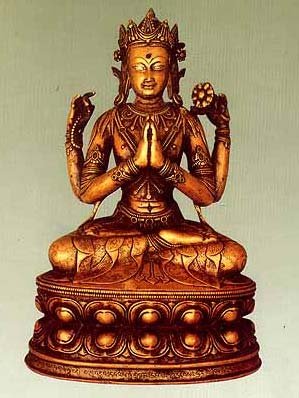
Mahayana (महायान, mahāyāna) is a major branch of Buddhism focusing on the path of a Bodhisattva (spiritual aspirants/ enlightened beings). Extant literature is vast and primarely composed in the Sanskrit language. There are many sūtras of which some of the earliest are the various Prajñāpāramitā sūtras.
Languages of India and abroad
Sanskrit dictionary
Śrāvakasaṃgha (in Sanskrit) can be associated with the following Chinese terms:
1) 僧 [sēng]: “community of monks and nuns”.
2) 弟子衆 [dì zi zhòng]: “group of disciples”.
3) 聖弟子衆 [shèng dì zi zhòng]: “group of disciples of the sage”.
4) 聲聞之衆 [shēng wén zhī zhòng]: “community of śrāvakas”.
5) 聲聞僧 [shēng wén sēng]: “direct disciple monk”.
6) 聲聞弟子 [shēng wén dì zi]: “śrāvaka-disciples”..
7) 聲聞衆 [shēng wén zhòng]: “group of direct disciples”.
Note: śrāvakasaṃgha can be alternatively written as: śrāvaka-saṃgha.
Sanskrit, also spelled संस्कृतम् (saṃskṛtam), is an ancient language of India commonly seen as the grandmother of the Indo-European language family (even English!). Closely allied with Prakrit and Pali, Sanskrit is more exhaustive in both grammar and terms and has the most extensive collection of literature in the world, greatly surpassing its sister-languages Greek and Latin.
See also (Relevant definitions)
Partial matches (+0): Shravaka, Samgha.
Full-text (+0): Seng, Samganusmriti, Sheng wen seng, Sheng wen zhong, Sheng wen di zi, Sheng wen zhi zhong, Di zi zhong, Sheng di zi zhong.
Relevant text
Search found 6 books and stories containing Shravakasamgha, Shravaka-samgha, Śrāvaka-saṃgha, Sravaka-samgha, Śrāvakasaṃgha, Sravakasamgha; (plurals include: Shravakasamghas, samghas, saṃghas, Śrāvakasaṃghas, Sravakasamghas). You can also click to the full overview containing English textual excerpts. Below are direct links for the most relevant articles:
Majjhima Nikaya (Middle Discourses)
Discourse 89: Shrines to the Teaching < [Rāja-vagga: The Chapter on Kings]
Discourse 7: The Simile of the Cloth < [Mūlapariyāya-vagga: The Chapter on the Root of All Things]
Anguttara Nikaya (Numbered Discourses)
Discourse 4.34: Aggappasāda-sutta < [Cakka-vagga: Situations]
Discourse 9.27: Paṭhamavera-sutta < [Sattāvāsa-vagga: Abodes of Sentient Beings]
Discourse 5.32: Cundī-sutta < [Sumana-vagga: The Chapter with Sumanā]
Digha Nikaya (Long Discourses)
1. Examination < [Discourse 8: The Longer Discourse on the Lion’s Roar]
1. Sāriputta’s Lion’s Roar < [Discourse 28: Inspiring Confidence]
10. The Mirror of the Teaching < [Discourse 16: The Great Discourse on the Buddha’s Extinguishment]
Samyuta Nikaya (Linked Discourses)
Discourse 41.10: Gilānadassana-sutta < [41.1. Citta-vagga: The Chapter with Citta]
Discourse 55.1: Cakkavattirāja-sutta < [55.1. Veḷudvāra-vagga: The Chapter at Bamboo Gate]
Discourse 55.13: Ānandatthera-sutta < [55.2. Rājakārāma-vagga: the Royal Monastery]
Maha Prajnaparamita Sastra (by Gelongma Karma Migme Chödrön)
Part 15 - Leading innumerable Bodhisattvas to the state of avaivartika < [Chapter LI - Seeing all the Buddha Fields]
Part 14 - Bringing innumerable beings to Arhathood by a single sermon < [Chapter LI - Seeing all the Buddha Fields]
III. Recollection of the community (saṃgānusmṛti) < [Part 2 - The Eight Recollections according to the Abhidharma]
Notices of Sanskrit Manuscripts (by Rajendralala Mitra)
Page 202 < [Volume 9 (1888)]