Pramoha, Pramohā: 11 definitions
Introduction:
Pramoha means something in Buddhism, Pali, Hinduism, Sanskrit. If you want to know the exact meaning, history, etymology or English translation of this term then check out the descriptions on this page. Add your comment or reference to a book if you want to contribute to this summary article.
In Hinduism
Ayurveda (science of life)
Pramoha (प्रमोह):—Impairement of orientation

Āyurveda (आयुर्वेद, ayurveda) is a branch of Indian science dealing with medicine, herbalism, taxology, anatomy, surgery, alchemy and related topics. Traditional practice of Āyurveda in ancient India dates back to at least the first millenium BC. Literature is commonly written in Sanskrit using various poetic metres.
In Buddhism
Tibetan Buddhism (Vajrayana or tantric Buddhism)
Pramohā (प्रमोहा) refers to one of the “Fifty-eight Wrathful Deities” (Tibetan: khro bo lha nga brgyad) according to various sources such as the Guhyagarbha Tantra and the Tibetan Book of the Dead.—They feature in Tantric teachings and practices which focus on purifying elements of the body and mind. These deities [e.g., Pramohā] form part part of the the Hundred Peaceful and Wrathful Deities who manifest to a deceased person following the dissolution of the body and consciousness whilst they are in the intermediate state (bardo) between death and rebirth. Pramohā is part of the “eight wrathful females” and is also known in Tibetan as (1) pra mo (2) rab tu rmongs ma.
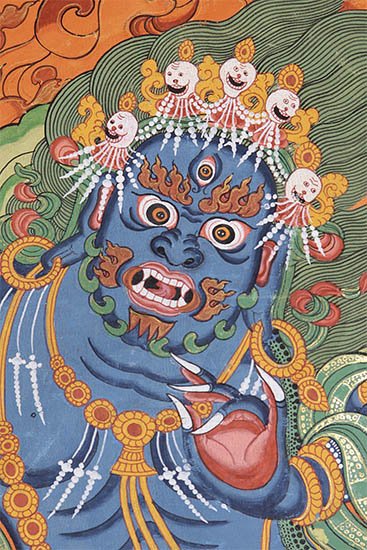
Tibetan Buddhism includes schools such as Nyingma, Kadampa, Kagyu and Gelug. Their primary canon of literature is divided in two broad categories: The Kangyur, which consists of Buddha’s words, and the Tengyur, which includes commentaries from various sources. Esotericism and tantra techniques (vajrayāna) are collected indepently.
Languages of India and abroad
Sanskrit dictionary
Pramoha (प्रमोह).—
1) Stupefaction, insensibility, stupor; तिरयति करणानां ग्राहकत्वं प्रमोहः (tirayati karaṇānāṃ grāhakatvaṃ pramohaḥ) Mālatīmādhava (Bombay) 1.41.
2) Infatuation, bewilderment.
Derivable forms: pramohaḥ (प्रमोहः).
Pramoha (प्रमोह).—m.
(-haḥ) 1. Fascination. 2. Fainting, insensibility. E. pra before, muh to be bewildered, ghaj aff.
Pramoha (प्रमोह).—i. e. pra-muh + a, m. 1. Fascination. 2. Fainting, insensibility, [Uttara Rāmacarita, 2. ed. Calc., 1862.] 23, 6. 3. Confusion, [Draupadīpramātha] 6, 20 (-citta, adj. bewildered in mind).
Pramoha (प्रमोह).—[masculine] bewilderment, perplexity.
1) Pramoha (प्रमोह):—[=pra-moha] [from pra-muh] a m. bewilderment, infatuation, [Mahābhārata; Suśruta; Uttararāma-carita]
2) [v.s. ...] insensibility, fainting, [Horace H. Wilson]
3) [=pra-moha] b etc. See pra-√muh.
Pramoha (प्रमोह):—[pra-moha] (haḥ) 1. m. Fascination; fainting, insensibility.
Pramoha (प्रमोह):—(von muh mit pra) m. Geistesverwirrung [Mahābhārata 1, 585. 6, 3145. 10, 668. 13, 1012] [?(= 14, 1086). 2254. Suśruta 1, 94, 14. 20. 2, 412, 17.] cittā [Mahābhārata 3, 15685.]
--- OR ---
Pramoha (प्रमोह):—[UTTARARĀMAC. 17, 3 (23, 6).]
Pramoha (प्रमोह):—m. Geistesverwirrung.
Sanskrit, also spelled संस्कृतम् (saṃskṛtam), is an ancient language of India commonly seen as the grandmother of the Indo-European language family (even English!). Closely allied with Prakrit and Pali, Sanskrit is more exhaustive in both grammar and terms and has the most extensive collection of literature in the world, greatly surpassing its sister-languages Greek and Latin.
Nepali dictionary
Pramoha (प्रमोह):—n. 1. stupefaction; insensibility; 2. ignorance; stupidity;
Nepali is the primary language of the Nepalese people counting almost 20 million native speakers. The country of Nepal is situated in the Himalaya mountain range to the north of India.
See also (Relevant definitions)
Partial matches (+0): Pra, Moha.
Starts with (+0): Pramohacitta, Pramohaka, Pramohan, Pramohana, Pramohayitva.
Full-text (+0): Pramohacitta, Sampramoha, Vipramoha, Smritipramoha, Pramohin, Pramoh, Fifty-eight wrathful deities, Vipramohita, Pamoha, Pra mo, Rab tu rmongs ma, Vishuddhaheruka, Krodhishvari, gau ri ma brgyad, Muh.
Relevant text
Search found 12 books and stories containing Pramoha, Pramohā, Pra-moha, Pra-mohā; (plurals include: Pramohas, Pramohās, mohas, mohās). You can also click to the full overview containing English textual excerpts. Below are direct links for the most relevant articles:
International Ayurvedic Medical Journal
Concept of hridroga and its manegement in ayurveda – a review article < [2023, Issue 02, February]
Hridroga – an outlook through samanya lakshana < [2021, Issue 9, September]
A review on tamaka shwasa and it’s ayurvedic management < [2022, Issue 11 November]
Journal of Ayurveda and Integrated Medical Sciences
Critical review on Hrudaya (Heart) and Hrudroga (Cardiovascular disorders)... < [Vol. 7 No. 5 (2022)]
Pharmaceutical preparation, standardization and comparative study of Tinduka... < [Vol. 9 No. 1 (2024)]
A clinical study to evaluate the efficacy of Tekaraja Churna in the... < [Vol. 7 No. 9 (2022)]
Ayurvedic concept of hridroga its present relevance < [Volume 12 (issue 3-4), Jan-Jun 1993]
A critical study of the concept of iaschaemic heart disease in ayurveda < [Volume 13 (issue 1-2), Jul-Dec 1993]
Clinical Study on Pippalyadi Kshara Gutika in Thamak Shwasa < [Volume 9, Issue 2: March-April 2022]
"Study of Vataja Hridroga and Its Correlation with ECG Changes" < [Volume 9, Issue 6: November-December 2022]
Ayurvedic review on hridroga and management of heart disease. < [Volume 7, Issue 3: May - June 2020]
Guhyagarbha Tantra (with Commentary) (by Gyurme Dorje)
Text 15.25 (Commentary) < [Chapter 15 (Text and Commentary)]
Text 16.3 (Commentary) < [Chapter 16 (Text and Commentary)]
Chapter 16 - Emanation of the Maṇḍala of Buddha-speech < [Chapter 16 (Text and Commentary)]
Sanskrit dramas by Kerala authors (Study) (by S. Subramania Iyer)
4. The sentiment (rasa) of the Kamalinikalahamsa < [Chapter 12: Kamalinikalahamsa (Kamalini-Kalahamsa)]