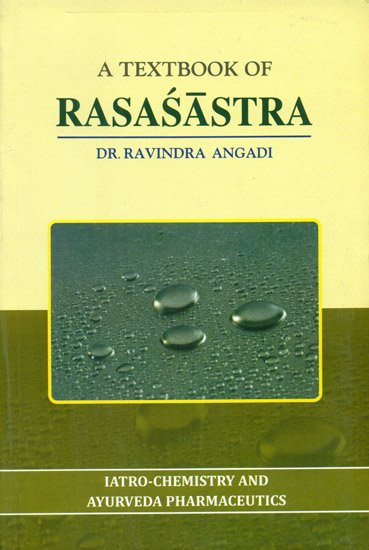
A Textbook of Rasasastra
author: Ravindra Angadi
edition: 2014, Chaukhamba Surbharati Prakashan
pages: 724
ISBN-13: 9789383712184
Topic: Rasashastra
Chapter 11 - Parada Gati and Bandha
This page describes Parada Gati and Bandha which is the eleventh chapter located on pages 116-127 in A Textbook of Rasasastra (Iatro-Chemistry and Ayurveda Pharmaceutics) composed by Ravindra Angadi. This book details the origins and history of Rasashastra (medicinal alchemy) as well as the medicinal applications of metals, minerals and previous stones. This page contains an online preview of the full text and summarizes technical terms, as well as information if you want to buy this book.
Full contents not available online!
To read the full text of A Textbook of Rasasastra, you can buy Ravindra Angadi’s book from Exotic India
You can look up the meaning of the phrase “Parada Gati and Bandha” according to 406 books dealing with Hinduism. The following list shows a short preview of potential definitions.
Elephantology and its Ancient Sanskrit Sources [by Geetha N.]
This training makes them capable of with standing hunger and thirst enduring strain and carrying great burdens. They also discard their natural laziness and timidity and are trained to walking-calls like vega-gati or drutagati, calana-gati, dhavanagati, or vahana-gati. They are also taught to run in circle and also in serpentine. They are called mandala rekha caturashrareksha and trikonarekha....
Read full contents: Chapter 6 - Capturing of Elephants
Gati in Theory and Practice [by Dr. Sujatha Mohan]
Many works on dance has elaborated on angika abhinaya and works on drama have elaborated on the origin, theory and practice of drama. Other than these commentaries on the dramas of Bhasa and Kalidasa has also been taken for explaining the concept of gati in dramas. Previous works and researchers in topics related to Natya Some of the previous works and researches done in the field of theatre has been taken for references. The technical details connected with natya, gati, karana, etc....
Read full contents: Secondary sources on Natya
Ganita-sara-sangraha by Mahavira-Acharya [by M. Rangacharya]
Vispu tirthaka dantin durita dagi dika AND The Jainas recognize seven such principles, viz. , jiva, ajiva, asava, bandha, samvara, nirjara, moksa . Siva is considered to have his body made mp of eight things, viz. prthivi, adhu, tejas, vayu, akasa, surya, candra, yajamana, The six kinds of evidence are pratyaksa, anumana, upamana, sabda, arthapatti, and anupalabdhi . Vide upendra . 9 000 Tirthankara or 24 Vide jina . Jina. An elephant Worldly action 8 Vide ibha ....
Read full contents: Appendix 1 - Sanskrit words denoting numbers
Total 406 books found: See all results here.
Summary:
You can return to the book Index to buy or shop for other books, or you can read the available online pages below:
[A Textbook of Rasasastra: index]
[About the Author (Ravindra Angadi)]
[Preface]