Essay name: Indian influences in the Philippines
Author:
Juan R. Francisco
Affiliation: University of Madras / Department of Sanskrit
This essay explores Indian cultural influences on the Philippines, focusing on language and literature. It aims to fill a largely unexplored gap in this area, addressing the misinterpretations from previous studies that lacked tangible evidence.
Chapter 4 - Indian Literature in the Philippines
33 (of 55)
External source: Shodhganga (Repository of Indian theses)
Download the PDF file of the original publication
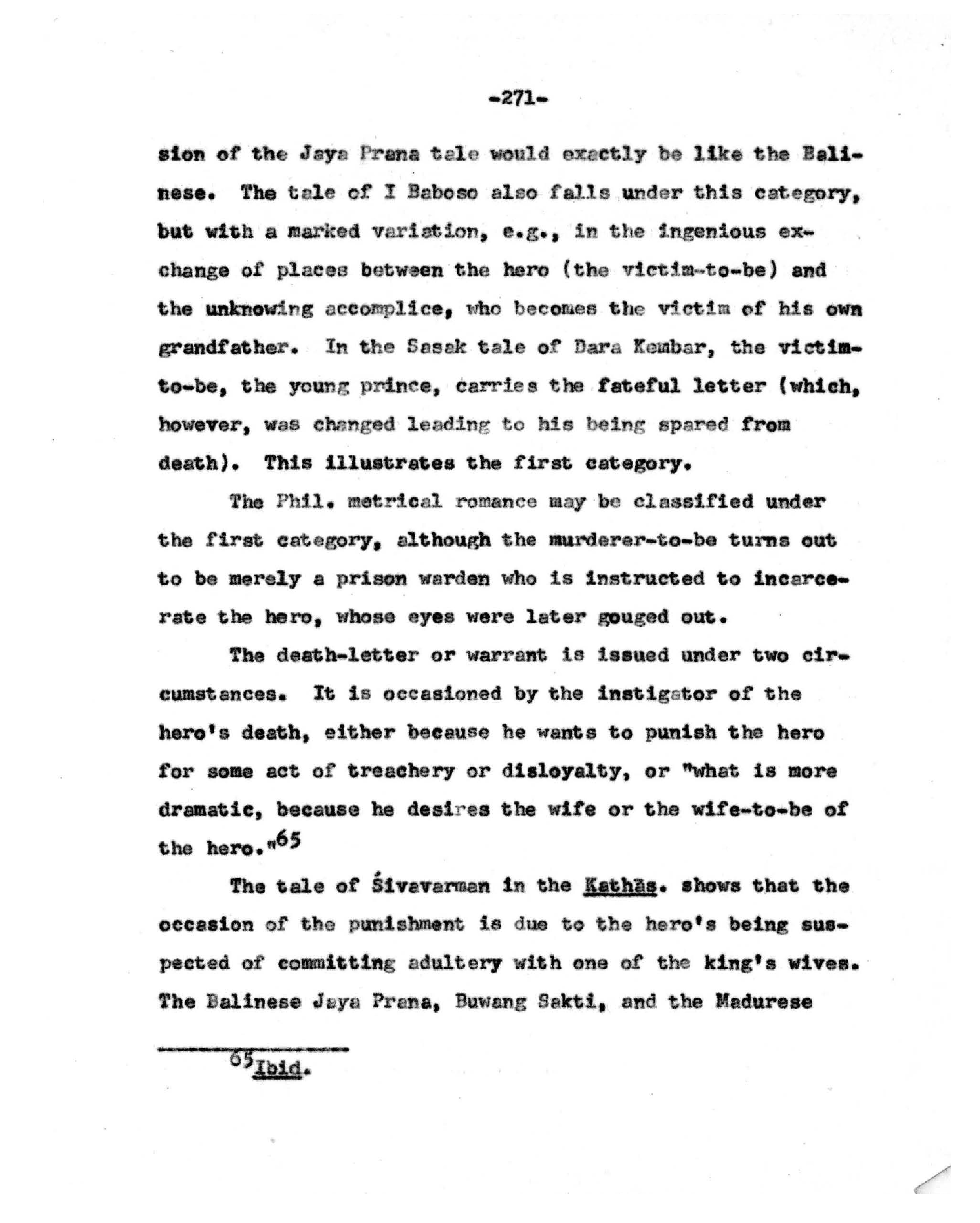
-271-
sion of the Jaya Prana tale would exactly be like the Bali-
nese. The tale of I Baboso also falls under this category,
but with a marked variation, e.g., in the ingenious ex-
change of places between the hero (the victim-to-be) and
the unknowing accomplice, who becomes the victim of his own
grandfather. In the Sasak tale of Dara Kembar, the victim-
to-be, the young prince, carries the fateful letter (which,
however, was changed leading to his being spared from
death). This illustrates the first category.
The Phil. metrical romance may be classified under
the first category, although the murderer-to-be turns out
to be merely a prison warden who is instructed to incarce-
rate the hero, whose eyes were later gouged out.
The death-letter or warrant is issued under two cir-
cumstances. It is occasioned by the instigator of the
hero's death, either because he wants to punish the hero
for some act of treachery or disloyalty, or "what is more
dramatic, because he desires the wife or the wife-to-be of
the hero. 165
The tale of Sivavarman in the Kathās. shows that the
occasion of the punishment is due to the hero's being sus-
pected of committing adultery with one of the king's wives.
The Balinese Jaya Prana, Buwang Sakti, and the Madurese
65Ibid.