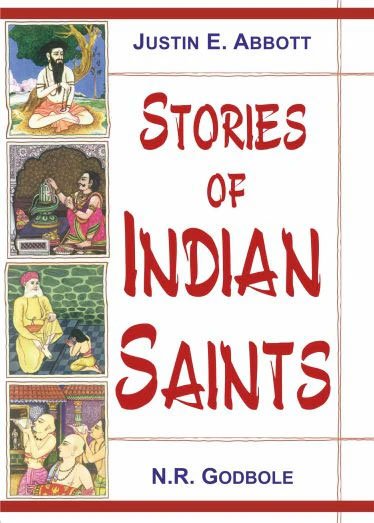
Bhaktavijaya: Stories of Indian Saints
by Justin E. Abbott | 1933 | 306,590 words
This is the English translation of Bhaktavijaya which is a Marathi poem written by Mahipati in 40,000 lines. The text documents the legends of Indian saints from various backgrounds and extensively covers figures like Ekanath, Tukaram, and Ramadasa, highlighting their contributions to scholarship, philosophy, poetry, and social reform. The Bhaktavi...
12.5: Nama and Dnyandev at Nagnath
73. After visiting Rameshwar both returned from there. The God-loving bhaktas, Nama and Dnyandev, finally arrived at Nagnath [Naganatha].
74. The fourteenth of the dark half of the moon in the month of Magh [Magha] (February) is the special night for the festival in honour of Shiva. On such an occasion Nama and Dnyandev arrived at that place.
75. Just as on the first day of the bright half of the moon in the month of Chaitra (April) the cycle of sixty years comes to one’s home; or as when on the second day of the bright half of the moon in the month of Magh, Dharmarao (god of death) comes to His home;
76. or as when on the third day of the bright half of the moon in the month of Vaishakh [Vaishakha] one’s host of ancestors come as one’s guests; or as when the elephantfaced god (Ganesh) arrives on the fourth day known as Ganesh Chaturthi;
77. or as on the fifth day of the bright half of the moon in the month of Shravan [Shravana] (August) the great serpent comes to one’s home; ot as when the Husband of Mhalasa (Khandoba) is to be met in the month of Margashirsh (December);
78. or as when on the seventh of the bright half of Magh (February) the sun comes as a guest; or as when the king of the Yadavas (Krishna) comes at the time of Janmashtami (or Gokul Ashtami) to occupy His cradle;
79. or as when the son of Kausalya (Ram) on Ramnavami day (the ninth of the month of Chaitra or April) suddenly arrives playing; or as when on the tenth of Vijaya (the month of Ashvin or October) the Mother of the world (Parvati) comes hastening home;
80. or as when on the eleventh of Ashadh (July) one sees the image of Shri Vitthal [Vitthala] as seen by the God-loving bhaktas, who look upon Him with great pleasure and feel a joy which their hearts cannot contain;
81. or as when on the twelfth day of the bright half of the moon in the month of Kartik (November) Shri Krishna comes to Vrindavan; or as when on the thirteenth of the month in the evening, the Husband of Mridani (Shiva) returns at the time of the evening worship;
82. or as when on the new moon day of the month of Shravan [Shravana] (August) Nandi-keshwar comes back to the cows’ stable; just so, Nama and Dnyandev arrived on Shivaratri (Shiva’s festival).
83. The bhaktas speak of the holy city Avandha-nagnath [Avandha-naganatha] as a second Kailas (heaven). At this place and at this time of the festival both arrived with joy of love.
84. After bathing in the sacred waters and performing their usual rites of worship, they prostrated themselves before the great door of the temple with feelings of love.
85. Then in their affection they entered into the inner shrine in order to see and worship God. Here again they prostrated themselves before Nagnath [Naganatha].
86. They said to the god, ‘0 Helper of the helpless, Husband of Parvati, Dweller in the cemeteries. Holder of the khatvang [khatvanga] (sword), Lord of Kailas [Kailasa], Digambar [Digambara], Lord of the earth, King of the universe.’
87. Having thus spoken they touched the god’s head with the palm of their hands, and knowing their love, Shiva was much pleased in His mind. nama’s kirtan before nagnath [naganatha]
88. Namdev [Namadeva] then stood before the great door of the temple and began a kirtan [kirtana]. He took in his hands the cymbals and vina and loudly shouted the names of God.
89. Bringing into his mind the image of Vitthal [Vitthala] he closed both his eyes. He had no longer the least consciousness of possessing a body.
90. He put aside the thoughts of honour and insult and the proud ways of men. He put aside every form of desire and in his love performed the kirtan [kirtana].
91. He put aside all idea of distinctions. He cut off from himself the idea of duality. He broke through the bonds made by the snare of desires and danced in his joy and love.
92. Accompanying the sound of cymbals, drum and vina- he performed a kirtan [kirtana] with feelings of love. A great crowd of people came with the desire to listen.
93. Just as at the time of the full moon the Husband of Rohini (the moon) looks beautiful in its various phases, and the ocean seeing it swells with the joy of love;
94. or as when the oil-wick is pushed far forward the flame is increased; or as at a Brahman’s oblation the sun feels happy;
95. or as when drinking nectar, one’s body becomes immortal; or as when a generous man distributes his wealth, beggars rejoice;
96. or as when the rain falls, the grass grows in desert places; or as when Brahmans receiving sweat delicious food they become supremely happy;
97. so, in listening to Nama’s kirtan [kirtana] all good listeners became happy. In listening to God’s goodness, in their joy of love, tears fell from their eyes.
98. Their throats choked with emotion, their hair stood on end, and the hearers for the time being lost all consciousness of body.
99. When a king throws aside the glory of courage, his army naturally does the same. If the mind drops all shame of sensual things, then the organs of sense forget their functions.
100. So when Namdev [Namadeva] cast aside his consciousness of body the very same thing happened to his listeners. As they listened to the character and deeds of Shri Hari they all lost consciousness of body.
101. As they brought into their minds the Lord of the world, they clapped their hands in joy, they shouted aloud the names of Vitthal [Vitthala], and their minds were unable to contain their happiness.