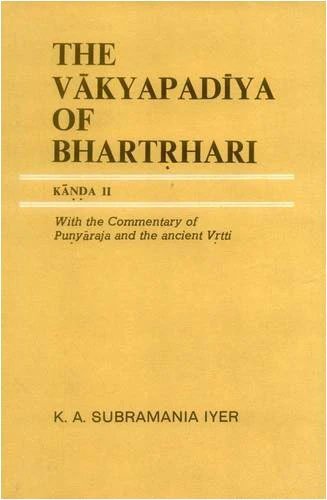
Vakyapadiya of Bhartrihari
by K. A. Subramania Iyer | 1965 | 391,768 words
The English translation of the Vakyapadiya by Bhartrihari including commentary extracts and notes. The Vakyapadiya is an ancient Sanskrit text dealing with the philosophy of language. Bhartrhari authored this book in three parts and propounds his theory of Sphotavada (sphota-vada) which understands language as consisting of bursts of sounds conveyi...
This book contains Sanskrit text which you should never take for granted as transcription mistakes are always possible. Always confer with the final source and/or manuscript.
Verse 3.14.111
Sanskrit text, Unicode transliteration and English translation of verse 3.14.111:
प्राग्वृत्तेर्युक्तवद्भावे षष्ठी भेदाश्रया भवेत् ।
वृत्तौ सङ्खयाविशेषाणां त्यागाद् भेदो निवर्तते ॥ १११ ॥prāgvṛtteryuktavadbhāve ṣaṣṭhī bhedāśrayā bhavet |
vṛttau saṅkhayāviśeṣāṇāṃ tyāgād bhedo nivartate || 111 ||111. If the view is that the gender and number of the word before it enters into the vṛtti are extended, then the sixth case-ending also would be extended. But as, in a vṛtti, particular numbers are abandoned, anything based on difference (like the sixth caseending) cannot come in.
Commentary
[If it is maintained that it is the gender and number of the word before it entered into the vṛtti which are extended, then the sixth case-ending also would have to be extended because it also expresses number. But the M. Bhā. has declared that it is number in general which is extended and not a particular number. Secondly, the sixth case-ending is based on difference and in a vṛtti, the meanings of the constituents become one and so there is no difference. Hence there cannot be any question of the sixth case-ending coming in. Really speaking, it is the gender and number of word after it has entered into the vṛtti which are extended and not what there was before.]
If that is so, the undifferentiated singular would come in as that is what the secondary constituent has after the word has entered the vṛtti and the form godau grāmaḥ would not be realised. So the original objection still stands. This is now answered.