Essay name: Panchavimsha Brahmana (English translation)
Author: W. Caland
This is the English translation of the Panchavimsha Brahmana, named so because it consists of twenty-five chapters (prapathakas). The text is classified as a Vedic Shruti commentary attached to the Samaveda, belonging to both of its Kauthuma and Ranayaniya recensions (shakhas).
Page 85 of: Panchavimsha Brahmana (English translation)
85 (of 716)
External source: Shodhganga (Repository of Indian theses)
Download the PDF file of the original publication
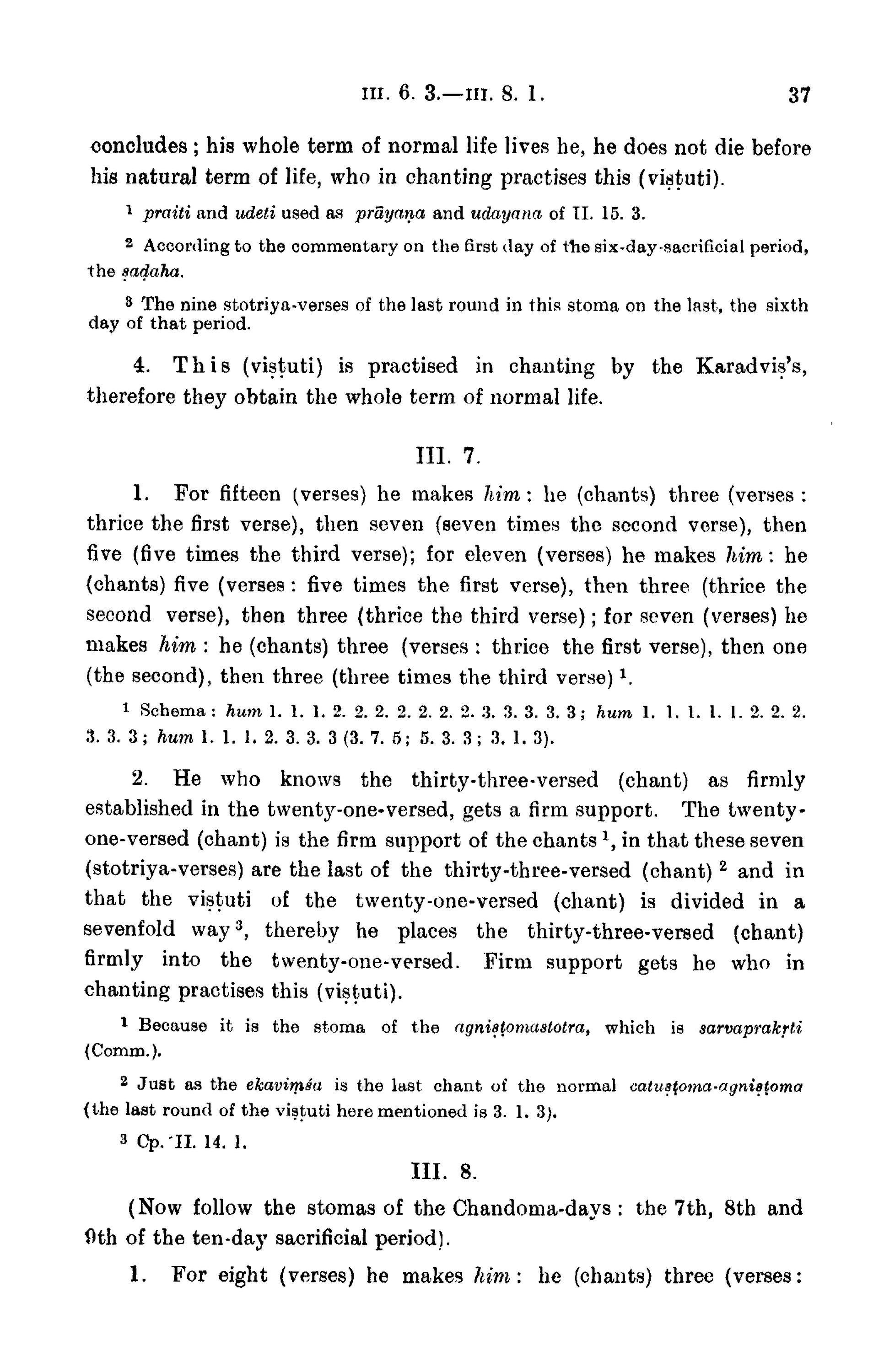
III. 6. 3. III. 8. 1. 37 concludes; his whole term of normal life lives he, he does not die before
his natural term of life, who in chanting practises this (vistuti).
1 praiti and udeti used as prāyaṇa and udayana of II. 15. 3.
2 According to the commentary on the first lay of the six-day-sacrificial period,
the gaḍaha.
3 The nine stotriya-verses of the last round in this stoma on the last, the sixth
day of that period.
4. This (viṣtuti) is practised in chanting by the Karadvis's,
therefore they obtain the whole term of normal life.
III. 7.
1. For fifteen (verses) he makes him he (chants) three (verses:
thrice the first verse), then seven (seven times the second verse), then
five (five times the third verse); for eleven (verses) he makes him he
(chants) five (verses: five times the first verse), then three (thrice the
second verse), then three (thrice the third verse); for seven (verses) he
makes him he (chants) three (verses: thrice the first verse), then one
(the second), then three (three times the third verse) 1.
:
1 Schema hum 1. 1. 1. 2. 2. 2. 2. 2. 2. 2. 3. 3. 3. 3. 3; hum 1. 1. 1. 1. 1. 2. 2. 2.
3. 3. 3; hum 1. 1. 1. 2. 3. 3. 3 (3. 7. 5; 5. 3. 3; 3. 1. 3).
2. He who knows the thirty-three-versed (chant) as firmly
established in the twenty-one-versed, gets a firm support. The twenty-
one-versed (chant) is the firm support of the chants', in that these seven
(stotriya-verses) are the last of the thirty-three-versed (chant) 2 and in
that the vistuti of the twenty-one-versed (chant) is divided in a
sevenfold way 3, thereby he places the thirty-three-versed (chant)
firmly into the twenty-one-versed. Firm support gets he who in
chanting practises this (vistuti).
1 Because it is the stoma of the agnistomastotra, which is sarvaprakṛti
(Comm.).
2 Just as the ekaviméa is the last chant of the normal catuṣtoma-agniṣṭoma
(the last round of the viṣṭuti here mentioned is 3. 1. 3).
3 Cp. II. 14. 1.
III. 8.
(Now follow the stomas of the Chandoma-days: the 7th, 8th and
9th of the ten-day sacrificial period).
1. For eight (verses) he makes him he (chants) three (verses: