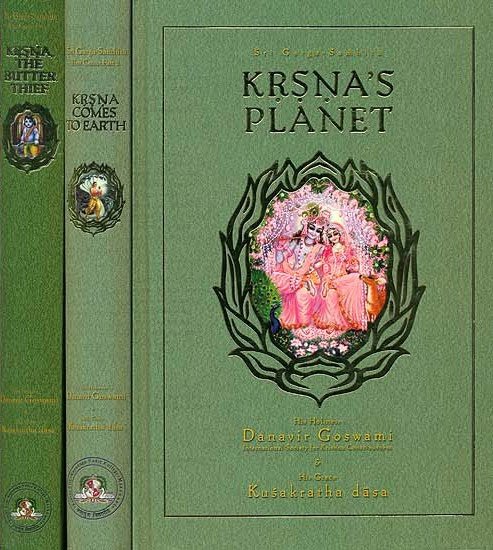
Garga Samhita (English)
by Danavir Goswami | 425,489 words
The Garga-samhita Verse 2.5.6, English translation, including word-by-word: This text represents a Vaishnava scripture which narrates the life Krishna, It was composed in seventeen cantos by Garga Muni: an ancient sage and priest of the Yadu dynasty having. This is verse 2 of Chapter 5 (The Liberation of Bakasura) of Canto 2 (vrindavana-khanda).
Verse 2.5.6
Sanskrit text, transliteration and word-by-word meaning:
विधुन्वन् स्व-तनुं वेगाज्
जृम्भितः पुनर् उत्थितः
न ममार तदा दैत्यो
जगर्ज घनवद् बली
vidhunvan sva-tanuṃ vegāj
jṛmbhitaḥ punar utthitaḥ
na mamāra tadā daityo
jagarja ghanavad balī
vidhunvan—shaking; sva-tanum—his body; vegāt—quickly; jṛmbhitaḥ—yawned; punaḥ—again; utthitaḥ—rose; na—not; mamāra—died; tadā—then; daityaḥ—the demon; jagarja—roared; ghanavat—like a cloud; balī—powerful.
English translation of verse 2.5.6:
The demon powerful did not die. He shook his body, yawned, again stood up, and roared like a cloud.