New Delhi Museum—Paintings: photo 53

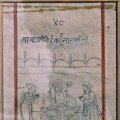
Image title: The philosophy of Sri Guru Nanak
Description of the photo
This exhibition is designed to draw attention to the life, philosophy, teachings and travels of Sri Guru Nanak Dev ji, the founder and first Guru of Sikhism, through carefully chosen paintings from the Janam Sakhi series, housed at National Museum, New Delhi. Janamsakhis, literally 'Birth Stories', are writings which profess to be biographies of the first Guru, Guru Nanak Dev ji. These compositions have been written at various stages after the demise of the first Guru. The early editions of the Janam-sakhi manuscripts are more than Guru Nanak's life story. They relate each story with a teaching in the hymn of the Sikh scripture and illustrate a fundamental moral or teachings.
Guru Nanak was born in the year 1469, in the village Talwandi, which is located in the Punjab region of the Indian subcontinent, a folio depicting birth has been displayed in this exhibition. Guru Nanak's father, Mehta Kalu ji, was a village accountant. His mother, Mata Tripta ji, was described as a simple and religious woman. He also had an older sister named Bebe Nanki ji, who adored her younger brother. From an early age, it was evident that Nanak was an extraordinary child, distinguished by his divine grace. Blessed with a deeply contemplative mind and rational thinking, young Nanak would often astound his elders and teachers with the sublimity of his knowledge, particularly on divine matters.
Accompanied by Bhai Mardana, Guru Nanak undertook four major spiritual journeys, running across India, South Asia, Tibet and Arabia, covering about 30,000 kilometers. He also covered Hindu and Muslim pilgrimages and met the saints like Kabir, Gorakh Nath, Qazi Ruknuddin and many others on his odyssey. In these journeys, he preached the new concept of God as "Supreme, All powerful and Truthful, Formless (Nirankar), Fearless (Nirbhau), without hate (Nirvair), the Sole (Ik), the Self-Existent (Saibhang), the Incomprehensible and Everlasting creator of all things (Karta Purakh), and the Eternal and Absolute Truth (Satnam)" which has also been shown in this exhibition. Nanak's religious ideas draw on both Hindu and Islamic thought, but are far more than just a synthesis. He expressed his thoughts in extraordinary poetry that forms the basis of Sikh scripture.
When Guru Nanak left for the heavenly abode, nine other Gurus followed his teachings and continued to spread his message.
Gallery information:
These photographs are from the section “Paintings” within the National Museum of New Delhi (India). The gallery opens with colorful paintings and drawings made op paper (Kagaj or Kaagaz).
Photo details:
Date: 2024-04-04
Camera: SONY ILCE-6400
Exposure: 1/30
Aperture: f/4
ISO: 100
Focal length: 22mm
High resolution:
Download file
Size: 500.74 KB
Resolution: 800 x 848
© Photograph by Gabe Hiemstra.
(except photos of text/posters)
License: CC BY-NC-ND 4.0