World of desire, Desire realm: 1 definition
Introduction:
World of desire means something in Buddhism, Pali. If you want to know the exact meaning, history, etymology or English translation of this term then check out the descriptions on this page. Add your comment or reference to a book if you want to contribute to this summary article.
In Buddhism
Tibetan Buddhism (Vajrayana or tantric Buddhism)
The World of Desire refers to one of the “Three Worlds” (which together constitute the Buddhist samsaric cosmos) which are known in Tibetan as khams gsum.—Accordingly, [while describing the standpoints of the extremists], [regarding the Brahmavādins]: The Vedāntins, or Highest Brahmans, assert an entity called the person. This is the “person” explained in the Vedas, which are the source of valid cognition; [...]. That person is the self-nature of the gods and also the nature of Maheśvara. From that person alone are produced all the Three Worlds [e.g., the world of desire], happiness and suffering, and bondage and freedom. However, the nature of the person itself is unchanging and inexhaustible. [...]
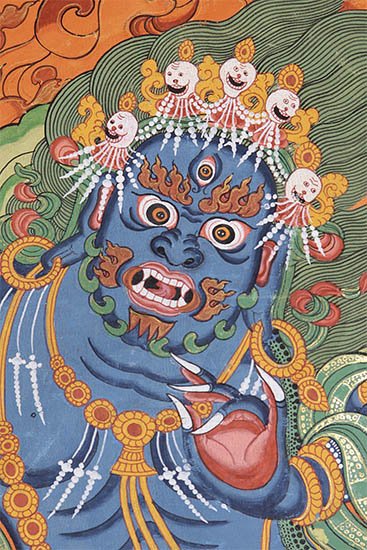
Tibetan Buddhism includes schools such as Nyingma, Kadampa, Kagyu and Gelug. Their primary canon of literature is divided in two broad categories: The Kangyur, which consists of Buddha’s words, and the Tengyur, which includes commentaries from various sources. Esotericism and tantra techniques (vajrayāna) are collected indepently.
See also (Relevant definitions)
Partial matches (+0): Desire, The, The, Realm, World, Te.
Full-text (+507): Kamadhatu, Three worlds, Yu ku, Kama, Kamavacara, Yu you, Da bao fang, Kamavacaraloka, Yu jie xi, Samskritashunyata, Arupyabhava, Jiu ye, 'dod pa na spyod pa, Kamabhava, Bhava, Jia mo tuo dou, Aryavamsha, Yu jie, Kamasrava, Rupa.
Relevant text
Search found 45 books and stories containing World of desire, Desire world, Realm of desire, Desire realm, World of sensusous desire, Realm of sensusous desire, Sensusous desire world, Sensusous desire realm, World of desires, Realm of desires, Desire realms, The world of desire; (plurals include: World of desires, Desire worlds, Realm of desires, Desire realms, World of sensusous desires, Realm of sensusous desires, Sensusous desire worlds, Sensusous desire realms, World of desireses, Realm of desireses, Desire realmses, The world of desires). You can also click to the full overview containing English textual excerpts. Below are direct links for the most relevant articles:
Ahara as depicted in the Pancanikaya (by Le Chanh)
2.1. Aharas of man < [Chapter 5 - Buddhist view on man and his Aharas]
4.3.1. Description of Kabalinkara Ahara < [Chapter 4 - Concept of Ahara in Buddhism]
1. A summary of the research work < [Chapter 7 - Conclusion]
Maha Prajnaparamita Sastra (by Gelongma Karma Migme Chödrön)
2. Actions producing the thirty-two marks (dvātriṃśallakṣaṇa) < [Part 4 - The Bodhisattva in the Abhidharma system]
Act 10.10: Śākyamuni gazes upon the immense assembly gathered before him < [Chapter XV - The Arrival of the Bodhisattvas of the Ten Directions]
II. Gates of concentration (samādhi-mukha) < [Part 4 - Obtaining the gates of recollection and concentration]
The Great Chariot (by Longchenpa)
Part 1b.1e - What predominates in the three chief realms < [B. The extensive explanation of the nature of karma]
Part 2b - The suffering of wandering in samsara because of ego-grasping < [B. The extended explanation of the particulars]
Part 1b.3d - How to eliminate the bad < [B. The extensive explanation of the nature of karma]
Guhyagarbha Tantra (with Commentary) (by Gyurme Dorje)
Commentary 3.2: The Recognition of Rudra < [Chapter 15 (Text and Commentary)]
Text 3.6 (Commentary) < [Chapter 3 (text and commentary)]
Text 9.14 (Commentary) < [Chapter 9 (Text And Commentary)]
What Kamma is (by Sayadaw U Thittila)
Kamma 2 - World Of Desires < [Part 3 - Classification Of Kamma]
Shurangama Sutra (with commentary) (English) (by Hsuan Hua)
A broad explanation of the fulfillment of an audience < [Chapter 3 - The Testimony of Faith]
Five kinds of immediate nirvana < [Chapter 5 - The Formations Skandha]
Concluding exhortation to transmit this teaching < [Chapter 8 - The Arising and Cessation of the Five Skandhas]