Vatadage, Vata-da-ge, Vaṭadāge, Vata-dage: 2 definitions
Introduction:
Vatadage means something in the history of ancient India. If you want to know the exact meaning, history, etymology or English translation of this term then check out the descriptions on this page. Add your comment or reference to a book if you want to contribute to this summary article.
Images (photo gallery)
India history and geography
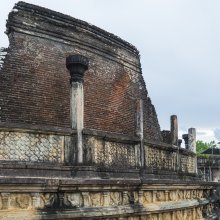
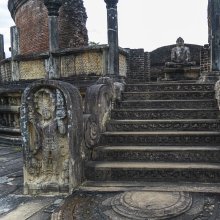
Vaṭadāge (Vaṭa-dā-ge) refers to a building (corresponding with Ratnagirivaṭageya) that once stood on the tooth relic terrace (or quadrangle) of Polonnaruva (Polonnaruwa), Ceylon (Sri Lanka).—Nissaṅka Malla built, on the Tooth Relic Terrace the Ratnagiri-vaṭageya or Vaṭa-dā-ge, by which latter name it is still known;
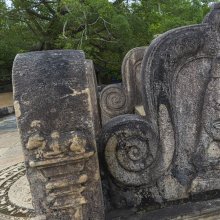
Vaṭadāge (වටදාගෙ) refers to a type of Buddhist structure found in Sri Lanka. It also known as a dage, thupagara and a cetiyagara. Although it may have had some Indian influence, it is a structure that is more or less unique to the architecture of ancient Sri Lanka. Vatadages were built around small stupas for their protection, which often enshrined a relic or were built on hallowed ground. Circular in shape, they were commonly built of stone and brick and adorned with elaborate stone carvings. Vatadages may have also had a wooden roof, supported by a number of stone columns arranged in several concentric rows. Only ten vatadages now remain in Sri Lanka. Only ten vatadages now remain in the country. These are located at Thuparama, Lankarama, Mihintale, Polonnaruwa, Medirigiriya, Attanagalla, Rajangana, Menikdena, Devundara, and Tiriyaya
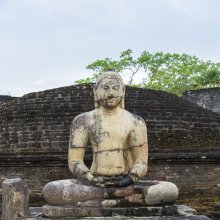
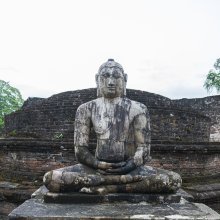
Vatadages were usually constructed around stupas which were either built on hallowed ground or contained a relic of the Buddha or an object used by him. The Polonnaruwa Vatadage may have had the tooth relic of the Buddha enshrined within it. Similarly, it is believed that a hair relic of the Buddha is enshrined at Tiriyaya, and his collarbone at Thuparama. The Attanagalla and Mihintale vatadages are both believed to have been built over hallowed ground.
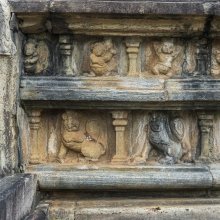
Vatadages were circular in shape. They were constructed around small stupas for their protection, as well as shelter for devotees. The stupa is located at the centre of a raised circular platform, commonly paved with stone. The vatadage in Polonnaruwa has two platforms, one above the other. This platform contained several concentric rows of stone columns. The columns on the inner row were the highest, while the heights of the columns in the outer rows gradually diminished as they spread further from the center. The number of stone columns and rows have varied from structure to structure, with the vatadage in Lankarama originally having as many as 88 columns. Vatadages often had four entrances, usually oriented to the four cardinal directions. However, not all of them have been built according to this tradition, and vatadages such as the Thuparama have only one entrance. These entrances were elaborately decorated. The steps that lead to the raised platform were adorned with carvings, as were the korawakgalas (stone balustrades). A sandakada-pahana (moonstone) was placed at the foot of the steps, flanked by two muragalas (guard stones).
The history of India traces the identification of countries, villages, towns and other regions of India, as well as mythology, zoology, royal dynasties, rulers, tribes, local festivities and traditions and regional languages. Ancient India enjoyed religious freedom and encourages the path of Dharma, a concept common to Buddhism, Hinduism, and Jainism.
See also (Relevant definitions)
Partial matches (+0): Dage, Ge, Da, Ta, Vata.
Full-text (+0): Dhatugeha, Ratnagirivatageya, Cetiyaghara, Yatgala, Udgala, Manisomarama, Somarama, Atadage, Mandalagirika.
Relevant text
Search found 3 books and stories containing Vatadage, Vata-da-ge, Vaṭa-dā-ge, Vaṭa-dā-gē, Vata-dage, Vaṭa-dāge, Vaṭa-dāgē, Vaṭadāge, Vaṭadāgē; (plurals include: Vatadages, ges, gēs, dages, dāges, dāgēs, Vaṭadāges, Vaṭadāgēs). You can also click to the full overview containing English textual excerpts. Below are direct links for the most relevant articles:
Historical topograhpy of ancient and medieval Ceylon (by C. W. Nicholas)
Chapter 16 - The Kalutara district (ancient history and topography)
Chapter 10 - The Jaffna district (ancient history and topography)
Chapter 4 - The Trincomalee district (ancient history and topography)
A Short history of Lanka (by Humphry William Codrington)
Society in Mediaeval Ceylon (by M. B. Ariyapala)