Varunatirtha, Varuna-tirtha, Vāruṇatīrtha: 4 definitions
Introduction:
Varunatirtha means something in Hinduism, Sanskrit, the history of ancient India. If you want to know the exact meaning, history, etymology or English translation of this term then check out the descriptions on this page. Add your comment or reference to a book if you want to contribute to this summary article.
In Hinduism
Purana and Itihasa (epic history)
Vāruṇatīrtha (वारुणतीर्थ).—A holy place at the mouth of river Indus. Mention is made in Mahābhārata, Vana Parva, Chapter 82, Stanza 63, that those who bathe in this place will be filled with radiance and will enter the world of Varuṇa.

The Purana (पुराण, purāṇas) refers to Sanskrit literature preserving ancient India’s vast cultural history, including historical legends, religious ceremonies, various arts and sciences. The eighteen mahapuranas total over 400,000 shlokas (metrical couplets) and date to at least several centuries BCE.
India history and geography
Varuṇatīrtha (वरुणतीर्थ) refers to one of the Tīrthas (“sacred water-bodies”) mentioned in the Anantaśayanakṣetramāhātmya, a text talking about the Thiruvananthapuram temple in eleven chapters, written before the 14th century and claiming to be part of the Brahmāṇḍapurāṇa.—A māhātmya usually describes the Tīrthas (sacred water-bodies) in the surroundings of the centres that figure in that māhātmya. In the eleventh chapter Anantaśayanakṣetramāhātmya, too, we find a list of Tīrthas around the Tiruvanantapuram Temple [e.g., Varuṇatīrtha] describing its legends and glory.
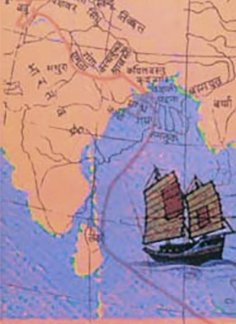
The history of India traces the identification of countries, villages, towns and other regions of India, as well as mythology, zoology, royal dynasties, rulers, tribes, local festivities and traditions and regional languages. Ancient India enjoyed religious freedom and encourages the path of Dharma, a concept common to Buddhism, Hinduism, and Jainism.
Languages of India and abroad
Sanskrit dictionary
1) Varuṇatīrtha (वरुणतीर्थ):—[=varuṇa-tīrtha] [from varuṇa > vara] n. Name of a Tīrtha, [Catalogue(s)]
2) Vāruṇatīrtha (वारुणतीर्थ):—[=vāruṇa-tīrtha] [from vāruṇa] n. Name of a Tīrtha, [Catalogue(s)]
Varuṇatīrtha (वरुणतीर्थ):—n. Nomen proprium eines heiligen Badeplatzes [Oxforder Handschriften 77,a,24. fg.]
--- OR ---
Vāruṇatīrtha (वारुणतीर्थ):—n. Nomen proprium eines Tīrtha [Oxforder Handschriften 66,b,38.] — Vgl. varuṇatīrtha .
Sanskrit, also spelled संस्कृतम् (saṃskṛtam), is an ancient language of India commonly seen as the grandmother of the Indo-European language family (even English!). Closely allied with Prakrit and Pali, Sanskrit is more exhaustive in both grammar and terms and has the most extensive collection of literature in the world, greatly surpassing its sister-languages Greek and Latin.
See also (Relevant definitions)
Relevant text
Search found 4 books and stories containing Varunatirtha, Varuna-tirtha, Vāruṇa-tīrtha, Varuṇa-tīrtha, Vāruṇatīrtha, Varuṇatīrtha; (plurals include: Varunatirthas, tirthas, tīrthas, Vāruṇatīrthas, Varuṇatīrthas). You can also click to the full overview containing English textual excerpts. Below are direct links for the most relevant articles:
Skanda Purana (by G. V. Tagare)
Chapter 7 - Different Tīrthas on Aruṇācala < [Section 3a - Arunācala-khaṇḍa (Pūrvārdha)]
Archaeology of Religious Ideas at Kolhapur (by Yogesh Prabhudesai)
Part 2 - Physiography of Kolhapur < [Chapter 1 - Introduction]
Part 2 - Temple Architecture in Kolhapur < [Chapter 4 - Temple Architecture]
Part 2 - Shaktism in Kollapura < [Chapter 5 - Religious Ideas in Kollapura]
108 Tirupathi Anthathi (English translation) (by Sri Varadachari Sadagopan)
Brahma Purana (critical study) (by Surabhi H. Trivedi)