Undifferentiated: 1 definition
Introduction:
Undifferentiated means something in Hinduism, Sanskrit. If you want to know the exact meaning, history, etymology or English translation of this term then check out the descriptions on this page. Add your comment or reference to a book if you want to contribute to this summary article.
Images (photo gallery)

In Hinduism
Yoga (school of philosophy)
(That which is) Undifferentiated is denoted by the Sanskrit term Niḥprapañca, and is used to describe the “highest reality” (paratattva) [paraṃ tattvaṃ], according to the Amanaska Yoga treatise dealing with meditation, absorption, yogic powers and liberation.—Accordingly, as Īśvara says to Vāmadeva: “[...] Now, I will teach knowledge for the liberation of those people who have conquered their passion. The highest reality is defined as that which is aspectless and undifferentiated (niḥprapañca). [...]”.
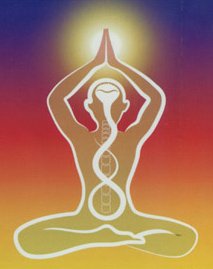
Yoga is originally considered a branch of Hindu philosophy (astika), but both ancient and modern Yoga combine the physical, mental and spiritual. Yoga teaches various physical techniques also known as āsanas (postures), used for various purposes (eg., meditation, contemplation, relaxation).
See also (Relevant definitions)
Partial matches (+0): The, The, Undifferentiated, Te.
Full-text (+116): Nishkalabhava, Nishkalabindu, Niruccara, Niraupamya, Vinirmukta, Kalpanamala, Icchadvandva, Anakula, Martya, Wu fen bie fa, Prakriti, Vetrin, Vetrirupa, Melapa, Mahamelapa, Avadharana, Avadhrita, Avadhriti, Avadhritarupa, Nada.
Relevant text
Search found 152 books and stories containing Undifferentiated, The undifferentiated; (plurals include: Undifferentiateds, The undifferentiateds). You can also click to the full overview containing English textual excerpts. Below are direct links for the most relevant articles:
Yoga-sutras (with Vyasa and Vachaspati Mishra) (by Rama Prasada)
Sūtra 2.19 < [Book 2 - Practice (Sādhana)]
Sūtra 4.34 < [Book 4 - Absolute Independence (Kaivalya)]
Sūtra 1.19 < [Book 1 - Trance (Samādhi)]
Making Sustainability a Core Competency < [Volume 14, Issue 18 (2022)]
Voluntary Certification of Agricultural Products in Competitive Markets < [Volume 8, Issue 9, September (2016)]
Algorithmic Pricing and Price Gouging. Consequences of High-Impact, Low... < [Volume 13, Issue 5 (2021)]
Idol Worship in Hindu Religion < [April – June, 2006]
The Future of Poetry < [July 1948]
The Growth of Political Science in India < [January – March, 1981]
International Journal of Environmental Research and Public Health (MDPI)
Pathways Linking Acculturation Profiles to Health Trajectories of Married... < [Volume 21, Issue 11 (2024)]
Vocational Identity Status in Chinese Emerging Adults with and without... < [Volume 19, Issue 21 (2022)]
Gender Self-Perception and Psychological Distress in Healthcare Students... < [Volume 18, Issue 20 (2021)]
The Complete Works of Swami Vivekananda (by Srila Narayana Maharaja)
Introduction to Jnana-Yoga < [Lectures and Discourses]
Cosmology < [Practical Vedanta and other lectures]
The Mantra: Om: Word and Wisdom < [Bhakti-Yoga]
Tattvasangraha [with commentary] (by Ganganatha Jha)
Verse 428-434 < [Chapter 8 - Examination of the Doctrine of the Permanence of Things]
Verse 147-148 < [Chapter 5 - The Doctrine of Sound (‘Word-Sound’) being the Origin of the World]
Verse 31 < [Chapter 1 - Examination of the Doctrine of Primordial Matter (prakṛti)]