Sumatikirti, Sumatikīrti, Sumati-kirti: 2 definitions
Introduction:
Sumatikirti means something in Hinduism, Sanskrit, the history of ancient India. If you want to know the exact meaning, history, etymology or English translation of this term then check out the descriptions on this page. Add your comment or reference to a book if you want to contribute to this summary article.
India history and geography
Sumatikīrti (सुमतिकीर्ति) is another name for Tsongkhapa (c. 1357–1419)—an influential Tibetan Buddhist monk, philosopher and Tantric Yogi, whose activities led to the formation of the Gelug school of Tibetan Buddhism. Tsongkhapa was born in Amdo, the son of a Tibetan Longben Tribal leader who also once served as an official of the Yuan dynasty. It is said that Tsongkhapa's father was probably a Mongolian because he was the head of a Tibetan tribe of the Yuan dynasty (Mongol Empire).
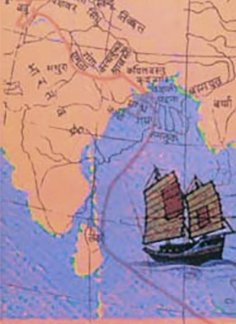
The history of India traces the identification of countries, villages, towns and other regions of India, as well as mythology, zoology, royal dynasties, rulers, tribes, local festivities and traditions and regional languages. Ancient India enjoyed religious freedom and encourages the path of Dharma, a concept common to Buddhism, Hinduism, and Jainism.
Languages of India and abroad
Sanskrit dictionary
Sumatikīrti (in Sanskrit) can be associated with the following Chinese terms:
1) 宗客巴 [zōng kè bā]: “Sumatikīrti” [Sanskrit personal name]; Alternatively: “Tsoṅ-kha-pa” [Tibetan personal name].
Sanskrit, also spelled संस्कृतम् (saṃskṛtam), is an ancient language of India commonly seen as the grandmother of the Indo-European language family (even English!). Closely allied with Prakrit and Pali, Sanskrit is more exhaustive in both grammar and terms and has the most extensive collection of literature in the world, greatly surpassing its sister-languages Greek and Latin.
See also (Relevant definitions)
Partial matches (+0): Sumati, Kirti, Ma, Cu, Shu, Ti.
Full-text (+0): Zong ke ba, Tong khach ba, Huang mao jiao, Huangjiao, Tsongkhapa.
Relevant text
Search found 5 books and stories containing Sumatikirti, Sumati-kīrti, Sumatikīrti, Sumati-kirti, Su ma ti kirti; (plurals include: Sumatikirtis, kīrtis, Sumatikīrtis, kirtis, Su ma ti kirtis). You can also click to the full overview containing English textual excerpts. Below are direct links for the most relevant articles:
Bodhisattvacharyavatara (by Andreas Kretschmar)
Translator’s Introduction < [Introduction Text]
Text Section 151-153 < [Khenpo Chöga’s Oral Explanations]
‘Examining Religion’ through Generations of Jain Audiences < [Volume 10, Issue 5 (2019)]
‘Tataḥ Śrī-Gurus-Tasmai Sūrimantraṃ Dadyāt’, ‘Then the Venerable Guru Ought... < [Volume 10, Issue 6 (2019)]
Bodies of Knowledge: Bodily Perfection in Tantric Buddhist Practice < [Volume 12, Issue 2 (2021)]
Blue Annals (deb-ther sngon-po) (by George N. Roerich)
Chapter 11 - The Chapter on the Venerable Master and his Spiritual Lineage. < [Book 5 - The Sovereign Lord (Atiśa)]
Chapter 2a - Niguma: Siddha khyung po rnal 'byor’s biography < [Book 9 - Kodrakpa and Niguma]
Chapter 5 - Cakrasaṃvara < [Book 7 - The preaching of the Tantras]
Reverberations of Dharmakirti’s Philosophy (by Birgit Kellner)
A Dictionary Of Chinese Buddhist Terms (by William Edward Soothill)