Sattvaloka, Sattva-loka: 4 definitions
Introduction:
Sattvaloka means something in Buddhism, Pali, Hinduism, Sanskrit. If you want to know the exact meaning, history, etymology or English translation of this term then check out the descriptions on this page. Add your comment or reference to a book if you want to contribute to this summary article.
In Buddhism
Mahayana (major branch of Buddhism)
Sattvaloka (सत्त्वलोक) refers to the “animate world”, according to Mahāprajñāpāramitāśāstra (chapter 4).—Accordingly, “[Question: How does the Buddha know the world?]—[Answer]: [...] He knows two kinds of worlds: (i) the animate world (sattvaloka), (ii) the inanimate world (asattvaloka) in their true nature (satyalakṣaṇa). He knows the world (loka), its cause (hetu), its destruction (nirodha) and the supra-worldly Path (lokottaramārga). [...]”.
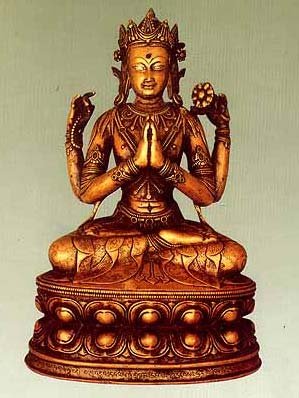
Mahayana (महायान, mahāyāna) is a major branch of Buddhism focusing on the path of a Bodhisattva (spiritual aspirants/ enlightened beings). Extant literature is vast and primarely composed in the Sanskrit language. There are many sūtras of which some of the earliest are the various Prajñāpāramitā sūtras.
General definition (in Buddhism)
Sattvaloka (सत्त्वलोक) refers to the “world of beings” and represents one of the “two worlds” (lokadvaya) as defined in the Dharma-saṃgraha (section 89). The Dharma-samgraha (Dharmasangraha) is an extensive glossary of Buddhist technical terms in Sanskrit (e.g., sattva-loka). The work is attributed to Nagarjuna who lived around the 2nd century A.D.
Languages of India and abroad
Sanskrit dictionary
Sattvaloka (सत्त्वलोक).—a world of living beings.
Derivable forms: sattvalokaḥ (सत्त्वलोकः).
Sattvaloka is a Sanskrit compound consisting of the terms sattva and loka (लोक).
Sattvaloka (सत्त्वलोक):—[=sat-tva-loka] [from sat-tva > sat] m. a world of living beings, [Monier-Williams’ Buddhism 120.]
Sanskrit, also spelled संस्कृतम् (saṃskṛtam), is an ancient language of India commonly seen as the grandmother of the Indo-European language family (even English!). Closely allied with Prakrit and Pali, Sanskrit is more exhaustive in both grammar and terms and has the most extensive collection of literature in the world, greatly surpassing its sister-languages Greek and Latin.
See also (Relevant definitions)
Partial matches (+0): Loka, Sattva.
Full-text (+0): Lokadvaya, Asattvaloka, Satyalakshana, Zhong sheng shi jian, Bhajana.
Relevant text
Search found 2 books and stories containing Sattvaloka, Sattva-loka; (plurals include: Sattvalokas, lokas). You can also click to the full overview containing English textual excerpts. Below are direct links for the most relevant articles:
Maha Prajnaparamita Sastra (by Gelongma Karma Migme Chödrön)
Preliminary note on distinguishing the movements of mind of all beings < [Part 2 - Distinguishing the movements of mind of all beings]
Part 7 - Why is the Buddha called Lokavid < [Chapter IV - Explanation of the Word Bhagavat]
Part 2.4 - Withstanding persecutors < [Chapter XXIV - The Virtue of Patience]
Korean Potalaka < [Volume 13, Issue 8 (2022)]