Sandrishtika, Samdrishtika, Sāṃdṛṣṭika, Saṃdṛṣṭika, Sāndṛṣṭika: 8 definitions
Introduction:
Sandrishtika means something in Buddhism, Pali, Hinduism, Sanskrit. If you want to know the exact meaning, history, etymology or English translation of this term then check out the descriptions on this page. Add your comment or reference to a book if you want to contribute to this summary article.
The Sanskrit terms Sāṃdṛṣṭika and Saṃdṛṣṭika and Sāndṛṣṭika can be transliterated into English as Samdrstika or Samdrishtika or Sandrstika or Sandrishtika, using the IAST transliteration scheme (?).
In Buddhism
Mahayana (major branch of Buddhism)
Sāṃdṛṣṭika (सांदृष्टिक, “immediately”) or Saṃdṛṣṭika refers to a quality of the Dharma associated with the “recollection of the Dharma” (dharmānusmṛti), representing one of the Anusmṛti (eight recollections), according to the 2nd century Mahāprajñāpāramitāśāstra chapter 36.—Accordingly, “the Dharma obtains its retribution in the present existence (sāṃdṛṣṭika): as it eliminates the various problems of the world caused by lust (rāga) as well as the various teachings (upadeśa) and arguments caused by wrong views (mithyādṛṣṭi), body (kāya) and mind (citta) find happiness in it”.
Moreover, if those who have not attained Bodhi do not arrive at Nirvāṇa in the present lifetime, in the future lifetime they will, nonetheless, have wealth and happiness and, little by little (kramaśas), they will attain Nirvāṇa. Finally, their efforts will not be in vain. Thus the Buddha said: “those who have gone forth from home (pravrajita) in view of Nirvāṇa will all reach Nirvāṇa, some slowly (manda) and other quickly (śīghra). Thus the Dharma ‘obtains its fruit in the present existence’ (sāṃdṛṣṭika).
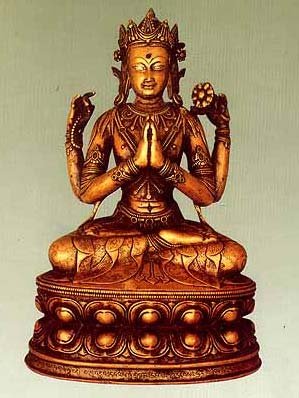
Mahayana (महायान, mahāyāna) is a major branch of Buddhism focusing on the path of a Bodhisattva (spiritual aspirants/ enlightened beings). Extant literature is vast and primarely composed in the Sanskrit language. There are many sūtras of which some of the earliest are the various Prajñāpāramitā sūtras.
Languages of India and abroad
Sanskrit dictionary
Sāṃdṛṣṭika (सांदृष्टिक).—a. (-kī f.)
1) Relating to present perception, visible at the same time.
2) Evident, undeniable.
-kam Immediate consequence.
Saṃdṛṣṭika (संदृष्टिक).—adj., = sāṃ°, q.v.: visible, actual, of the present (life): Divyāvadāna 426.10 °kam idaṃ phalam.
--- OR ---
Sāṃdṛṣṭika (सांदृष्टिक).—adj. (= Sanskrit Lex. id., Pali saṃdiṭṭhika; also saṃ°, q.v.), visible, actual, perceptible; of the present (life); opp. to āgāmika; syn. akālika, āk°: Mahāvastu ii.405.16 (see āgāmika); iii.195.11 °kaṃ…idaṃ vipākaṃ; 200.10 dharmavinayaḥ sāṃdṛṣṭika akāliko; Mahāvyutpatti 1292 (of dhar- maḥ) °kaḥ, followed in 1294 by ākālikaḥ; Karmavibhaṅga (and Karmavibhaṅgopadeśa) 58.1, 6 °kaḥ (phalavipākaḥ).
Sāndṛṣṭika (सान्दृष्टिक).—n.
(-kaṃ) Immediate consequence. f. (-kī) Relating to present perception. E. sam with, dṛṣṭi sight, present perception, ṭhañ aff.
Sāndṛṣṭika (सान्दृष्टिक).—i. e. sam -dṛś + ti + ika, m. Immediate consequence.
1) Saṃdṛṣṭika (संदृष्टिक):—[=saṃ-dṛṣṭika] [from saṃ-dṛṣṭi > saṃ-dṛś] [wrong reading] for sāṃd, [Divyāvadāna]
2) Sāṃdṛṣṭika (सांदृष्टिक):—mfn. ([from] saṃdṛṣṭi) visible or perceptible at the same time, relating to present perception, appearing at once or immediately, [cf. Lexicographers, esp. such as amarasiṃha, halāyudha, hemacandra, etc.]
3) evident, undeniable, [Varāha-mihira’s Bṛhat-saṃhitā]
4) n. ([scilicet] phala) present perception of a result, immediate consequence, [cf. Lexicographers, esp. such as amarasiṃha, halāyudha, hemacandra, etc.]
Sāndṛṣṭika (सान्दृष्टिक):—(kaṃ) 1. m. Immediate consequence.
Sāṃdṛṣṭika (सांदृष्टिक):—(von saṃdṛṣṭi) adj. unmittelbar —, alsbald erfolgend: phala Lohn [Amarakoṣa 2, 8, 1, 29.] [Hemacandra’s Abhidhānacintāmaṇi 162.] [Halāyudha 1, 118.] Nach den Erklärern n. (sc. phala).
Sanskrit, also spelled संस्कृतम् (saṃskṛtam), is an ancient language of India commonly seen as the grandmother of the Indo-European language family (even English!). Closely allied with Prakrit and Pali, Sanskrit is more exhaustive in both grammar and terms and has the most extensive collection of literature in the world, greatly surpassing its sister-languages Greek and Latin.
See also (Relevant definitions)
Partial matches (+0): Drishtika, Sam, Cam.
Full-text (+0): Samsrishtika, Ehipashyika, Agamika, Dharmanusmriti.
Relevant text
Search found 7 books and stories containing Sandrishtika, Sam-drishtika, Saṃ-dṛṣṭika, Sam-drstika, Samdrishtika, Sāṃdṛṣṭika, Saṃdṛṣṭika, Samdrstika, Sāndṛṣṭika, Sandrstika; (plurals include: Sandrishtikas, drishtikas, dṛṣṭikas, drstikas, Samdrishtikas, Sāṃdṛṣṭikas, Saṃdṛṣṭikas, Samdrstikas, Sāndṛṣṭikas, Sandrstikas). You can also click to the full overview containing English textual excerpts. Below are direct links for the most relevant articles:
Anguttara Nikaya (Numbered Discourses)
Discourse 3.53: Aññatarabrāhmaṇa-sutta < [Brāhmaṇa-vagga: Brahmins]
Discourse 9.47: Sandiṭṭhikanibbāna-sutta < [Sāmañña-vagga: Similarity]
Discourse 5.34: Sīhasenāpati-sutta < [Sumana-vagga: The Chapter with Sumanā]
Samyuta Nikaya (Linked Discourses)
Discourse 35.70: Upavāṇasandiṭṭhika-sutta < [35.7. Migajāla-vagga: The Chapter with Migajāla]
Discourse 4.21: Sambahula-sutta < [4.3. Tatiya-vagga: Chapter Three]
Discourse 1.20: Samiddhi-sutta < [1.2. Nandana-vagga: the Garden of Delight]
Digha Nikaya (Long Discourses)
4.2. The Second Fruit of the Ascetic Life < [Discourse 2: The Fruits of the Ascetic Life]
4.1. The First Fruit of the Ascetic Life < [Discourse 2: The Fruits of the Ascetic Life]
5. Six Drawbacks of Drinking < [Discourse 31: Advice to Sigālaka]
Maha Prajnaparamita Sastra (by Gelongma Karma Migme Chödrön)
II.2. Dharma, obtaining its retribution in the present lifetime (saṃdṛṣṭika) < [II. Recollection of the Dharma (dharmānusmṛti)]
II. Recollection of the Dharma (dharmānusmṛti) < [Part 2 - The Eight Recollections according to the Abhidharma]
The Dhvajāgrasūtra < [Part 1 - Position and results of the recollections]
Majjhima Nikaya (Middle Discourses)
Discourse 14: The Shorter Discourse on the Mass of Suffering < [Sīhanāda-vagga: The Chapter on the Lion’s Roar]
Discourse 13: The Longer Discourse on the Mass of Suffering < [Sīhanāda-vagga: The Chapter on the Lion’s Roar]
Discourse 70: At Kīṭāgiri < [Bhikkhu-vagga: The Chapter on Mendicants]
Diksha (initiation) in Pancharatra (by Shanta Srinivasan)