Ranajit, Raṇajit, Rana-jit: 2 definitions
Introduction:
Ranajit means something in Buddhism, Pali, the history of ancient India. If you want to know the exact meaning, history, etymology or English translation of this term then check out the descriptions on this page. Add your comment or reference to a book if you want to contribute to this summary article.
In Buddhism
Mahayana (major branch of Buddhism)
Raṇajit (रणजित्) is the name of a Devaputra appointed as one of the Divine protector deities of Pañcāla, according to chapter 17 of the Candragarbha: the 55th section of the Mahāsaṃnipāta-sūtra, a large compilation of Sūtras (texts) in Mahāyāna Buddhism partly available in Sanskrit, Tibetan and Chinese.—In the Candragarbhasūtra, the Bhagavat invites all classes of Gods and Deities to protect the Law [dharma?] and the faithful in their respective kingdoms of Jambudvīpa [e.g., the Devaputra Raṇajit in Pañcāla], resembling the time of the past Buddhas.
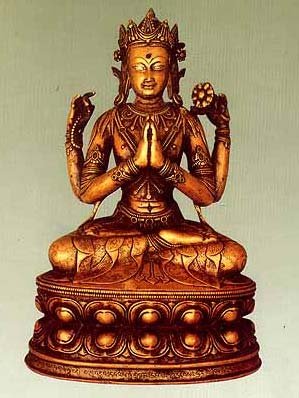
Mahayana (महायान, mahāyāna) is a major branch of Buddhism focusing on the path of a Bodhisattva (spiritual aspirants/ enlightened beings). Extant literature is vast and primarely composed in the Sanskrit language. There are many sūtras of which some of the earliest are the various Prajñāpāramitā sūtras.
India history and geography
1) Ranajin (=Ranajinmalla) is the name of an ancient Raja (king of Nepal) from the Bhaktapur Dynasty (i.e., the Rajas of Bhaktapur or Bhatgaon), mentioned in the list of “Rajas of Nepal from the time of Ne Muni”, as extracted from the translation of the Vanshavali or Bansawali (“history and genealogical accounts of Nepal”).—Note: This list has been carefully revised and collated with the original manuscript, and gives the most correct forms of the royal names (e.g., Ranajin-malla). The reader should compare it with the list in Thomas’s edition of Prinsep’s Essays on Indian Antiquities, Vol. II., pp. 268-271.
2) Ranajit (=Ranajinmalla of Bhatgaon) is also mentioned as a Raja (king of Nepal) from the Lalitapur or Patan Dynasty.
The history of India traces the identification of countries, villages, towns and other regions of India, as well as mythology, zoology, royal dynasties, rulers, tribes, local festivities and traditions and regional languages. Ancient India enjoyed religious freedom and encourages the path of Dharma, a concept common to Buddhism, Hinduism, and Jainism.
See also (Relevant definitions)
Partial matches (+0): Jit, Rana.
Starts with (+0): Ranajinmalla, Ranajinmalla, Ranajita.
Full-text (+0): Ranajinmalla, Pancala.
Relevant text
Search found 16 books and stories containing Ranajit, Raṇajit, Raṇa-jit, Rana-jit; (plurals include: Ranajits, Raṇajits, jits). You can also click to the full overview containing English textual excerpts. Below are direct links for the most relevant articles:
Kailash: Journal of Himalayan Studies
Part 16 - Dalmardana Shah (Shaha) < [A Chronology of the Later Kings of Patan]
Part 15 - Rana Jita (Ranajit) Malla < [A Chronology of the Later Kings of Patan]
Part 1 - Guide to Kimdol Vihara (Kindo Baha) < [A Buddhist Guide to the Power Places of the Kathmandu Valley]
Dictionaries of Indian languages (Kosha)
Page 224 < [Bengali-Hindi-English, Volume 2]
History of Nepal (the Bansawali) (by Munshi Shew Shunker Singh)
International Ayurvedic Medical Journal
Role of agni in the management of hypertension- a review study < [2023, Issue 04, April]
Successful ayurvedic management of superficial dermatophytosis -a case study < [2023, Issue 02, February]
Effect of ksheerbala taila in the management of vata vyadhi-a review article < [2019, Issue 6, June]
Physician as depicted in Manasollasa (by Sri B. S. Hebballi)
"Livina Protects Against Ethanol-Induced Liver Damage in Rats" < [Volume 28 (issue 3), Jan-Mar 2009]