Pushpabhadra, Puṣpabhadrā, Pushpa-bhadra, Puṣpabhadra: 8 definitions
Introduction:
Pushpabhadra means something in Hinduism, Sanskrit. If you want to know the exact meaning, history, etymology or English translation of this term then check out the descriptions on this page. Add your comment or reference to a book if you want to contribute to this summary article.
The Sanskrit terms Puṣpabhadrā and Puṣpabhadra can be transliterated into English as Puspabhadra or Pushpabhadra, using the IAST transliteration scheme (?).
In Hinduism
Purana and Itihasa (epic history)
Puṣpabhadrā (पुष्पभद्रा) is the name of a river, according to the Śivapurāṇa 2.5.34 (“The March of Śaṅkhacūḍa”).—Accordingly: “[While describing the military campaign of Śaṅkhacūḍa]: In the holy land of Bhārata, to the east of the western ocean and to the west of Malaya mountain, on the banks of river Puṣpabhadrā [i.e., puṣpabhadrānadī-tīra] there is a hermitage of Kapila with an auspicious holy Banyan tree. It is called Siddhāśrama. It is the place where holy men achieve the result of their action, It is to the north of Śrīśaila and to the south of Gaṇḍhamādana. It is five Yojanas in width and a hundred times as much in length. The river Puṣpabhadrā [=puṣpabhadrānadī] is very beautiful and full of transparent water. It confers merits on everyone in Bhārata, like the river Sarasvatī. It starts from Himālaya, has its confluence with Sarasvatī. It is the beloved of the briny sea and blessess people with good fortune. It enters the western ocean where Gomanta is on its left. Śaṅkhacūḍa went there and saw the army of Śiva”.
Note: It has not been possible to identify this river. According to the present context, Puṣpabhadrā issues from the Himalayas, rises along with the Sarasvatī and falls into the Western ocean. (Cp. Verses 24-25 of this ch.)
1) Puṣpabhadra (पुष्पभद्र).—A maṇṭapa with 62 pillars.*
- * Matsya-purāṇa 270. 3, 7.
2) Puṣpabhadrā (पुष्पभद्रा).—(River) (also Puṣpavahā)—on its banks in the Himālayas, Mārkaṇḍeya performed tapas.*
- * Bhāgavata-purāṇa XII. 8. 17; 9. 10 and 30.

The Purana (पुराण, purāṇas) refers to Sanskrit literature preserving ancient India’s vast cultural history, including historical legends, religious ceremonies, various arts and sciences. The eighteen mahapuranas total over 400,000 shlokas (metrical couplets) and date to at least several centuries BCE.
Vastushastra (architecture)
Puṣpabhadra (पुष्पभद्र) refers to a variety of maṇḍapa (halls attached to the temple), according to the Matsya-purāṇa (verses 270.1-30). The puṣpabhadra-maṇḍapa is to be built with 62 pillars (stambha). The Matsyapurāṇa is one of the eighteen major purāṇas dating from the 1st-millennium BCE.
Accordingly (verse 270.15-17), “These maṇḍapas (e.g., puṣpabhadra) should be either made triangular, circular, octagonal or with 16 sides or they are square. They promote kingdoms, victory, longevity, sons, wife and nourishment respecitvely. Temples of other shape than these are inauspicious.”
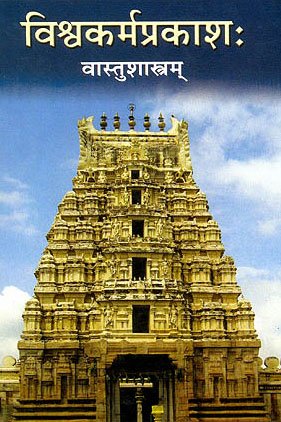
Vastushastra (वास्तुशास्त्र, vāstuśāstra) refers to the ancient Indian science (shastra) of architecture (vastu), dealing with topics such architecture, sculpture, town-building, fort building and various other constructions. Vastu also deals with the philosophy of the architectural relation with the cosmic universe.
Languages of India and abroad
Sanskrit dictionary
Puṣpabhadra (पुष्पभद्र).—a kind of pavilion with 62 columns.
Derivable forms: puṣpabhadraḥ (पुष्पभद्रः).
Puṣpabhadra is a Sanskrit compound consisting of the terms puṣpa and bhadra (भद्र).
Puṣpabhadra (पुष्पभद्र).—[masculine] a man’s name.*
1) Puṣpabhadra (पुष्पभद्र):—[=puṣpa-bhadra] [from puṣpa > puṣ] m. ‘beautiful with f°’, a kind of pavilion with 62 columns, [Vāstuvidyā]
2) [v.s. ...] Name of a man, [Mṛcchakaṭikā]
3) [v.s. ...] n. Name of a city, [Hemacandra’s Pariśiṣṭaparvan]
4) Puṣpabhadrā (पुष्पभद्रा):—[=puṣpa-bhadrā] [from puṣpa-bhadra > puṣpa > puṣ] f. Name of a river, [Bhāgavata-purāṇa]
Puṣpabhadrā (पुष्पभद्रा):—(pu + bha) f. Nomen proprium eines Flusses [Oxforder Handschriften 24,a, Nalopākhyāna 2. 77,b,43.]
--- OR ---
Puṣpabhadrā (पुष्पभद्रा):—[Bhāgavatapurāṇa 12, 8, 17. 9, 10.]
Puṣpabhadra (पुष्पभद्र):——
1) m. eine Art Pavillon mit 62 Säulen [Viśvakarma’s Vāstuvidyā 830.] —
2) f. ā Nomen proprium eines Flusses.
Sanskrit, also spelled संस्कृतम् (saṃskṛtam), is an ancient language of India commonly seen as the grandmother of the Indo-European language family (even English!). Closely allied with Prakrit and Pali, Sanskrit is more exhaustive in both grammar and terms and has the most extensive collection of literature in the world, greatly surpassing its sister-languages Greek and Latin.
See also (Relevant definitions)
Partial matches (+0): Pushpa, Bhadra.
Starts with (+0): Pushpabhadraka, Pushpabhadranadi, Pushpabhadranadi, Pushpabhadrayamuna, Pushpabhadrayamunasangama.
Full-text (+14): Pushpabhadrayamuna, Pushpabhadranadi, Mandapa, Pushpavaha, Akshayavata, Pushpaketu, Lavanodadhi, Lavanodadhipriya, Shashvatsaubhagya, Shashvatsaubhagyasamyuta, Sarasvatisamshrita, Gacchat, Snatum, Yuvati, Gomanta, Niyantrita, Samipastha, Umathita, Jalapurna, Kamonmathita.
Relevant text
Search found 18 books and stories containing Pushpabhadra, Pushpa-bhadra, Puṣpa-bhadrā, Puspa-bhadra, Puṣpa-bhadra, Puṣpabhadrā, Puṣpabhadra, Puspabhadra; (plurals include: Pushpabhadras, bhadras, bhadrās, Puṣpabhadrās, Puṣpabhadras, Puspabhadras). You can also click to the full overview containing English textual excerpts. Below are direct links for the most relevant articles:
Shiva Purana (by J. L. Shastri)
Chapter 34 - The March of Śaṅkhacūḍa < [Section 2.5 - Rudra-saṃhitā (5): Yuddha-khaṇḍa]
Chapter 25 - Pippalāda incarnation of Śiva (2) < [Section 3 - Śatarudra-saṃhitā]
Chapter 34 - The Story of Anaraṇya < [Section 2.3 - Rudra-saṃhitā (3): Pārvatī-khaṇḍa]
Rivers in Ancient India (study) (by Archana Sarma)
10. Various other rivers in the Purāṇas < [Chapter 5 - Rivers in the Purāṇic Literature]
12. List of rivers as found in the Purāṇas < [Chapter 5 - Rivers in the Purāṇic Literature]
Notices of Sanskrit Manuscripts (by Rajendralala Mitra)
Page 6 < [Volume 4 (1877)]
A Descriptive Catalogue of the Sanskrit Manuscripts, Madras (by M. Seshagiri Sastri)
Arts in the Puranas (study) (by Meena Devadatta Jeste)
9. Mandapas (halls, porches) < [Chapter 3 - Architecture in the Puranas]
Matsya Purana (critical study) (by Kushal Kalita)
Part 2.2 - Temple (prāsāda) architecture in the Matsyapurāṇa < [Chapter 7 - Art and Architecture in the Matsyapurāṇa]