Pratipada, Pratipadā, Prātipada, Pratipāda: 16 definitions
Introduction:
Pratipada means something in Hinduism, Sanskrit, the history of ancient India, Marathi, Hindi. If you want to know the exact meaning, history, etymology or English translation of this term then check out the descriptions on this page. Add your comment or reference to a book if you want to contribute to this summary article.
Images (photo gallery)
In Hinduism
Purana and Itihasa (epic history)
Pratipāda (प्रतिपाद).—A King of the race of Bharata. He was the son of Gandhamādana and the father of Svavalkala(?) (Navama Skandha, Bhāgavata)

The Purana (पुराण, purāṇas) refers to Sanskrit literature preserving ancient India’s vast cultural history, including historical legends, religious ceremonies, various arts and sciences. The eighteen mahapuranas total over 400,000 shlokas (metrical couplets) and date to at least several centuries BCE.
Kavya (poetry)
Prātipada (प्रातिपद) is the name of an ancient teacher, as mentioned in the Vividhatīrthakalpa by Jinaprabhasūri (13th century A.D.): an ancient text devoted to various Jaina holy places (tīrthas).—Accordingly, “To punish Kalkin for wanting to extract tax money from the Jaina monks, the city goddess rains a cloud for seventeen days. Kalkin, Master Prātipada, and a few other members of the community and town manage to survive by being perched on an elevation of land”.
Cf. Triṣaṣṭiśalākāpuruṣacaritra X. 13.v. 84-120: Johnson VI p. 341.
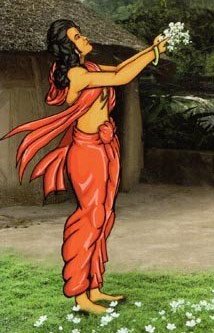
Kavya (काव्य, kavya) refers to Sanskrit poetry, a popular ancient Indian tradition of literature. There have been many Sanskrit poets over the ages, hailing from ancient India and beyond. This topic includes mahakavya, or ‘epic poetry’ and natya, or ‘dramatic poetry’.
India history and geography
Pratipadā.—(EI 24), a slab with foot-prints. Cf. Ep. Ind., Vol. XXXIII, p. 247. Note: pratipadā is defined in the “Indian epigraphical glossary” as it can be found on ancient inscriptions commonly written in Sanskrit, Prakrit or Dravidian languages.

The history of India traces the identification of countries, villages, towns and other regions of India, as well as mythology, zoology, royal dynasties, rulers, tribes, local festivities and traditions and regional languages. Ancient India enjoyed religious freedom and encourages the path of Dharma, a concept common to Buddhism, Hinduism, and Jainism.
Languages of India and abroad
Marathi-English dictionary
pratipada (प्रतिपद).—f pratipadā f The first day of the lunar fortnight.
Marathi is an Indo-European language having over 70 million native speakers people in (predominantly) Maharashtra India. Marathi, like many other Indo-Aryan languages, evolved from early forms of Prakrit, which itself is a subset of Sanskrit, one of the most ancient languages of the world.
Sanskrit dictionary
Pratipadā (प्रतिपदा).—The first day of lunar fortnight.
See also (synonyms): pratipadī.
--- OR ---
Prātipada (प्रातिपद).—a. (-dī f.)
1) Forming the commencement.
2) Produced in, or belonging to, the day called प्रतिपद् (pratipad) q. v.
Pratipadā (प्रतिपदा).—= prec. (as in Pali paṭipadā), but very much rarer; hence, where saṃdhi is ambiguous, I have assigned the doubtful forms to pratipad: dharmadeśanā- pratipadā-saṃpannaṃ…śāstāraṃ Mahāvastu iii.201.9, perfected in the practice of preaching the law; ye sarvatragāminīprati- padāṃ tatratatragāminīpratipadāṃ…prajānanti 320.14, in list of the ten bala of a Tathāgata, see pratipad, towards the end; nirvāṇagāminī °dā 201.15, 18; madhyamā °dā 331.8, 10, between the two extremes, introducing Four Noble Truths; in 12 the word mārga is omitted, text reading yad idam āryāṣṭāṅgikā, sayyathīdaṃ samyag- dṛṣṭiḥ etc.; but one ms. reads āryāṣṭāṅgikaḥ, implying mārgaḥ as in all known parallels, and the adaptation to the fem. gender of pratipad in one ms. (followed by Senart) is probably an error, resulting from the accidental omission of the noun mārgaḥ; below the usual formulas are found, duḥkhanirodhagāminī pratipad-āryasatyaṃ 331.18; tatra katamā (mss. °mo!) duḥkhanirodhagāminī pratipad āryasatyā (! so mss. and Senart), eṣaiva āryāṣṭāṅgo mārgo, etc., 332.9-10.
Pratipada (प्रतिपद).—Ind. or n. adv.
(-daṃ) 1. Step by step. 2. At every word. 3. Continually, every moment. E. prati, and pada step.
--- OR ---
Pratipadā (प्रतिपदा) or Pratipadī.—f. (-dā or dī) The first day of a lunar fortnight.
Pratipada (प्रतिपद).—(°—) & dam [adverb] at every step or word.
1) Pratipada (प्रतिपद):—[=prati-pada] n. Name of an Upāṅga
2) Pratipadā (प्रतिपदा):—[=prati-padā] [from prati-pad] f. See under pad.
3) Prātipada (प्रातिपद):—[=prāti-pada] [from prāti] mf(ī)n. ([from] -pad) forming the commencement, [Śāṅkhāyana-śrauta-sūtra]
4) [v.s. ...] m. Name of a man, [Śatruṃjaya-māhātmya]
Pratipada (प्रतिपद):—[prati-pada] (daṃ) adv. Step by step.
Pratipada (प्रतिपद):—(1. pra + pada) n. Bez. eines Upāṅga [Weber’s Indische Studien 3, 260. fg.]
--- OR ---
Pratipadā (प्रतिपदा):—und pratipadī f. = pratipad [4.] [Oxforder Handschriften 30,b, Nalopākhyāna 1. 31,a,3.]
--- OR ---
Prātipada (प्रातिपद):—(von pratipad)
1) adj. gaṇa saṃdhivelādi zu [Pāṇini’s acht Bücher 4, 3, 16.] den Anfang bildend: tṛca [Śāṅkhāyana’s Śrautasūtrāṇi 7, 19, 8.] —
2) m. Nomen proprium eines Mannes [Śatruṃjayamāhātmya 14, 303. 307.]
Pratipada (प्रतिपद):—1. —
1) n. Titel eines Upāṅga. —
2) f. ā und ī = pratipad 4).
--- OR ---
Pratipada (प्रतिपद):—2. und m Adv. —
1) bei jedem Schritt , überall , bei jeder Gelegenheit. —
2) Wort für Wort , bei jedem Wort. —
3) wörtlich , namentlich , ausdrücklich. —
4) je einzeln.
--- OR ---
Prātipada (प्रातिपद):——
1) Adj. den Anfang bildend. —
2) m. Nomen proprium eines Mannes.
Pratipāda (प्रतिपाद) in the Sanskrit language is related to the Prakrit words: Paḍipāa, Paḍipāya, Paḍivāya, Pāḍivaya.
Sanskrit, also spelled संस्कृतम् (saṃskṛtam), is an ancient language of India commonly seen as the grandmother of the Indo-European language family (even English!). Closely allied with Prakrit and Pali, Sanskrit is more exhaustive in both grammar and terms and has the most extensive collection of literature in the world, greatly surpassing its sister-languages Greek and Latin.
Hindi dictionary
Pratipadā (प्रतिपदा):—: (nf) the first day of the lunar fortnight.
...
Kannada-English dictionary
Pratipada (ಪ್ರತಿಪದ):—
1) [noun] a word that can be used as a substitute for or equivalent to another; a synonym.
2) [noun] each word (of a passage).
Kannada is a Dravidian language (as opposed to the Indo-European language family) mainly spoken in the southwestern region of India.
Nepali dictionary
Pratipada (प्रतिपद):—adv. 1. in each and every step; 2. in each and every word;
Nepali is the primary language of the Nepalese people counting almost 20 million native speakers. The country of Nepal is situated in the Himalaya mountain range to the north of India.
See also (Relevant definitions)
Partial matches (+0): Prati, Pada, Pata.
Starts with (+3): Pratipaadan-kaal, Pratipadak, Pratipadaka, Pratipadakatva, Pratipadam, Pratipadan, Pratipadana, Pratipadana-kala, Pratipadanaka, Pratipadane, Pratipadanem, Pratipadaniya, Pratipadapam, Pratipadapatha, Pratipadarshani, Pratipadarshini, Pratipadatva, Pratipadavidhana, Pratipadavidhi, Pratipadayati.
Full-text (+27): Pratipadam, Samvatsarapratipada, Pratipadatva, Pratipad, Pratipadi, Pratipadika, Patava, Bhagavadgitapratipada, Padivaya, Padipaa, Padipaya, Samvartanaka, Devatirtha, Bhimeshvara, Ayira, Apratyudavarta, Pratipat, Annakuta, Pratipatti, Balidana.
Relevant text
Search found 73 books and stories containing Pratipada, Prati-pada, Prati-padā, Prāti-pada, Pratipadā, Prātipada, Pratipāda; (plurals include: Pratipadas, padas, padās, Pratipadās, Prātipadas, Pratipādas). You can also click to the full overview containing English textual excerpts. Below are direct links for the most relevant articles:
Kathasaritsagara [Sanskrit/English] (by C. H. Tawney)
Anguttara Nikaya (Numbered Discourses)
Discourse 4.164: Paṭhamakhama-sutta < [Paṭipadā-vagga: Practice]
Discourse 4.107: Mūsika-sutta < [Valāhaka-vagga: Gods of the Clouds]
Discourse 4.102: Dutiyavalāhaka-sutta < [Valāhaka-vagga: Gods of the Clouds]
Shiva Purana [sanskrit/english]
Samyuta Nikaya (Linked Discourses)
Discourse 38.7: Vedanāpañhā-sutta < [38.1. Jambukhādaka-vagga: The Chapter with Jambukhādaka]
Discourse 38.8: Āsavapañhā-sutta < [38.1. Jambukhādaka-vagga: The Chapter with Jambukhādaka]
Digha Nikaya (Long Discourses)
3. Converging < [Discourse 13: The Three Knowledges]
Majjhima Nikaya (Middle Discourses)
Discourse 53: A Trainee < [Gahapati-vagga: The Chapter on Householders]
Discourse 152: The Development of the Faculties < [Saḷāyatana-vagga: The Chapter on the Six Senses]