Parikarman, Parikarma: 16 definitions
Introduction:
Parikarman means something in Buddhism, Pali, Hinduism, Sanskrit, Jainism, Prakrit, Marathi, Hindi. If you want to know the exact meaning, history, etymology or English translation of this term then check out the descriptions on this page. Add your comment or reference to a book if you want to contribute to this summary article.
In Hinduism
Ganitashastra (Mathematics and Algebra)
Parikarma (परिकर्म) refers to “fundamental operations” and represents one of the various subjects treated in the Hindu gaṇita (“science of calculation”).—The term gaṇita is a very ancient one and occurs copiously in Vedic literature. The Vedāṅga-jyotiṣa (c. 1200 B.C.) gives it the highest place of honour among the sciences which form the Vedāṅga: “As the crests on the heads of peacocks, as the gems on the hoods of snakes, so is gaṇita at the top of the sciences known as the Vedāṅga”. The subjects treated in the Hindu gaṇita of the early renaissance period consisted of [e.g., parikarma (“fundamental operations”)] [...].
Parikarman (परिकर्मन्) refers to a “arithmetical operation”, and represents a technical term occurring in the Gaṇitasāra-saṅgraha—an ancient Sanskrit text dealing with ancient Indian algebra and mathematical problems written by Mahāvīra (Mahāvīrācārya) in the 9th century.
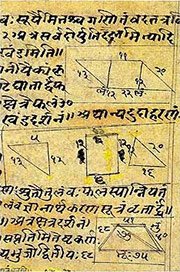
Ganita (गणित) or Ganitashastra refers to the ancient Indian science of mathematics, algebra, number theory, arithmetic, etc. Closely allied with astronomy, both were commonly taught and studied in universities, even since the 1st millennium BCE. Ganita-shastra also includes ritualistic math-books such as the Shulba-sutras.
In Buddhism
Mahayana (major branch of Buddhism)
Parikarma (परिकर्म) refers to “preparations” (i.e., ‘the twenty-four preparations to accomplish the twenty-four sorts of eloquence’), according to the Gaganagañjaparipṛcchā: the eighth chapter of the Mahāsaṃnipāta (a collection of Mahāyāna Buddhist Sūtras).—Accordingly, “Then, they [the twenty-four types of pratibhāna—‘eloquence’] are accomplished by means of the following twenty-four preparations (parikarma). What are the twenty-four? [...]”.
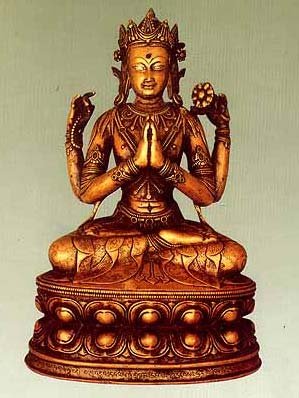
Mahayana (महायान, mahāyāna) is a major branch of Buddhism focusing on the path of a Bodhisattva (spiritual aspirants/ enlightened beings). Extant literature is vast and primarely composed in the Sanskrit language. There are many sūtras of which some of the earliest are the various Prajñāpāramitā sūtras.
In Jainism
General definition (in Jainism)
Parikarma (परिकर्म) refers to one of the five parts of Dṛṣṭivāda: one of the twelve limbs of the internal-corpus (aṅga-praviṣṭa). The Aṅgapraviṣṭa refers to one of the two types of scriptural knowledge (śruta), which refers to one of the five types of knowledge (jñāna). according to the 2nd-century Tattvārthasūtra 1.20, “scriptural knowledge (śruta) preceded by sensory knowledge (mati) is of two, or of twelve (e.g., dṛṣṭivāda) or of many kinds”.
How many sub divisions of parikarma are there? There are five sub divisions of parikarma, namely: Vyāykhyā-prajñapti, Dvīpasāgara-prajñapti, Jambūdvīpa-prajñapti, Sūrya-prajñapti and Candra-prajñapti.

Jainism is an Indian religion of Dharma whose doctrine revolves around harmlessness (ahimsa) towards every living being. The two major branches (Digambara and Svetambara) of Jainism stimulate self-control (or, shramana, ‘self-reliance’) and spiritual development through a path of peace for the soul to progess to the ultimate goal.
Languages of India and abroad
Marathi-English dictionary
parikarma (परिकर्म).—n S A preparatory, appendent, or appertaining work or act. 2 An elementary rule in arithmetic; any one of eight. Vide infra.
Marathi is an Indo-European language having over 70 million native speakers people in (predominantly) Maharashtra India. Marathi, like many other Indo-Aryan languages, evolved from early forms of Prakrit, which itself is a subset of Sanskrit, one of the most ancient languages of the world.
Sanskrit dictionary
Parikarman (परिकर्मन्).—m. A servant. -n.
1) Painting or perfuming the body, personal decoration, dressing, toilet; कृताचारपरिकर्माणम् (kṛtācāraparikarmāṇam) Ś.2.
2) Painting or dyeing the foot; असमाप्ते परिकर्मणि स्मृतः (asamāpte parikarmaṇi smṛtaḥ) Kumārasambhava 4.19.
3) Preparation.
4) Worship, adoration; अविक्लमस्ते परिकर्मणि स्थितः (aviklamaste parikarmaṇi sthitaḥ) Bhāg. 2.9.29.
5) (In Yoga phil.) Purifying, a means of purifying the mind; मैञ्यादिचित्तपरिकर्मविदो विधाय क्लेशप्रहाण- मिह लब्धसबीजयोगाः (maiñyādicittaparikarmavido vidhāya kleśaprahāṇa- miha labdhasabījayogāḥ) Śiśupālavadha 4.55. (see Malli. thereon).
6) An arithmetical operation (of which there are 8 divisions).
Parikarman (परिकर्मन्).—i. e. pari -kṛ + man, I. m. A servant. Ii. n. 1. Adoration, [Bhāgavata-Purāṇa, (ed. Burnouf.)] 2, 9, 29. 2. Personal decoration, dressing, painting, or perfuming the body, [Kumārasaṃbhava, (ed. Stenzler.)] 4, 19. 3. Preparation, [Kathāsaritsāgara, (ed. Brockhaus.)] 22, 101.
Parikarman (परिकर्मन्).—[neuter] the being about or intent upon something, preparation for (—°), attendance, worship, veneration, care, [especially] of the body, as anointing, perfuming, toilet i.[grammar]
1) Parikarman (परिकर्मन्):—[=pari-karman] [from pari-kṛ] m. a servant, assistant, [cf. Lexicographers, esp. such as amarasiṃha, halāyudha, hemacandra, etc.]
2) [v.s. ...] n. attendance, worship, adoration, [Bhāgavata-purāṇa]
3) [v.s. ...] dressing, painting or perfuming the body ([especially] after bathing), [Mahābhārata; Kālidāsa]
4) [v.s. ...] cleansing, purification, [Śiśupāla-vadha]
5) [v.s. ...] preparation, [Kathāsaritsāgara] (cf. kara)
6) [v.s. ...] arithmetical computation or operation, [Horace H. Wilson]
Parikarman (परिकर्मन्):—[pari-karman] (rmma) 5. n. Personal decoration, or perfuming; computation. m. A servant or slave.
Parikarman (परिकर्मन्):—(von 1. kar mit pari oder pari + ka)
1) m. Gehülfe, Diener [Ratnamālā im Śabdakalpadruma] Vielleicht ist hierher zu ziehen [KĀM. NĪTIS. 4, 35], wenn parikarma svadākṣyam verbunden wird. Vgl. parikarmin . —
2) n. a) das Herumsein um Jmd, Cult, Verehrung: te parikarmaṇi sthitaḥ [Bhāgavatapurāṇa 2, 9, 29. 4, 23, 11.] dattam (Nomen proprium) — ārādhya parikarmabhiḥ [9, 15, 17.] — b) Pflege des Körpers, das Salben und Schmücken desselben [Amarakoṣa 2, 6, 3, 22.] [Hemacandra’s Abhidhānacintāmaṇi 635.] prasādaṃ kuru tanvaṅgi kriyatāṃ parikarma te . bhajasva mām [Mahābhārata 3, 16173.] [Kumārasaṃbhava 4, 19.] Reinigung, Reinigungsmittel: maitryādicittaparikarmavid [Śiśupālavadha 4, 55.] — c) Vorbereitungen (vgl. parikara 3): kṛtādhva [Kathāsaritsāgara 22, 101.] der alle Mühen des Weges wegzuräumen bemüht war [BROCKHAUS.] — d) eine arithmetische Operation [Algebra 277. 286. 339.] parikarmāṣṭaka die acht arithmetischen Operationen: Addition, Subtraction, Multiplication, Division, Erhebung zur 2ten Potenz, das Ausziehen der Quadratwurzel, Erhebung zur 3ten Potenz, das Ausziehen der Kubikwurzel, 5. bhinnaparikarmāṣṭaka, abhinna 16. — e) bei den Jaina Name eines der 5 Theile des dṛṣṭivāda; nach dem Schol. parikarma n.
Parikarman (परिकर्मन्):—1. n. —
1) das Herumsein um Jmd , Cult , Verehrung. —
2) Pflege des Körpers , das Salben und Schmücken desselben. —
3) Reinigung , Reinigungsmittel —
4) Vorbereitungen zu (im Comp. vorangehend). —
5) eine arithmetische Operation. —
6) bei den Jaina einer der 5 Theile des Dṛṣṭivāda [Hemacandra's Abhidhānacintāmaṇi 246.]
--- OR ---
Parikarman (परिकर्मन्):—2. m. Gehülfe , Diener. Vgl. parikarmin.
Parikarman (परिकर्मन्) in the Sanskrit language is related to the Prakrit words: Paḍikamma, Parikamma, Parikammaṇa.
Sanskrit, also spelled संस्कृतम् (saṃskṛtam), is an ancient language of India commonly seen as the grandmother of the Indo-European language family (even English!). Closely allied with Prakrit and Pali, Sanskrit is more exhaustive in both grammar and terms and has the most extensive collection of literature in the world, greatly surpassing its sister-languages Greek and Latin.
Hindi dictionary
Parikarma (परिकर्म) [Also spelled parikarm]:—(nm) make-up.
...
Kannada-English dictionary
Parikarma (ಪರಿಕರ್ಮ):—
1) [noun] the act of putting on clothes ornaments, and using cosmetics to beautify oneself.
2) [noun] that which is used to enhance the beauty, as an ornament.
3) [noun] a religious service; worship.
4) [noun] the act of cleaning; cleansing.
5) [noun] a menial servant.
6) [noun] (math.) any process, as addition, division, etc., involving a change or transformation in a quantity; a mathematical operation.
Kannada is a Dravidian language (as opposed to the Indo-European language family) mainly spoken in the southwestern region of India.
Nepali dictionary
Parikarma (परिकर्म):—n. 1. painting the body; personal decoration; 2. painting or dying the foot; 3. preparation; 4. worship; adoration;
Nepali is the primary language of the Nepalese people counting almost 20 million native speakers. The country of Nepal is situated in the Himalaya mountain range to the north of India.
See also (Relevant definitions)
Partial matches (+0): Karma, Pari.
Starts with (+0): Parikarmana, Parikarmashtaka.
Full-text (+66): Parikarmashtaka, Bhinnaparikarman, Parikarmakatha, Cittaparikarmam, Kritaparikarman, Purvaparikarman, Kritaparikarma, Snanaparikarman, Bhumiparikarman, Parikarmabhavana, Cittaparikarman, Parikarmakrita, Parikarmana, Parikarmin, Padikamma, Parikamma, Parikarmaya, Parikammana, Parikarm, Parikarmika.
Relevant text
Search found 22 books and stories containing Parikarman, Pari-karma, Pari-karmā, Pari-karman, Parikarma, Parikarmā; (plurals include: Parikarmans, karmas, karmās, karmans, Parikarmas, Parikarmās). You can also click to the full overview containing English textual excerpts. Below are direct links for the most relevant articles:
International Ayurvedic Medical Journal
Chitta parikarma of yoga darshana and its application in the ayurveda < [2021, Issue 10, October]
Gommatsara by Acharya Nemichandra (by Bai Bahadur J. L. Jaini)
Part 4.1 - The Twelve Angas < [Introduction (volume 1)]
Chapter 12 - The concept of Jnana margana (Knowledge Soul Quest) < [Volume 1 - Jiva-kanda (the soul)]
Index < [Volume 1 - Jiva-kanda (the soul)]
Ganita-sara-sangraha by Mahavira-Acharya (by M. Rangacharya)
Chapter 2 - Arithmetical operations (parikarma-vyavahara) < [Part 1 - English translation]
Chapter 1 - Samjnadhikarah < [Part 2 - Sanskrit text]
Appendix 2 - Sanskrit words used in the Translation and their explanation
Dictionaries of Indian languages (Kosha)
Page 192 < [Hindi-English-Nepali (1 volume)]
The Sanskrit Buddhist Literature of Nepal (by Rajendralala Mitra)
Page 231 < [The Sanskrit Buddhist Literature of Nepal (pages)]
Page 267 < [The Sanskrit Buddhist Literature of Nepal (pages)]
Brahmasphutasiddhanta by Brahmagupta (Introduction) (by Acharyavara Ram Swarup Sharma)
Part 3 - Operations and Determinations in Patiganita < [Chapter 9 - Brahmagupta and Arithmetic]