Padmapatra, Padmapātra: 11 definitions
Introduction:
Padmapatra means something in Hinduism, Sanskrit, biology. If you want to know the exact meaning, history, etymology or English translation of this term then check out the descriptions on this page. Add your comment or reference to a book if you want to contribute to this summary article.
In Hinduism
Purana and Itihasa (epic history)
Padmapatra (पद्मपत्र) refers to “lotus petals” (used to describe the decoration of Śiva’s assembly room), according to the Śivapurāṇa 2.5.30 (“Prayer to the lord of gods”).—Accordingly: “[While describing the assembly room of Śivaloka]: Going in, they saw the grand assembly chamber of Śiva, highly decorated and thronged by his attendants with lustrous bodies. [...] The chamber was square in shape and beautiful like the lunar sphere. Gems, necklaces, diamonds, etc. increased its brilliance. Valuable precious stones were used to stud them. It was brightened by lotus petals (padmapatra). [amūlyaratnaracitāṃ padmapatraiśca śobhitām] Māṇikya, Padmarāga and other valuable gems were used in the same. It was very wonderful. It was laid according to the desire of Śiva. [...]”.
Padmapātra (पद्मपात्र).—The Gandharvas and the Apsarasas milked the earth making Citraratha the calf; milkman Śucī Viśvavasu.*
- * Vāyu-purāṇa 62. 187.
The Purana (पुराण, purāṇas) refers to Sanskrit literature preserving ancient India’s vast cultural history, including historical legends, religious ceremonies, various arts and sciences. The eighteen mahapuranas total over 400,000 shlokas (metrical couplets) and date to at least several centuries BCE.
Shaivism
Padmapatra (पद्मपत्र) refers to the “petal of a lotus”, according to the Mālinīvijayottaratantra, chapter 18 (“appropriate conduct of the accomplished Yogin”) verses 18.74-81 (as quoted in the Tantrāloka verse 4.213-221ab).—Accordingly, “[...] Moreover, the one whose consciousness is fixed on reality, partaking even in the pleasures of the senses, is not touched by bad consequences, just as the petal of a lotus (padmapatra) (is not affected) by water. The Yogin who has great understanding is the one who is similar to the person who, armed with mantras that counteract poison and the like, is not deluded by the poison even while devouring it”.
Padmapatra (पद्मपत्र) refers to a “lotus petal”, according to the Netratantra of Kṣemarāja: a Śaiva text from the 9th century in which Śiva (Bhairava) teaches Pārvatī topics such as metaphysics, cosmology, and soteriology.—Accordingly, [verse 13.1-9, while describing the appearance and worship of Viṣṇu, in the form of Nārāyaṇa]—“Thus, [I have] spoken the kaulika rule of the mantrarāṭ. I again shall tell another method by which [the deity] grants fruits. He should always think of the four-armed Nārāyaṇa arising. [Nārāyaṇa has] two, long, lotus petal eyes (padmapatra-āyatekṣaṇa), one face, has the appearance of a [blue] linseed flower, [and is] adorned with all [of his] instruments: a conch, discus, mace, and lotus. [...]”.
Shaiva (शैव, śaiva) or Shaivism (śaivism) represents a tradition of Hinduism worshiping Shiva as the supreme being. Closely related to Shaktism, Shaiva literature includes a range of scriptures, including Tantras, while the root of this tradition may be traced back to the ancient Vedas.
Shilpashastra (iconography)
Padmapatra (पद्मपत्र) refers to the “petal of lotus flower” and represents one of the five different types of Eyes, according to the Viṣṇudharmottarapurāṇa, an ancient Sanskrit text which (being encyclopedic in nature) deals with a variety of cultural topics such as arts, architecture, music, grammar and astronomy.—The forth variety of eye should be in the shape of padmapatra i.e., petal of lotus flower and the size should be nine yavas. In the Kumārasambhava, Pārvatī is referred to utpalākṣyā i.e., one with the eyes in the shape of utpala i.e., lotus. The Viṣṇudharmottarapurāṇa states that the eyes of the scared and lamenting person should be in the shape of lotus petal.
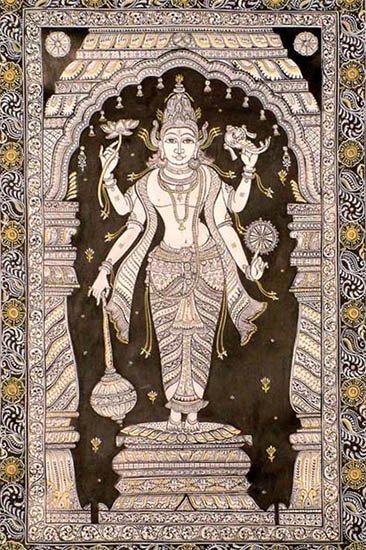
Shilpashastra (शिल्पशास्त्र, śilpaśāstra) represents the ancient Indian science (shastra) of creative arts (shilpa) such as sculpture, iconography and painting. Closely related to Vastushastra (architecture), they often share the same literature.
Biology (plants and animals)
Padmapatra [ಪದ್ಮಪತ್ರ] in the Kannada language is the name of a plant identified with Hellenia speciosa (J.Koenig) S.R.Dutta from the Costaceae (Spiral Ginger) family having the following synonyms: Costus speciosus, Cheilocostus speciosus, Amomum arboreum. For the possible medicinal usage of padmapatra, you can check this page for potential sources and references, although be aware that any some or none of the side-effects may not be mentioned here, wether they be harmful or beneficial to health.
Padmapatra in the Sanskrit language is the name of a plant identified with Inula racemosa Hook. f. from the Asteraceae (Sunflower) family.
1) Padmapatra in India is the name of a plant defined with Cheilocostus speciosus in various botanical sources. This page contains potential references in Ayurveda, modern medicine, and other folk traditions or local practices It has the synonym Banksea speciosa J. König (among others).
2) Padmapatra is also identified with Inula racemosa It has the synonym Inula royleana C.B. Clarke, nom. illeg. (etc.).
Example references for further research on medicinal uses or toxicity (see latin names for full list):
· Revisio Generum Plantarum (1891)
· Queensland Agricultural Journal (1898)
· Nucleus (1975)
· Transactions of the Linnean Society of London (1791)
· Systema Naturae, ed. 13 (1791)
· Species Plantarum (1753)
If you are looking for specific details regarding Padmapatra, for example diet and recipes, health benefits, side effects, pregnancy safety, chemical composition, extract dosage, have a look at these references.
This sections includes definitions from the five kingdoms of living things: Animals, Plants, Fungi, Protists and Monera. It will include both the official binomial nomenclature (scientific names usually in Latin) as well as regional spellings and variants.
Languages of India and abroad
Sanskrit dictionary
Padmapatra (पद्मपत्र).—n.
(-traṃ) A sort of Costus, (C. specious.) E. padma a lotus, and patra a leaf; also padmaparṇa n.
(-rṇaṃ) from parṇa a leaf.
Padmapatra (पद्मपत्र):—[padma-patra] (traṃ) 1. n. A sort of costus.
Padmapatra (in Sanskrit) can be associated with the following Chinese terms:
1) 蓮華 [lián huá]: “lotus flower”.
Note: padmapatra can be alternatively written as: padma-patra.
Sanskrit, also spelled संस्कृतम् (saṃskṛtam), is an ancient language of India commonly seen as the grandmother of the Indo-European language family (even English!). Closely allied with Prakrit and Pali, Sanskrit is more exhaustive in both grammar and terms and has the most extensive collection of literature in the world, greatly surpassing its sister-languages Greek and Latin.
Kannada-English dictionary
Padmapatra (ಪದ್ಮಪತ್ರ):—
1) [noun] a leaf of a lotus plant.
2) [noun] a petal of a lotus flower.
3) [noun] the plant Costus speciosus of Zingiberaceae family; mountin sweet flag.
Kannada is a Dravidian language (as opposed to the Indo-European language family) mainly spoken in the southwestern region of India.
See also (Relevant definitions)
Partial matches (+0): Patra, Padma.
Starts with (+0): Padmapatramulira.
Full-text (+0): Padma, Lotus petal, Lian hua, Mallikaksha, Petal, Utpala, Mallikakhya, Lamenting, Scared, Ayatekshana, Ayata, Kaumari, Lotus.
Relevant text
Search found 25 books and stories containing Padmapatra, Padma-patra, Padmapātra; (plurals include: Padmapatras, patras, Padmapātras). You can also click to the full overview containing English textual excerpts. Below are direct links for the most relevant articles:
Garga Samhita (English) (by Danavir Goswami)
Verse 3.1.30 < [Chapter 1 - The Worship of Śrī Girirāja]
Verse 2.16.8 < [Chapter 16 - The Worship of Tulasī]
Verse 4.19.137 < [Chapter 19 - A Thousand Names of Srī Yamunā]
Bhagavad-gita (with Vaishnava commentaries) (by Narayana Gosvami)
Verse 5.10 < [Chapter 5 - Karma-sannyāsa-yoga (Yoga through Renunciation of Action)]
Verse 2.38 < [Chapter 2 - Sāṅkhya-yoga (Yoga through distinguishing the Soul from the Body)]
Brahma Sutras (Govinda Bhashya) (by Kusakratha das Brahmacari)
Sūtra 3.4.30 < [Adhyaya 3, Pada 4]
Amarakoshodghatana of Kshirasvamin (study) (by A. Yamuna Devi)
Flora (10): Roots < [Chapter 5 - Aspects of Nature]
A Descriptive Catalogue of the Sanskrit Manuscripts, Madras (by M. Seshagiri Sastri)
Page 167 < [Volume 23 (1918)]
Bhagavad Gita in contemporary perspective (study) (by Tapan Dutta)
Needs the Yoga of Renunciation < [Chapter 4 - Contemporary relevance of the teachings of the Śrīmadbhagavadgītā]