Narayaniya, Nārāyaṇīya: 8 definitions
Introduction:
Narayaniya means something in Hinduism, Sanskrit. If you want to know the exact meaning, history, etymology or English translation of this term then check out the descriptions on this page. Add your comment or reference to a book if you want to contribute to this summary article.
Images (photo gallery)
In Hinduism
Purana and Itihasa (epic history)
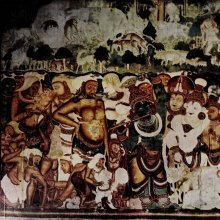
Nārāyaṇīya (नारायणीय) section of the Mahābhārata is named after the main deity Nārāyaṇa who is glorified throughout the treatise. He is explained as supreme teacher and soul of the universe. He reclines on Śeṣa in Yoganidrā in primeval waters symbolising eternity. Bhīṣma in response to Yudhiṣṭhara’s question explains that his father told him that Nārāyaṇa is the soul of the entire world, caturmūrtī and sanātana god. Nārāyaṇa took birth as the son of Dharma along with Nara, Hari, and Kṛṣṇa. Amongst his four incarnations in the satyayuga of svāmbhuva manvaṅtara, Nara and Nārāyaṇa performed severe austerities at their āśrama in Badari.

The Purana (पुराण, purāṇas) refers to Sanskrit literature preserving ancient India’s vast cultural history, including historical legends, religious ceremonies, various arts and sciences. The eighteen mahapuranas total over 400,000 shlokas (metrical couplets) and date to at least several centuries BCE.
Pancaratra (worship of Nārāyaṇa)
Nārāyaṇīya (नारायणीय) or Nārāyaṇīyasaṃhitā is the name of an ancient Pāñcarātra Saṃhitā mentioned in the Hayaśīrṣasaṃhitā: a large Pāñcarātra Āgama consisting of roughly 6500 verses dealing primarily with architecture, temple-building and consecration rituals and iconography.—The passage listing these titles concludes by saying that originally there were only these twenty-five. Later on, however, saṃhitā-works multiplied in numbers. But all of them are to be understood to be derived from the ones named above.
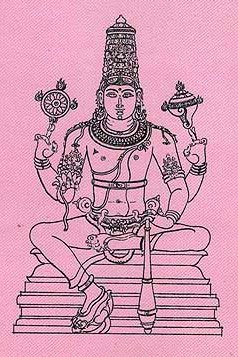
Pancaratra (पाञ्चरात्र, pāñcarātra) represents a tradition of Hinduism where Narayana is revered and worshipped. Closeley related to Vaishnavism, the Pancaratra literature includes various Agamas and tantras incorporating many Vaishnava philosophies.
Shilpashastra (iconography)
Nārāyaṇīya (नारायणीय) refers to one of the works included in the Śilpasaṅgraha—a Sanskrit compilation containing various works on Śilpa, giving detailed rules for the construction of temples and for the making, for purposes of worship, of images of various deities, a description of which is added.
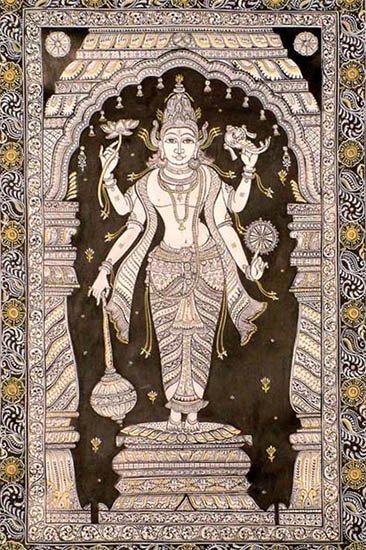
Shilpashastra (शिल्पशास्त्र, śilpaśāstra) represents the ancient Indian science (shastra) of creative arts (shilpa) such as sculpture, iconography and painting. Closely related to Vastushastra (architecture), they often share the same literature.
Languages of India and abroad
Sanskrit dictionary
Nārāyaṇīya (नारायणीय).—i. e. nārāyaṇa + īya, adj. Referring to Nārāyaṇa, Mahābhārata 12, 13422.
1) Nārāyaṇīya (नारायणीय) as mentioned in Aufrecht’s Catalogus Catalogorum:—Taylor. 1, 482.
—from Karṇaparvan (ch. 33). Burnell. 202^a.
Nārāyaṇīya has the following synonyms: Īśvarastotra.
2) Nārāyaṇīya (नारायणीय):—stotra, by Nārāyaṇa Bhaṭṭa of Kerala. As. Soc. of Greatbritain 1884, 449. Oppert. 2625. 2867. 4313. 6021. Rice. 286.
—[commentary] Bhaktidīpikā. Oppert. 6022.
—[commentary] by Kṛṣṇa Śāstrin. Oppert. 2626.
3) Nārāyaṇīya (नारायणीय):—śr. by Nārāyaṇa. Hz. 687 (an obscure entry).
1) Nārāyaṇīya (नारायणीय):—[from nāra] mfn. relating to Nārāyaṇa (also -ka, [Agni-purāṇa]), treating of him, [Mahābhārata]
2) [v.s. ...] n. Name of sub voce works.
Nārāyaṇīya (नारायणीय):—(von nārāyaṇa) adj. f. ā zu Nārāyaṇa in Beziehung stehend, über ihn handelnd u.s.w.: ākhyāna [Mahābhārata 12, 13442.] upaniṣad [Weber’s Indische Studien 1, 75. 2, 79.] Ohne weiteren Zusatz als Bez. eines Werkes [Oxforder Handschriften 95,a,37.]
Nārāyaṇīya (नारायणीय):——
1) Adj. (f. ā) zu Nārāyaṇa in Beziehung stehend , von ihm handelnd u.s.w. —
2) n. Titel verschiedener Werke [Private libraries (Gustav) 1.] vyākhyā f. und vyākhyābhaktidīpikā f. desgl. [ebend.]
Sanskrit, also spelled संस्कृतम् (saṃskṛtam), is an ancient language of India commonly seen as the grandmother of the Indo-European language family (even English!). Closely allied with Prakrit and Pali, Sanskrit is more exhaustive in both grammar and terms and has the most extensive collection of literature in the world, greatly surpassing its sister-languages Greek and Latin.
See also (Relevant definitions)
Starts with (+0): Narayaniya kavya, Narayaniya stotra, Narayaniyabija, Narayaniyaka, Narayaniyam, Narayaniyasamhita, Narayaniyatantra, Narayaniyavyakhya, Narayaniyopanishad.
Full-text (+0): Narayaniyabija, Vidyaranyanarayaniya, Narayaniyatantra, Narayaniyopanishad, Tirunarayaniyam, Narayaniyam, Narayaniyavyakhya, Harinarayaniya, Narayaniya kavya, Viranarayaniya, Narayaniya stotra, Narayaniyasamhita, Narayana kavi, Pramshu, Ishvarastotra, Shilpasamgraha, Citrashikhandin, Varakam, Ranganatha, Narayana-bhatta.
Relevant text
Search found 49 books and stories containing Narayaniya, Nārāyaṇīya; (plurals include: Narayaniyas, Nārāyaṇīyas). You can also click to the full overview containing English textual excerpts. Below are direct links for the most relevant articles:
Dictionaries of Indian languages (Kosha)
Page 570 < [Malayalam-English-Kannada (1 volume)]
Page 456 < [Kannada-English-Malayalam (1 volume)]
Page 233 < [Telugu-English-Malayalam (1 volume)]
A Descriptive Catalogue of the Sanskrit Manuscripts, Madras (by M. Seshagiri Sastri)
Soundarya Lahari of Shri Shankara (Study) (by Seetha N.)
Kerala’s contribution to Stotra Literature < [Chapter 1 - Introduction]
Concept of Bhakti (Devotion) < [Chapter 1 - Introduction]
Annadatri-carita (study) (by Sarannya V.)
7. Influences and Adaptations < [Chapter 3 - An Introduction to Annadatri-carita]
Narayaniya (Narayaneeyam) (by Vishwa Adluri)
Vedic influence on the Sun-worship in the Puranas (by Goswami Mitali)
Part 5 - Semi-Vedic Religious System < [Chapter 3 - General Characteristics of the Purāṇic Religion and its Link with the Vedic Tradition]