Nabhicakra, Nābhicakra, Nabhi-cakra: 7 definitions
Introduction:
Nabhicakra means something in Buddhism, Pali, Hinduism, Sanskrit. If you want to know the exact meaning, history, etymology or English translation of this term then check out the descriptions on this page. Add your comment or reference to a book if you want to contribute to this summary article.
Alternative spellings of this word include Nabhichakra.
In Hinduism
Purana and Itihasa (epic history)
Nābhicakra (नाभिचक्र) refers to the “umbilical region”, from where Satī lifted up the udāna-wind while in a yogic trance, according to the Śivapurāṇa 2.2.30. Accordingly as Brahmā narrated to Nārada:—“[...] having sipped water duly, covering up her body entirely with her cloth she closed her eyes and remembered her lord. She then entered the yogic trance. Keeping her face steady she balanced the winds Prāṇa and Apāna. She then lifted up the wind Udāna from the umbilical region (nābhicakra), stabilised it in the cardiac region took it through the throat and finally fixed it in the middle of the eyebrows. She desired to cast-off her body due to her anger with Dakṣa. She desired to burn off the body and retain the pure wind by yogic means. In this posture she remembered the feet of her lord and nothing else”.
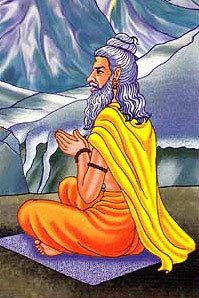
The Purana (पुराण, purāṇas) refers to Sanskrit literature preserving ancient India’s vast cultural history, including historical legends, religious ceremonies, various arts and sciences. The eighteen mahapuranas total over 400,000 shlokas (metrical couplets) and date to at least several centuries BCE.
Pancaratra (worship of Nārāyaṇa)
Nābhicakra (नाभिचक्र) refers to the “fire-reservoir in the middle of the body”, as discussed in the thirty-second chapter of the Ahirbudhnyasaṃhitā, a Pāñcarātra work in 60 chapters dealing with topics such as Viṣṇu’s discus-power, the processes of creation and esoteric practices related to Sudarśana (such as mantras and yantras).—Description of the chapter [nāḍīśuddhi-vāyujaya-yogāṅga-prāṇāyāmādi-pañcakanirūpaṇa]: Nārada wants to know about prāṇāyāma-breathing exercises. He is told that when a man is divided into ninety-six parts, right in the middle forty-eighth space is a fire-reservoir—and this is called the “nāḍīcakra” or “nābhicakra”. The epicenter of this has twelve spokes whence spring two of the body’s most important nerves. From this center radiate out through the body the 27,000 nerves (nāḍī). But control of only three of these brings about control of the rest (1-22). [...]
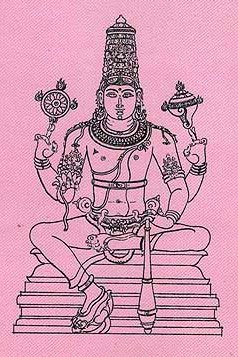
Pancaratra (पाञ्चरात्र, pāñcarātra) represents a tradition of Hinduism where Narayana is revered and worshipped. Closeley related to Vaishnavism, the Pancaratra literature includes various Agamas and tantras incorporating many Vaishnava philosophies.
In Buddhism
Tibetan Buddhism (Vajrayana or tantric Buddhism)
Nābhicakra (नाभिचक्र) refers to the “discus in the navel”, according to the Gaṇacakravidhi attributed to Ratnākaraśānti.—[Translation by Péter-Dániel Szántó in his Minor Vajrayāna texts V]—Accordingly, [verse13-15]: “[...] Thereafter, the deity [in form of a] drop, the great pervasive Lord located on a moon-disk in the heart, or one’s chosen deity, etc. adorned with the retinue should be bathed by oozing streams of nectar (sudhādhāra-ambu) [emitted from the substances blazing with] rays [owing to their] having been agitated by the three realities (i.e., three mantras) placed on the tip of the tongue in a small quantity by the [joined] tips of the ring finger and the thumb. Gradually drawing in that nectar (rasa) with subtle sounds (or: channels) arising from the discus in the navel (nābhicakra-utthita), after having taken three sips, the great Yogin(s) should rest at ease”.
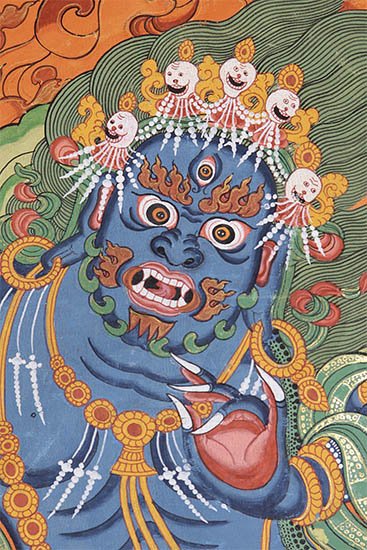
Tibetan Buddhism includes schools such as Nyingma, Kadampa, Kagyu and Gelug. Their primary canon of literature is divided in two broad categories: The Kangyur, which consists of Buddha’s words, and the Tengyur, which includes commentaries from various sources. Esotericism and tantra techniques (vajrayāna) are collected indepently.
Languages of India and abroad
Sanskrit dictionary
Nābhicakra (नाभिचक्र):—[=nābhi-cakra] [from nābhi > nābh] n. (magical) navel-circle, [Catalogue(s)]
Nābhicakra (नाभिचक्र):—n. Nabelkreis (in der Mystik) [Oxforder Handschriften 230,b,36. fgg.]
Nābhicakra (नाभिचक्र):—n. Nabelkreis (in der Mystik).
Nābhicakra (in Sanskrit) can be associated with the following Chinese terms:
1) 臍輪 [qí lún]: “navel cakra”.
Sanskrit, also spelled संस्कृतम् (saṃskṛtam), is an ancient language of India commonly seen as the grandmother of the Indo-European language family (even English!). Closely allied with Prakrit and Pali, Sanskrit is more exhaustive in both grammar and terms and has the most extensive collection of literature in the world, greatly surpassing its sister-languages Greek and Latin.
See also (Relevant definitions)
Partial matches (+0): Nabhi, Cakra.
Full-text (+0): Cakranabhi, Qi lun, Nadicakra, Pranapana, Ida, Shatacakrabheda, Nadishuddhivayujayayogangapranayamadipancakanirupana, Nadi.
Relevant text
Search found 14 books and stories containing Nabhicakra, Nābhicakra, Nabhi-cakra, Nābhi-cakra; (plurals include: Nabhicakras, Nābhicakras, cakras). You can also click to the full overview containing English textual excerpts. Below are direct links for the most relevant articles:
Yoga-sutra with Bhashya Vivarana (study) (by Susmi Sabu)
Eight limbs of Yoga (ashtanga yoga) < [Chapter 4 - Textual Examination of the Text]
Outcome of Samyama when practiced in different objects < [Chapter 4 - Textual Examination of the Text]
Rig Veda (translation and commentary) (by H. H. Wilson)
Rig Veda 1.164.2 < [Sukta 164]
Preksha meditation: History and Methods (by Samani Pratibha Pragya)
4.2. Elements and Sources from Hindu Yoga Systems < [Chapter 4 - Theory and Methods of Prekṣā-Dhyāna]
Dictionaries of Indian languages (Kosha)
Page 43 < [Hindi-Assamese-English Volume 2]
Yogashikha Upanishad (critical study) (by Sujatarani Giri)
Part 1.2 - The Purpose of Awakening (Kuṇḍalinī) < [Chapter 4 - Concept of Kuṇḍalinī in Yogaśikhopaniṣad]
Part 1.3 - The Human Body according to Yoga Śikhopaniṣad < [Chapter 3 - Yogaśikhopaniṣad and its Nature]
Yoga Upanishads (study) (by Heena B. Kotak)
Part 4.4 - Description of the Plexus (Cakra) < [Chapter 3 - Analytical and Critical study of 20 Yoga-Upanishads]
Part 4.5 - Kundalini (the serpent power) according to the Yoga-upanishads < [Chapter 3 - Analytical and Critical study of 20 Yoga-Upanishads]