Maudgalyayana, Maudgalyāyana: 7 definitions
Introduction:
Maudgalyayana means something in Buddhism, Pali, Jainism, Prakrit, Hinduism, Sanskrit. If you want to know the exact meaning, history, etymology or English translation of this term then check out the descriptions on this page. Add your comment or reference to a book if you want to contribute to this summary article.
Images (photo gallery)
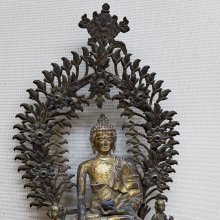
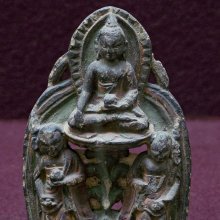
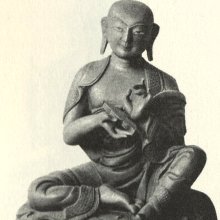
In Buddhism
Tibetan Buddhism (Vajrayana or tantric Buddhism)
Maudgalyāyana (मौद्गल्यायन) is the name of a Śrāvaka mentioned as attending the teachings in the 6th century Mañjuśrīmūlakalpa: one of the largest Kriyā Tantras devoted to Mañjuśrī (the Bodhisattva of wisdom) representing an encyclopedia of knowledge primarily concerned with ritualistic elements in Buddhism. The teachings in this text originate from Mañjuśrī and were taught to and by Buddha Śākyamuni in the presence of a large audience (including Maudgalyāyana).
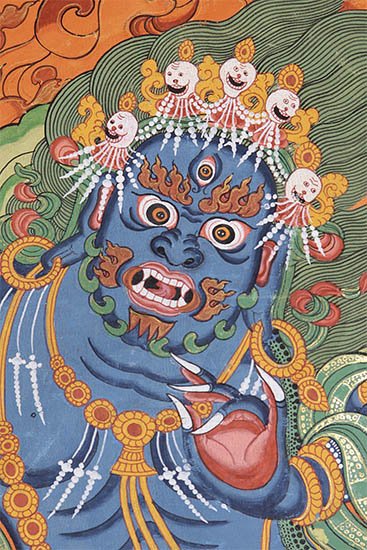
Tibetan Buddhism includes schools such as Nyingma, Kadampa, Kagyu and Gelug. Their primary canon of literature is divided in two broad categories: The Kangyur, which consists of Buddha’s words, and the Tengyur, which includes commentaries from various sources. Esotericism and tantra techniques (vajrayāna) are collected indepently.
General definition (in Buddhism)
See Ten Great Disciples of Shakyamuni.Languages of India and abroad
Sanskrit dictionary
Maudgalyāyana (मौद्गल्यायन).—(1) also Mahā-m°, = Pali Moggal-lāna, gotra-name and usual appellation of Kolita, often paired with Śāriputra as leading disciples of the Buddha: story of his conversion, Mahāvastu iii.56.16 ff.; 57.18 etc.; the forms without and with Mahā- often interchange in the same passage and sometimes without significance, but the Buddha himself always speaks of or to him as Maud° (without Mahā-), e.g. in contexts where Mahā- is usually prefixed, Divyāvadāna 160.13, 17; 299.16 (but in 18 Ānanda calls him Mahā-m°); Avadāna-śataka ii.91.15; Aśoka refers to him without Mahā-, but in a verse, Divyāvadāna 395.20; other cases without Mahā-, Mahāvyutpatti 1033; Divyāvadāna 50.29 ff.; 182.22; 268.6; 314.15; 486.25; Avadāna-śataka i.241.7 etc.; Sukhāvatīvyūha 31.3; Karmavibhaṅga (and Karmavibhaṅgopadeśa) 161.18; et passim; (2) pl., name of a brahmanical gotra: Divyāvadāna 635.13; compare Maudgalyāyanīgotreṇa, of the nakṣatra Uttarāṣāḍha, Divyāvadāna 640.22.
Maudgalyāyana (मौद्गल्यायन):—[from maudgali] m. ([patronymic] [from] Prec.) Name of a pupil of Gautama Buddha, [Lalita-vistara]
Maudgalyāyana (मौद्गल्यायन):—(patron. von maudgalya) m. Nomen proprium eines Schulers Śākyamuni’s [Rgva tch’er rol pa ed. Calc. 1, 13.] [Lot. de Lassen’s Anthologie b. l. 1. 490.] [Burnouf 181. fg. 269. 312. 390. fg. 448. 564.] [WASSILJEW 21 u.s.w.]
Maudgalyāyana (मौद्गल्यायन):—m. Patron. Nomen proprium eines Schulers Śākyamuni's.
Maudgalyāyana (in Sanskrit) can be associated with the following Chinese terms:
1) 勿伽羅 [wù jiā luó]: “Maudgalyāyana” [Sanskrit personal name].
2) 勿伽羅子 [wù jiā luó zi]: “Maudgalyāyana” [Sanskrit personal name].
3) 採菽氏 [cǎi shū shì]: “Maudgalyāyana” [Sanskrit personal name].
4) 摩訶羅夜那 [mó hē luó yè nà]: “Maudgalyāyana” [Sanskrit personal name].
5) 沒力伽羅子 [méi lì jiā luó zi]: “Maudgalyāyana” [Sanskrit personal name].
6) 沒特伽羅子 [méi tè jiā luó zi]: “Maudgalyāyana” [Sanskrit personal name].
7) 目乾連 [mù gān lián]: “Maudgalyāyana” [Sanskrit personal name].
8) 目伽略 [mù jiā lüè]: “Maudgalyāyana” [Sanskrit personal name].
9) 目揵蘭 [mù qián lán]: “Maudgalyāyana” [Sanskrit personal name].
10) 目犍蘭 [mù jiān lán]: “Maudgalyāyana” [Sanskrit personal name].
11) 目犍連 [mù jiān lián]: “Mahāmaudgalyāyana”; “Maudgalyāyana”; “Moggallāna” [Sanskrit personal name]; Alternatively: “Mo'u dga la gyi bu” [Tibetan personal name].
12) 目連 [mù lián]: “Mahāmaudgalyāyana”; “Maudgalyāyana” [Sanskrit personal name].
13) 讚誦 [zàn sòng]: “Maudgalyāyana” [Sanskrit personal name].
Sanskrit, also spelled संस्कृतम् (saṃskṛtam), is an ancient language of India commonly seen as the grandmother of the Indo-European language family (even English!). Closely allied with Prakrit and Pali, Sanskrit is more exhaustive in both grammar and terms and has the most extensive collection of literature in the world, greatly surpassing its sister-languages Greek and Latin.
See also (Relevant definitions)
Full-text (+136): Mahamaudgalyayana, Bhadrakanya, Kolika, Mu lian, Cai shu shi, Mu jian lian, Shariputra, Mei te jia luo zi, Mo he mu jian lian, Da mu jian lian, Wu jia luo zi, Wu bai wen, Mo he luo ye na, Mu gan lian, Mu jia lue, Mu jian lan, Wu jia luo, Qing ti nu, Muc kien lan, Upatishya.
Relevant text
Search found 40 books and stories containing Maudgalyayana, Maudgalyāyana; (plurals include: Maudgalyayanas, Maudgalyāyanas). You can also click to the full overview containing English textual excerpts. Below are direct links for the most relevant articles:
Anguttara Nikaya (Numbered Discourses)
Discourse 4.167: Mahāmoggallāna-sutta < [Paṭipadā-vagga: Practice]
Discourse 6.34: Mahāmoggallāna-sutta < [Paṭhamapaṇṇāsaka-devatā-vagga: Deities]
Discourse 1.188-197: Paṭhama-vagga < [Etadagga-vagga: Seven Chapters on the Foremost Individuals]
Samyuta Nikaya (Linked Discourses)
Discourse 51.31: Moggallāna-sutta < [51.3. Ayoguḷa-vagga: the Iron Ball]
Discourse 46.15: Dutiyagilāna-sutta < [46.2. Gilāna-vagga: Sick]
Discourse 19.1: Aṭṭhi-sutta < [19.1. Paṭhama-vagga: Chapter One]
Majjhima Nikaya (Middle Discourses)
Discourse 37: The Shorter Discourse on the Ending of Craving < [Mahāyamaka-vagga: The Greater Chapter on Pairs]
Discourse 108: With Moggallāna the Guardian < [Devadaha-vagga: The Chapter Beginning With Devadaha]
Discourse 69: With Gulissāni < [Bhikkhu-vagga: The Chapter on Mendicants]
Shurangama Sutra (with commentary) (English) (by Hsuan Hua)
Mahamaudgalyayana: the mind consciousness < [Chapter 2 - Twenty-five Means to Enlightenment]
The king and officials prepare offerings < [Chapter 4 - Ananda’s Fall]
The assembly that arrived later after hearing the Buddha’s voice < [Chapter 3 - The Testimony of Faith]
Taisho: Chinese Buddhist Canon
Sutta 2: The Buddha's Admonition and the Virtues of Bhikkhus < [Part 125 - Ekottara-Agama (Numbered Discourses)]
Sutta 2: The Display of Supernormal Powers by Mahamaudgalyayana and Shariputra < [Part 125 - Ekottara-Agama (Numbered Discourses)]
Chapter 27: The Conversion of Sariputra and Maudgalyayana Chapter < [Part 187 - Lalitavistara (translated by Divakara)]
Mahavastu (great story) (by J. J. Jones)
Chapter VI - A visit to the Śuddhāvāsa Devas < [Volume I]
Chapter IV(a) - The story of Abhiya < [Volume I]
Chapter XX - The history of Dīpaṃkara (Dīpaṅkara) < [Volume I]