Mahatrina, Mahātṛṇa, Maha-trina: 2 definitions
Introduction:
Mahatrina means something in Buddhism, Pali, Hinduism, Sanskrit. If you want to know the exact meaning, history, etymology or English translation of this term then check out the descriptions on this page. Add your comment or reference to a book if you want to contribute to this summary article.
The Sanskrit term Mahātṛṇa can be transliterated into English as Mahatrna or Mahatrina, using the IAST transliteration scheme (?).
In Hinduism
Ayurveda (science of life)
Kalpa (Formulas, Drug prescriptions and other Medicinal preparations)
Mahātṛṇa (महातृण) [=mahā-tṛṇaka-taila ] refers to one of the topics discussed in the Yogāmṛta, a Sanskrit manuscript collected in volume 4 of the catalogue “Notices of Sanskrit Manuscripts (first series)” by Rajendralal Mitra (1822–1891), who was one of the first English-writing historians dealing with Indian culture and heritage.—The Yogāmṛta is a large Ayurvedic compilation dealing with the practice of medicine and therapeutics authored by Gopāla Sena, Kavirāja, of Dvārandhā. It is dated to the 18th century and contains 11,700 ślokas.—The catalogue includes the term—Mahātṛṇaka-taila in its subject-matter list’ or Viṣaya (which lists topics, chapters and technical terms). The complete entry reads: mahātṛṇakatailaṃ .

Āyurveda (आयुर्वेद, ayurveda) is a branch of Indian science dealing with medicine, herbalism, taxology, anatomy, surgery, alchemy and related topics. Traditional practice of Āyurveda in ancient India dates back to at least the first millenium BC. Literature is commonly written in Sanskrit using various poetic metres.
In Buddhism
Mahayana (major branch of Buddhism)
Mahātṛṇa (महातृण) refers to the “large plants”, according to the 2nd century Mahāprajñāpāramitāśāstra chapter 38.—[While describing the thirty-seven auxiliaries (pākṣika)]: [...] The Bodhisattva-Mahāsattva must practice the paths of all the good dharmas. [...] According to his previous vows and the sharpness or dullness of his faculties, the person has great compassion or does not have great compassion. Similarly, when the Nāga king makes rain to fall, it rains on the earth everywhere indiscriminately; the big trees (mahāvṛkṣa) and the large plants (mahātṛṇa) receive a lot of rain because of their big roots; the small trees (alpavṛkṣa) and the small plants (alpatṛṇa) receive but little because of their small roots. [...]”.
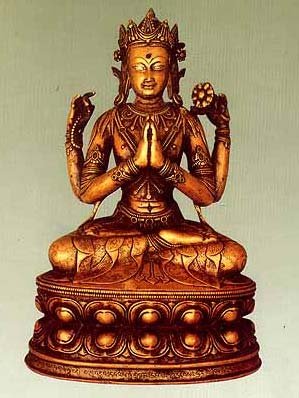
Mahayana (महायान, mahāyāna) is a major branch of Buddhism focusing on the path of a Bodhisattva (spiritual aspirants/ enlightened beings). Extant literature is vast and primarely composed in the Sanskrit language. There are many sūtras of which some of the earliest are the various Prajñāpāramitā sūtras.
See also (Relevant definitions)
Partial matches (+0): Trina, Maha.
Starts with (+0): Mahatrinaka, Mahatrinakataila, Mahatrinataila.
Full-text (+0): Mahatrinataila, Mahavriksha, Alpavriksha, Alpatrina.
Relevant text
Search found 1 books and stories containing Mahatrina, Mahātṛṇa, Mahā-tṛṇa, Maha-trina, Mahatrna, Maha-trna; (plurals include: Mahatrinas, Mahātṛṇas, tṛṇas, trinas, Mahatrnas, trnas). You can also click to the full overview containing English textual excerpts. Below are direct links for the most relevant articles:
Maha Prajnaparamita Sastra (by Gelongma Karma Migme Chödrön)
Part 1 - The auxiliaries belong to the Greater Vehicle as well < [Chapter XXXI - The Thirty-seven Auxiliaries to Enlightenment]