Joga, Jōga: 8 definitions
Introduction:
Joga means something in Jainism, Prakrit, the history of ancient India, Marathi. If you want to know the exact meaning, history, etymology or English translation of this term then check out the descriptions on this page. Add your comment or reference to a book if you want to contribute to this summary article.
In Jainism
Jain philosophy
Joga (जोग) (in Sanskrit: Yoga) refers to “activity” (of three types: physical, vocal and mental), as mentioned in the Anekāntajayapatākā-prakaraṇa, a Śvetāmbara Jain philosophical work written by Haribhadra Sūri.—[Cf. Vol. II, P. 220, l. 16]
-
General definition (in Jainism)
Joga (जोग) in Prakrit refers to “activity” and represents one of the twenty-four Daṇḍakas (“parameters relating to the description of living beings”).—The most common list of daṇḍakas has 24 terms in Prakrit. This has been the starting point of a variety of works, among which the Caturviṃśatidaṇḍaka by Gajasāra stands as a classic.
Joga (जोग) refers to the “activity” (of the Gods, Humans, Animals, etc.), as defined in the “Arhadvijñaptirūpā Vicāraṣaṭtriṃśikā” by Gajasāra, which is included in the collection of manuscripts at the ‘Vincenzo Joppi’ library, collected by Luigi Pio Tessitori during his visit to Rajasthan between 1914 and 1919.—The Vicāraṣaṭtriṃśikā (in Prakrit) was first presented in tabular form (yantra) according to the commentators, and then put in the form of a text. [...] Each category is then examined through twenty-four parameters [e.g., activity (joga)].

Jainism is an Indian religion of Dharma whose doctrine revolves around harmlessness (ahimsa) towards every living being. The two major branches (Digambara and Svetambara) of Jainism stimulate self-control (or, shramana, ‘self-reliance’) and spiritual development through a path of peace for the soul to progess to the ultimate goal.
India history and geography
Joga (जोग) or Jogarāvala refers to one of the eighty-four Siddhas (Siddhācāryas) mentioned in various sources as being representative teachers of Sahajiya Tantrism, Alchemy, Nath Sampradaya and other traditions having influence in the Indian subcontinent and the Himalayas.—Many of these Mahāsiddhas [e.g., Joga-rāvala] were historical figures whose lives and mystical powers were the subject of legends. They are often associated with teachings belonging to Hinduism, Buddhism, Ajivikism and Jainism and are evident of a caste-less interreligious spiritual society.
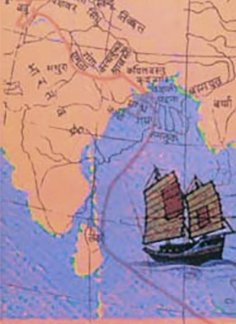
The history of India traces the identification of countries, villages, towns and other regions of India, as well as mythology, zoology, royal dynasties, rulers, tribes, local festivities and traditions and regional languages. Ancient India enjoyed religious freedom and encourages the path of Dharma, a concept common to Buddhism, Hinduism, and Jainism.
Languages of India and abroad
Marathi-English dictionary
jōga (जोग).—m (yōga S) Renunciation of the world and conquest of worldly passions and affections. v ghē. jōga bharaṇēṃ To fill with food the basket of a muraḷī. This is considered as an act of worship. 2 To matriculate a jōgīṇa.
jōga (जोग).—m Renunciation of the world and conquest of worldly passions and affections. v ghē. jōga bharaṇēṃ To fill with food the basket of a muraḷī.
--- OR ---
jōgā (जोगा).—a suitable to, worthy of.
Marathi is an Indo-European language having over 70 million native speakers people in (predominantly) Maharashtra India. Marathi, like many other Indo-Aryan languages, evolved from early forms of Prakrit, which itself is a subset of Sanskrit, one of the most ancient languages of the world.
Prakrit-English dictionary
1) Joga (जोग) in the Prakrit language is related to the Sanskrit word: Yoga.
2) Joga (जोग) also relates to the Sanskrit word: Yoga.
Prakrit is an ancient language closely associated with both Pali and Sanskrit. Jain literature is often composed in this language or sub-dialects, such as the Agamas and their commentaries which are written in Ardhamagadhi and Maharashtri Prakrit. The earliest extant texts can be dated to as early as the 4th century BCE although core portions might be older.
Kannada-English dictionary
Jōga (ಜೋಗ):—
1) [noun] the state of the mind in which it has perfect communion or association with the higher planes of consciousness or a divinity; deep and abstract meditation.
2) [noun] the act or fact of being associated with; a union; a combination.
3) [noun] an expedient, plan or means.
4) [noun] a small water vessel; a boat.
--- OR ---
Jōga (ಜೋಗ):—[noun] a kind of cloth.
--- OR ---
Jōga (ಜೋಗ):—[noun] a distinct species of dogs; .
Kannada is a Dravidian language (as opposed to the Indo-European language family) mainly spoken in the southwestern region of India.
See also (Relevant definitions)
Starts with (+27): Joga-dhusa, Jogad, Jogada, Jogadeva Ashthaka, Jogadhusa, Jogadhusa, Jogadhusa-bahal, Jogadhusa-bahal, Jogadyacem Bhata, Jogaisu, Jogajasa, Jogala, Jogalaiya, Jogalanem, Jogale, Jogalevadu, Jogali, Jogalivadu, Jogaliya-shak, Jogamayi.
Full-text (+0): Jogadhusa, Navacakra, Yoga, Jogaravala, Jogata, Jogaraya, Neg, Jagajotivihara, Jagajoti, Aneka, Diao jia, Yoga-pattaka, Jogu, Ku, Somku, Dandaka, Siddhantasaroddhara, Parigha.
Relevant text
Search found 27 books and stories containing Joga, Jōga, Jōgā, Jogā; (plurals include: Jogas, Jōgas, Jōgās, Jogās). You can also click to the full overview containing English textual excerpts. Below are direct links for the most relevant articles:
Yogadrstisamuccaya of Haribhadra Suri (Study) (by Riddhi J. Shah)
Chapter 1.2 - Yoga in Jain Canon and Commentarial Literature < [Chapter 1 - The Jain Yoga Tradition—A Historical Review]
Gommatsara by Acharya Nemichandra (by Bai Bahadur J. L. Jaini)
Chapter 9 - The concept of Yoga margana (Vibration Quest) < [Volume 1 - Jiva-kanda (the soul)]
Corrigenda et Addenda < [Volume 1 - Jiva-kanda (the soul)]
Chapter 22 - Appendix 2: Further Distinctions (Alapa) < [Volume 1 - Jiva-kanda (the soul)]
The Hoyasala Commander < [October 1950]
Book Review < [October – December, 2006]
Book Reviews < [October – December, 2001]
Bhaktavijaya: Stories of Indian Saints (by Justin E. Abbott)
20.4: Joga’s self-inflicted suffering < [Chapter 20 - Joga Paramanand, Narahari the goldsmith and Namdev]
20.3: Joga and the silk garment < [Chapter 20 - Joga Paramanand, Narahari the goldsmith and Namdev]
20.2: Joga Paramanand of Barsi < [Chapter 20 - Joga Paramanand, Narahari the goldsmith and Namdev]
Dictionaries of Indian languages (Kosha)
Page 1077 < [Marathi-Hindi-English, Volume 1]
Page 800 < [Gujarati-Hindi-English, Volume 1]
Page 799 < [Gujarati-Hindi-English, Volume 1]
Vasudevahindi (cultural history) (by A. P. Jamkhedkar)
22. The philosophy of Samkha and Joga (the Parivvayaga) < [Chapter 5 - Religion and Philosophy]
21. The philosophy of Natthiyavaya < [Chapter 5 - Religion and Philosophy]