Gunottara, Guṇōttara, Guṇottara: 6 definitions
Introduction:
Gunottara means something in Hinduism, Sanskrit, Marathi. If you want to know the exact meaning, history, etymology or English translation of this term then check out the descriptions on this page. Add your comment or reference to a book if you want to contribute to this summary article.
In Hinduism
Ganitashastra (Mathematics and Algebra)
Guṇottara (गुणोत्तर) refers to “multiplicative (series)”.—Indian mathematicians long knew about finite geometric series, which they called guṇottara-saṅkalitā or guṇottara-śreḍhī (multiplicative series), and methods of summing the finite geometric series were a part of the elementary school curriculum from at least 1,300 years ago and are found in numerous elementary texts such as the Pāṭigaṇita of Śrīdhara. Indeed, summing a finite multiplicative series was a very common commercial problem found in a variety of other sources such as the Gaṇitasāra-Saṃgraha of Mahāvīra, Mahā Siddhānta of Ᾱryabhaṭa II, the Līlāvatī of Bhaskara II, etc. (Cf. rule 126 et. seq; the numbering differs between Colebrooke, 1816 and the critical edition of Sarma, 1975).
Guṇottara (गुणोत्तर) refers to the “multiplicative increase”, according to the article “the treatment of Series in the Gaṇitasāra-saṃgraha of Mahāvīrācārya and its Connections to Jaina Cosmology”.—Accordingly, [while describing Geometrical Progressions]: The shift from arithmetical to geometrical progressions is not clearly indicated in the manuscripts. It has to be deduced from the appearance of a new terminology: the increase (uttara) becomes the common ratio q, which is called guṇa or guṇottara (multiplicative increase), but sometimes only uttara. The names for the first term and the number of terms do not change. The last term (antyadhana) is defined as it is today and there is something new, the guṇadhana, equivalent to the term that comes after the antyadhana. This does not have a specific name in our modern mathematics. The sum is called guṇasaṃkalita or “multiplicative summation”.
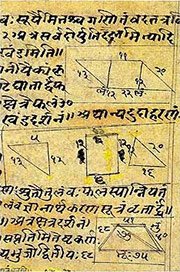
Ganita (गणित) or Ganitashastra refers to the ancient Indian science of mathematics, algebra, number theory, arithmetic, etc. Closely allied with astronomy, both were commonly taught and studied in universities, even since the 1st millennium BCE. Ganita-shastra also includes ritualistic math-books such as the Shulba-sutras.
Languages of India and abroad
Marathi-English dictionary
guṇōttara (गुणोत्तर).—n S Ratio or the common difference in geometrical progression.
Marathi is an Indo-European language having over 70 million native speakers people in (predominantly) Maharashtra India. Marathi, like many other Indo-Aryan languages, evolved from early forms of Prakrit, which itself is a subset of Sanskrit, one of the most ancient languages of the world.
Sanskrit dictionary
Guṇottara (गुणोत्तर).—m. superior virtue, [Rāmāyaṇa] 5, 2, 4; n. Mahābhārata 3, 13922.
Guṇottara is a Sanskrit compound consisting of the terms guṇa and uttara (उत्तर).
Guṇottara (गुणोत्तर):—[from guṇa] mfn. idem, [Suśruta i, 45, 64.]
Guṇottara (गुणोत्तर):—Adj. dass. [Suśruta (rotrh) 1,177,20.]
Sanskrit, also spelled संस्कृतम् (saṃskṛtam), is an ancient language of India commonly seen as the grandmother of the Indo-European language family (even English!). Closely allied with Prakrit and Pali, Sanskrit is more exhaustive in both grammar and terms and has the most extensive collection of literature in the world, greatly surpassing its sister-languages Greek and Latin.
See also (Relevant definitions)
Partial matches (+0): Uttara, Guna.
Starts with (+0): Gunottara-madhyaka, Gunottara-vriddhi.
Full-text (+0): Kriyakalagunottara, Gunottara-vriddhi, Gunottara-madhyaka, Gunottar-madhyak, Gunottar-vruddhi, Shredhi, Samkalita, Guna, Uttaraguna, Gunasamkalita, Bilva.
Relevant text
Search found 7 books and stories containing Gunottara, Guna-uttara, Guṇa-uttara, Guṇōttara, Guṇottara; (plurals include: Gunottaras, uttaras, Guṇōttaras, Guṇottaras). You can also click to the full overview containing English textual excerpts. Below are direct links for the most relevant articles:
Shiva Purana [sanskrit/english]
Uttaradhyayana Sutra [prakrit]
Verse 12.1 < [Chapter 12. Hariesa]
Verse 26.11 < [Chapter 26. Sāmāyārī]
Verse 26.17 < [Chapter 26. Sāmāyārī]
A Descriptive Catalogue of the Sanskrit Manuscripts, Madras (by M. Seshagiri Sastri)
Dictionaries of Indian languages (Kosha)
Page 391 < [Gujarati-Hindi-English, Volume 2]
Page 445 < [Marathi-Hindi-English, Volume 2]
Page 471 < [English-Gujarati-Hindi (1 volume)]
World Journal of Pharmaceutical Research
Study of makshika bhasma in classical texts. < [2022: Volume 11, December issue 16]
Ganita-sara-sangraha by Mahavira-Acharya (by M. Rangacharya)
Chapter 6 - Pascamah misraka vyavaharah < [Part 2 - Sanskrit text]