Divyastra, Divya-astra, Divyāstra: 4 definitions
Introduction:
Divyastra means something in Hinduism, Sanskrit. If you want to know the exact meaning, history, etymology or English translation of this term then check out the descriptions on this page. Add your comment or reference to a book if you want to contribute to this summary article.
In Hinduism
Dhanurveda (science of warfare)
Divyāstra (दिव्यास्त्र) refers to a weapon (“divine weapon”). It is a Sanskrit word defined in the Dhanurveda-saṃhitā, which contains a list of no less than 117 weapons. The Dhanurveda-saṃhitā is said to have been composed by the sage Vasiṣṭha, who in turn transmitted it trough a tradition of sages, which can eventually be traced to Śiva and Brahmā.
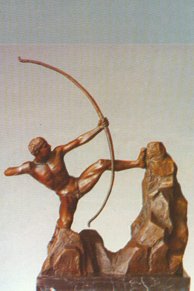
Dhanurveda (धनुर्वेद) refers to the “knowledge of warfare” and, as an upaveda, is associated with the Ṛgveda. It contains instructions on warfare, archery and ancient Indian martial arts, dating back to the 2nd-3rd millennium BCE.
Shaktism
Divyāstra (दिव्यास्त्र) refers to “divine weapon”, according to the Śrīmatottara-tantra, an expansion of the Kubjikāmatatantra: the earliest popular and most authoritative Tantra of the Kubjikā cult.—Accordingly, while describing the Mūrti (visualized iconic form) of the goddess Mālinī: “She is like the rising sun and is blissful with wine. Very beautiful, she has five faces and is radiant with five time three eyes. She is adorned with beautiful earrings and shines with diadem and crown. She has ten arms adorned with many ornaments. O beloved, (she holds) a bow, javelin, conch, makes the gesture of fearlessness and holds a mirror. (Such) is the divine weapon [i.e., divyāstra] in her left hands. (She holds) a thunderbolt, arrow, snake, makes a boon bestowing gesture and holds a rosary. O goddess, such is the divine weapon (held) by (her) right (hands)”.
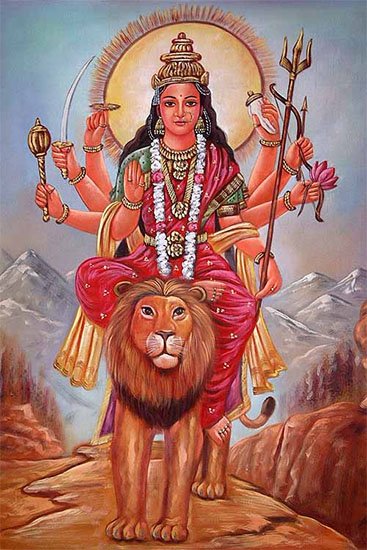
Shakta (शाक्त, śākta) or Shaktism (śāktism) represents a tradition of Hinduism where the Goddess (Devi) is revered and worshipped. Shakta literature includes a range of scriptures, including various Agamas and Tantras, although its roots may be traced back to the Vedas.
Purana and Itihasa (epic history)
Divyāstra (दिव्यास्त्र) refers to a “divine missile” (used in warfare), according to the Śivapurāṇa 2.5.37 (“Śaṅkhacūḍa fights with the full contingent of his army”).—Accordingly: “[As Kārttikeya withstood Śaṅkhacūḍa’s volley of arrows]: He exhibited many types of illusions in the manner indicated by Maya. O excellent sage, none of the gods or Gaṇas understood it. At the same time, the powerful Śaṅkhacūḍa of great illusion split his bow with a divine arrow. He split his divine chariot and the horses pulling it. With a divine missile (divyāstra) he shattered the peacock too. The Dānava hurled his spear as refulgent as the sun fatally on his chest whereat he fell unconscious by the force of the blow. Regaining consciousness, Kārttikeya the destroyer of heroic enemies, mounted his vehicle of sturdy build, set with gems. [...]”.

The Purana (पुराण, purāṇas) refers to Sanskrit literature preserving ancient India’s vast cultural history, including historical legends, religious ceremonies, various arts and sciences. The eighteen mahapuranas total over 400,000 shlokas (metrical couplets) and date to at least several centuries BCE.
Languages of India and abroad
Sanskrit dictionary
Divyāstra (दिव्यास्त्र).—[neuter] a cert. magical weapon.
Sanskrit, also spelled संस्कृतम् (saṃskṛtam), is an ancient language of India commonly seen as the grandmother of the Indo-European language family (even English!). Closely allied with Prakrit and Pali, Sanskrit is more exhaustive in both grammar and terms and has the most extensive collection of literature in the world, greatly surpassing its sister-languages Greek and Latin.
See also (Relevant definitions)
Partial matches (+0): Divya, Astra.
Starts with (+0): Divyastrajala.
Full-text (+0): Astra, Divyastrajala, Sampradaya, Yodhin, Divyarupin, Samarthastra, Samarthastraka, Samartha, Vidvams.
Relevant text
Search found 5 books and stories containing Divyastra, Divya-astra, Divyāstra; (plurals include: Divyastras, astras, Divyāstras). You can also click to the full overview containing English textual excerpts. Below are direct links for the most relevant articles:
Shiva Purana [sanskrit/english]
Kathasaritsagara [Sanskrit/English] (by C. H. Tawney)
A Descriptive Catalogue of the Sanskrit Manuscripts, Madras (by M. Seshagiri Sastri)
Formal Education System in Ancient India (by Sushmita Nath)
The Gurukula centre of learning < [Chapter 3 - Centres of Learning in Vedic and Buddhist Period]
Sundara Ramayana (translation and study) (by T. N. Jaya)
Part 1 - Bala Kanda (English translation) < [Chapter 2 - Prose Rendering of the poem Sundara Ramayana]