Dharmadeva: 10 definitions
Introduction:
Dharmadeva means something in Hinduism, Sanskrit, the history of ancient India. If you want to know the exact meaning, history, etymology or English translation of this term then check out the descriptions on this page. Add your comment or reference to a book if you want to contribute to this summary article.
Images (photo gallery)

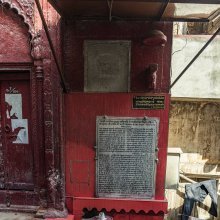
India history and geography
1) Dharmadeva (धर्मदेव) (=Dharmadevastūpa / Candravināyaka) is mentioned in the list of “selected settlements and sacred sites” of the Nepal Mandala (lit. “circle or country of Nepal”), the ancient name for the Kathmandu Valley. Historically, seventh-century Licchavi inscriptions define the Valley (including Dharmadevastūpa) not just as a geographic location and socio-political center, but it is also regarded as a sacred space specifically chosen by the Gods as their dwelling place.
2) Dharmadeva (धर्मदेव) (=Dharmadevastūpa) is also mentioned as a sacred site of the Deopatan region.
Dharmadeva is the name of an ancient Raja (king of Nepal) from the Somavanshi (=soma-vamshi) dynasty, mentioned in the list of “Rajas of Nepal from the time of Ne Muni”, as extracted from the translation of the Vanshavali or Bansawali (“history and genealogical accounts of Nepal”).—Note: This list has been carefully revised and collated with the original manuscript, and gives the most correct forms of the royal names (e.g., Dharmadeva). The reader should compare it with the list in Thomas’s edition of Prinsep’s Essays on Indian Antiquities, Vol. II., pp. 268-271.
Dharmadeva (धर्मदेव) is the patron of the Dharmadevacaitya monastery in Kathmadu valley.—According to the Gopālarājavaṃśāvalī, the earliest local chronicle, the following monasteries and caitya were named after the donor: the Mānavihāra by Mānadeva, the Dharmadevacaitya by Dharmadeva, and the Devalavihāra by Devaladeva (Sanderson 2009, 74). The first one is confirmed by its mention in an undated inscription assigned to his reign (Sanderson 2009, 75). Several of the monasteries of the Kathmadu valley are attributed to kings of the period of the Ṭhākurī kings—most probably Kuladatta flourished in this period—in inscriptions, palm-leaf deeds, manuscript colophons, or their own tradition. But no monastery or caitya named after a king is reported (Sanderson 2009, 77–80).
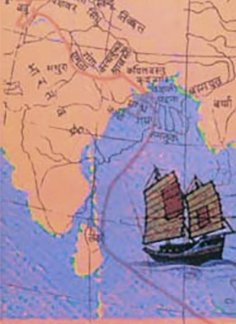
The history of India traces the identification of countries, villages, towns and other regions of India, as well as mythology, zoology, royal dynasties, rulers, tribes, local festivities and traditions and regional languages. Ancient India enjoyed religious freedom and encourages the path of Dharma, a concept common to Buddhism, Hinduism, and Jainism.
Languages of India and abroad
Sanskrit dictionary
Dharmadeva (धर्मदेव).—(corresp. to Pali Dhammasena), name of a leading disciple of Buddha Maṅgala: Mahāvastu i.248.17; 252.7.
Dharmadeva (धर्मदेव).—[masculine] the god of justice.
Dharmadeva (धर्मदेव) as mentioned in Aufrecht’s Catalogus Catalogorum:—poet. [Subhāshitāvali by Vallabhadeva]: Purāṇadṛṣṭāntaśataka.
Dharmadeva (धर्मदेव):—[=dharma-deva] [from dharma > dhara] m. the god of justice, [Mahābhārata]
Dharmadeva (धर्मदेव):—m. der Gott der Gerechtigkeit [56,16.]
Dharmadeva (in Sanskrit) can be associated with the following Chinese terms:
1) 法天 [fǎ tiān]: “Dharmadeva” [Sanskrit personal name].
Sanskrit, also spelled संस्कृतम् (saṃskṛtam), is an ancient language of India commonly seen as the grandmother of the Indo-European language family (even English!). Closely allied with Prakrit and Pali, Sanskrit is more exhaustive in both grammar and terms and has the most extensive collection of literature in the world, greatly surpassing its sister-languages Greek and Latin.
Nepali dictionary
Dharmadeva (धर्मदेव):—n. Dharmadev (a Licchavi king; father of Manadeva I);
Nepali is the primary language of the Nepalese people counting almost 20 million native speakers. The country of Nepal is situated in the Himalaya mountain range to the north of India.
See also (Relevant definitions)
Partial matches (+0): Deva, Dharma, Dharma, Dharma.
Starts with (+0): Dharmadevacaitya, Dharmadevastupa, Dharmadevastupa.
Full-text (+51): Fa tian, Maitri, Da mo ti po, Dharmadevacaitya, Prabhata, Tushti, Dharmavrita, Dharmadev, Puranadrishtantashataka, Samkalpa, Buddha, Yami, Dharmavati, Phap thien, Shambhunatha siddhantavagisha, Dharmadevastupa, Shvasa, Sunrita, Kriya, Titiksha.
Relevant text
Search found 35 books and stories containing Dharmadeva, Dharma-deva; (plurals include: Dharmadevas, devas). You can also click to the full overview containing English textual excerpts. Below are direct links for the most relevant articles:
Puranic encyclopaedia (by Vettam Mani)
Brihaddharma Purana (abridged) (by Syama Charan Banerji)
Mahavastu (great story) (by J. J. Jones)
Chapter XXIV - The Buddha Maṅgala < [Volume I]
Notices of Sanskrit Manuscripts (by Rajendralala Mitra)
Atithi or Guest Reception (study) (by Sarika. P.)
Part 2 - Treatment of Atithi (guest-reception) in Mahābhārata < [Chapter 3 - Atithi-saparyā in Epics and Purāṇas]
Dictionaries of Indian languages (Kosha)
Page 529 < [Bengali-Hindi-English, Volume 1]