Aupanayika, Aupanāyika: 4 definitions
Introduction:
Aupanayika means something in Buddhism, Pali, Hinduism, Sanskrit. If you want to know the exact meaning, history, etymology or English translation of this term then check out the descriptions on this page. Add your comment or reference to a book if you want to contribute to this summary article.
In Buddhism
Mahayana (major branch of Buddhism)
Aupanayika (औपनयिक) in Sanskrit or Opanayika in Pali refers to a quality of the Dharma associated with the “recollection of the Dharma” (dharmānusmṛti), representing one of the Anusmṛti (eight recollections), according to the 2nd century Mahāprajñāpāramitāśāstra chapter 36.—Accordingly, “the Dharma leads to the good place (aupanayika). The thirty-seven pure auxiliaries of Bodhi lead (upanayanti) a person to Nirvāṇa. Thus, when one sets sail on the Ganges, one necessarily reaches the great ocean. The outside heretical systems (anyatīrthika) which the Omniscient One (sarvajñā) did not preach that are full of wrong views (mithyadṛṣṭi) lead to the bad places or, if they sometimes lead to the heavens (svarga), one falls back from them and suffers. Not being eternal, these heavens are not ‘the good place’”.
Moreover, in the complex of causes and conditions, there is neither agent (kāraka) nor leader (upanetṛ) who exercises control (vaśita) over the causes and conditions on which the retribution depends.
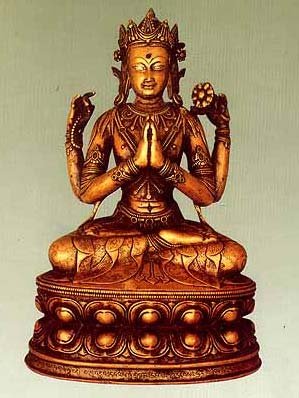
Mahayana (महायान, mahāyāna) is a major branch of Buddhism focusing on the path of a Bodhisattva (spiritual aspirants/ enlightened beings). Extant literature is vast and primarely composed in the Sanskrit language. There are many sūtras of which some of the earliest are the various Prajñāpāramitā sūtras.
Languages of India and abroad
Sanskrit dictionary
Aupanāyika (औपनायिक).—a. Belonging to, or serving for an offering.
Aupanayika (औपनयिक).—adj. (= Pali opa°; epithet of Buddha's dhamma; from Sanskrit upanaya plus -ika; compare next), con- [Page162-b+ 71] ducive (to the desired religious end), epithet of dharma- vinaya: Mahāvastu iii.200.10 (see s.v. ehipaśyika).
--- OR ---
Aupanāyika (औपनायिक).—adj., = prec. (in same formula): Mahāvyutpatti 1295. (So also Mironov.)
Aupanāyika (औपनायिक):—mfn. ([from] upa-nāya), belonging to or serving for an offering, [Harivaṃśa]
Sanskrit, also spelled संस्कृतम् (saṃskṛtam), is an ancient language of India commonly seen as the grandmother of the Indo-European language family (even English!). Closely allied with Prakrit and Pali, Sanskrit is more exhaustive in both grammar and terms and has the most extensive collection of literature in the world, greatly surpassing its sister-languages Greek and Latin.
See also (Relevant definitions)
Full-text (+0): Aupanayanika, Aupanayaka, Ehipashyika, Opanayika, Dharmanusmriti.
Relevant text
Search found 6 books and stories containing Aupanayika, Aupanāyika; (plurals include: Aupanayikas, Aupanāyikas). You can also click to the full overview containing English textual excerpts. Below are direct links for the most relevant articles:
Samyuta Nikaya (Linked Discourses)
Discourse 35.70: Upavāṇasandiṭṭhika-sutta < [35.7. Migajāla-vagga: The Chapter with Migajāla]
Discourse 1.20: Samiddhi-sutta < [1.2. Nandana-vagga: the Garden of Delight]
Discourse 12.41: Pañcaverabhaya-sutta < [12.5. Gahapati-vagga: Householders]
Anguttara Nikaya (Numbered Discourses)
Discourse 3.53: Aññatarabrāhmaṇa-sutta < [Brāhmaṇa-vagga: Brahmins]
Discourse 6.48: Dutiyasandiṭṭhika-sutta < [Dhammika-vagga: The Chapter with Dhammika]
Discourse 3.54: Paribbājaka-sutta < [Brāhmaṇa-vagga: Brahmins]
Maha Prajnaparamita Sastra (by Gelongma Karma Migme Chödrön)
II. Recollection of the Dharma (dharmānusmṛti) < [Part 2 - The Eight Recollections according to the Abhidharma]
II.5. Dharma leading to the good place (aupanayika) < [II. Recollection of the Dharma (dharmānusmṛti)]
Digha Nikaya (Long Discourses)
2. Eight Genuine Praises < [Discourse 19: The Great Steward]
9. Seven Prerequisites of Immersion < [Discourse 18: With Janavasabha]
10. The Mirror of the Teaching < [Discourse 16: The Great Discourse on the Buddha’s Extinguishment]
Majjhima Nikaya (Middle Discourses)
Discourse 38: The Longer Discourse on the Ending of Craving < [Mahāyamaka-vagga: The Greater Chapter on Pairs]
Discourse 7: The Simile of the Cloth < [Mūlapariyāya-vagga: The Chapter on the Root of All Things]
Mahavastu (great story) (by J. J. Jones)
Chapter XX - The Mahāgovindīya-sūtra < [Volume III]