Asamskritadharma, Asaṃskṛtadharma, Asamskrita-dharma: 2 definitions
Introduction:
Asamskritadharma means something in Buddhism, Pali, Hinduism, Sanskrit. If you want to know the exact meaning, history, etymology or English translation of this term then check out the descriptions on this page. Add your comment or reference to a book if you want to contribute to this summary article.
The Sanskrit term Asaṃskṛtadharma can be transliterated into English as Asamskrtadharma or Asamskritadharma, using the IAST transliteration scheme (?).
In Buddhism
Mahayana (major branch of Buddhism)
Asaṃskṛtadharma (असंस्कृतधर्म) refers to “unconditioned dharmas” according to the 2nd century Mahāprajñāpāramitāśāstra chapter 36.—Accordingly, “unconditioned dharmas (asaṃskṛtadharma), being without causes (ahetuka) or conditions (apratyaya), do not arise and do not cease. As they do not arise and do not cease, they are not said to be impermanent”.
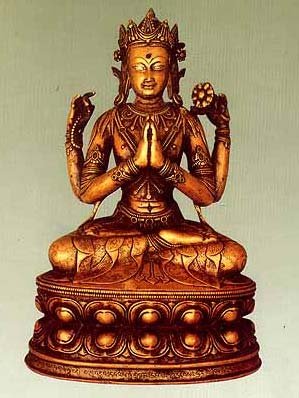
Mahayana (महायान, mahāyāna) is a major branch of Buddhism focusing on the path of a Bodhisattva (spiritual aspirants/ enlightened beings). Extant literature is vast and primarely composed in the Sanskrit language. There are many sūtras of which some of the earliest are the various Prajñāpāramitā sūtras.
Languages of India and abroad
Sanskrit dictionary
Asaṃskṛtadharma (in Sanskrit) can be associated with the following Chinese terms:
1) 無爲 [wú wèi]: “unconditioned”; “uncreated”.
Note: asaṃskṛtadharma can be alternatively written as: asaṃskṛta-dharma.
2) Asaṃskṛtādharmā (in Sanskrit) can be associated with the following Chinese terms:
1) 無爲法 [wú wèi fǎ]: “unconditioned phenomena”.
Note: asaṃskṛtādharmā can be alternatively written as: asaṃskṛtā-dharmāḥ.
Sanskrit, also spelled संस्कृतम् (saṃskṛtam), is an ancient language of India commonly seen as the grandmother of the Indo-European language family (even English!). Closely allied with Prakrit and Pali, Sanskrit is more exhaustive in both grammar and terms and has the most extensive collection of literature in the world, greatly surpassing its sister-languages Greek and Latin.
See also (Relevant definitions)
Partial matches (+0): Asamskrita, Dharma, Dharma, Dharma.
Full-text (+0): Tryasamskritadharma, Aninjyasamskritadharma, Wu wei fa, Xu kong wu wei, Asamskrita, Avacya, Avacyadharma, Vacya, Samskritadhrma, Qi shi wu fa, Caitasikadharma, Samskara, Nirvana, Caitasika, San wu wei, Samskrita, Wu wei bai fa, Wu Wei.
Relevant text
Search found 7 books and stories containing Asamskritadharma, Asamskrita dharmas, Asamskrita-dharma, Asaṃskṛta-dharma, Asamskrta-dharma, Asaṃskṛtā-dharmā, Asaṃskṛtadharma, Asamskrtadharma, Asaṃskṛtādharmā; (plurals include: Asamskritadharmas, Asamskrita dharmases, dharmas, dharmās, Asaṃskṛtadharmas, Asamskrtadharmas, Asaṃskṛtādharmās). You can also click to the full overview containing English textual excerpts. Below are direct links for the most relevant articles:
Maha Prajnaparamita Sastra (by Gelongma Karma Migme Chödrön)
Emptinesses 7-8: Emptiness of the conditioned unconditioned < [Chapter XLVIII - The Eighteen Emptinesses]
1. The ātman is not an object of consciousness. < [Part 13 - Non-existence of the donor]
Emptiness 9: Absolute emptiness < [Chapter XLVIII - The Eighteen Emptinesses]
A History of Indian Philosophy Volume 1 (by Surendranath Dasgupta)
Part 10 - The Schools of Theravada Buddhism < [Chapter V - Buddhist Philosophy]
The Core Idea, Theoretical Doubts, and Re-Understanding of the Theory of... < [Volume 16, Issue 2 (2025)]
Chan Gong’an and the “Flexible Method” < [Volume 14, Issue 9 (2023)]
The Buddhist Path to Enlightenment (study) (by Dr Kala Acharya)
5.1. The Two Categories of Mokṣa in Jainism < [Chapter 4 - Comparative Study of Liberation in Jainism and Buddhism]
The Buddhist Philosophy of Universal Flux (by Satkari Mookerjee)
Chapter XVI - Nirvāṇa < [Part I - Metaphysics]
A Dictionary Of Chinese Buddhist Terms (by William Edward Soothill)