Apramanabha, Apramāṇābha, Apramana-abha: 8 definitions
Introduction:
Apramanabha means something in Buddhism, Pali, Hinduism, Sanskrit. If you want to know the exact meaning, history, etymology or English translation of this term then check out the descriptions on this page. Add your comment or reference to a book if you want to contribute to this summary article.
Images (photo gallery)

In Buddhism
Mahayana (major branch of Buddhism)
Apramāṇābha (अप्रमाणाभ) is part of the group of Gods inhabiting the second dhyāna of the Rūpadhātu (or Brahmaloka): the second of the three worlds, according to the 2nd century Mahāprajñāpāramitāśāstra chapter 32-34. The gods of the form realm (rūpadhātu), having fallen from the pure abodes (śuddhāvāsa), will again conceive sensual desire and will abide in the impure spheres.
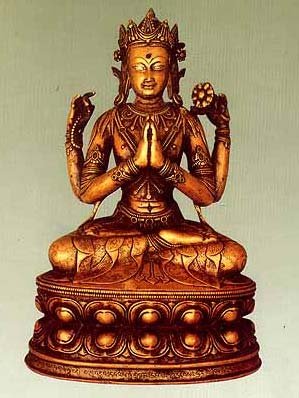
Mahayana (महायान, mahāyāna) is a major branch of Buddhism focusing on the path of a Bodhisattva (spiritual aspirants/ enlightened beings). Extant literature is vast and primarely composed in the Sanskrit language. There are many sūtras of which some of the earliest are the various Prajñāpāramitā sūtras.
General definition (in Buddhism)
Apramāṇābha (अप्रमाणाभ) refers to “unbounded radiance” and represents one of the eighteen “gods of the form-realms” (rūpāvacaradeva) as defined in the Dharma-saṃgraha (section 128). The Dharma-samgraha (Dharmasangraha) is an extensive glossary of Buddhist technical terms in Sanskrit (e.g., apramāṇābha). The work is attributed to Nagarjuna who lived around the 2nd century A.D.
Languages of India and abroad
Sanskrit dictionary
Apramāṇābha (अप्रमाणाभ).—(pl.) 'of unlimited lustre', Name of a class of deities (with Buddhists).
Derivable forms: apramāṇābhaḥ (अप्रमाणाभः).
Apramāṇābha is a Sanskrit compound consisting of the terms apramāṇa and ābha (आभ). See also (synonyms): apramāṇaśubha.
Apramāṇābha (अप्रमाणाभ).—m. pl. (= Pali appa°), of limitless splendor, name of one (usually the 2d) of the classes of rūpā- vacara gods in the 2d dhyāna-bhūmi (see s.v. deva): Mahāvyutpatti 3091; Dharmasaṃgraha 128; Mahāvastu ii.348.19; 360.18; Lalitavistara 150.6; Avadāna-śataka i.5.2; Divyāvadāna 68.14; 138.21; 367.12; 568.27; Gaṇḍavyūha 249.14; Bodhisattvabhūmi 62.3.
Apramāṇābha (अप्रमाणाभ):—[from a-pramāṇa > a-pramā] m. [plural] ‘of unlimited splendour’, Name of a class of divinities, [Buddhist literature]
Apramāṇābha (अप्रमाणाभ):—[bahuvrihi compound] m. pl.
(-bhāḥ) (In Buddhistic doctrine.) The name of a class of divinities which belong to the second degree of the second dhyāna or contemplation (liter. ‘of immeasurable splendour’). E. apramāṇa and ābhā.
Apramāṇābha (अप्रमाणाभ):—(von apramāṇa + ābhā) von unermesslichem Glanze, Name einer Klasse von Göttern bei den Buddh. [Burnouf 202. 611.] [Rgva tch’er rol pa 143] (ābhā).
Apramāṇābha (in Sanskrit) can be associated with the following Chinese terms:
1) 廅波 [è bō]: “(Skt. Apramāṇābha)”.
2) 廅波摩那 [è bō mó nà]: “(Skt. Apramāṇābha)”.
3) 廅波摩那天 [è bō mó nà tiān]: “apramāṇâbha Heaven”..
4) 無量光 [wú liàng guāng]: “Amitābha” [name of a Buddha]; Alternatively: “limitless light”.
5) 阿波摩那天 [ā bō mó nà tiān]: “Apramāṇâbha Heaven”..
6) 阿波摩那婆 [ā bō mó nà pó]: “Apramāṇābha”.
7) 阿波羅摩那阿婆 [ā bō luó mó nà ā pó]: “Apramāṇābha”.
8) 無量光天 [wú liàng guāng tiān]: “heaven of unlimited light”.
Note: apramāṇābha can be alternatively written as: apramāṇa-ābha.
Sanskrit, also spelled संस्कृतम् (saṃskṛtam), is an ancient language of India commonly seen as the grandmother of the Indo-European language family (even English!). Closely allied with Prakrit and Pali, Sanskrit is more exhaustive in both grammar and terms and has the most extensive collection of literature in the world, greatly surpassing its sister-languages Greek and Latin.
See also (Relevant definitions)
Partial matches (+0): Abha, Apramana.
Starts with (+0): Apramanabhacakravartin, Apramanabhasvara.
Full-text (+12): E bo mo na, A bo luo mo na a po, Wu liang guang tian, Wu liang guang, Ebo, A bo mo na po, Apramanashubha, A bo mo na, Apramanabhacakravartin, A bo mo na a po, Cap ba, Bo mo na, A ba ma na, Cap ba ma na, A po mo na po, E po mo na po, E bo mo na po, A ba ma na ba, tshad med 'od, A ba la ma na a ba.
Relevant text
Search found 6 books and stories containing Apramanabha, Apramāṇābha, Apramana-abha, Apramāṇa-ābha, Apramanabhas; (plurals include: Apramanabhas, Apramāṇābhas, abhas, ābhas, Apramanabhases). You can also click to the full overview containing English textual excerpts. Below are direct links for the most relevant articles:
Maha Prajnaparamita Sastra (by Gelongma Karma Migme Chödrön)
Part 4 - Illuminating the darkness of the intermediary worlds < [Chapter LI - Seeing all the Buddha Fields]
I. The three concentrations (samādhi) according to the Abhidharma < [Part 2 - The three meditative stabilizations]
Act 7.1: The Buddha shows his ordinary body (prakṛtyātmabhāva) < [Chapter XIV - Emission of rays]
Ksitigarbha Bodhisattva fundamental vow sutra (by Johnny Yu)
Guhyagarbha Tantra (with Commentary) (by Gyurme Dorje)
Text 15.6 (Commentary) < [Chapter 15 (Text and Commentary)]
Taisho: Chinese Buddhist Canon
Chapter 22: The Fortune Tellers Examine the Prince < [Part 190 - The Abhinishkramana-sutra]
Chapter 5: The Chapter on Descent to Birth < [Part 187 - Lalitavistara (translated by Divakara)]
Further Reflections on Zhi Qian’s Foshuo Pusa Benye Jing < [Volume 12, Issue 8 (2021)]
A Dictionary Of Chinese Buddhist Terms (by William Edward Soothill)