
On the use of Human remains in Tibetan ritual objects
by Ayesha Fuentes | 2020 | 86,093 words
The study examines the use of Tibetan ritual objects crafted from human remains highlighting objects such as skulls and bones and instruments such as the “rkang gling” and the Damaru. This essay further it examines the formalization of Buddhist Tantra through charnel asceticism practices. Methodologies include conservation, iconographic analysis, c...
Go directly to: Footnotes.
Early representations of “Ma gcig lab sgron”
[Full title: Early representations of Machig Labdrön (ma gcig lab sgron), Kangling (rkang gling) and the practice of Chöd (gcod)]
While the above has introduced sources for the history of gcod and the rkang gling, a series of fourteenth and fifteenth century images—a number of which, like fig. 3.2, are preserved in the ‘Bri gung bKa’ brgyud monuments of the western Himalayas—offer alternative perspectives on the representation of this practice and its characteristic instruments. This narrative initially centers on representations of Ma gcig Lab sgron as the Tibetan gcod lineage founder and the relationship between her iconography, teachings and the ritual methods of lus sbyin.
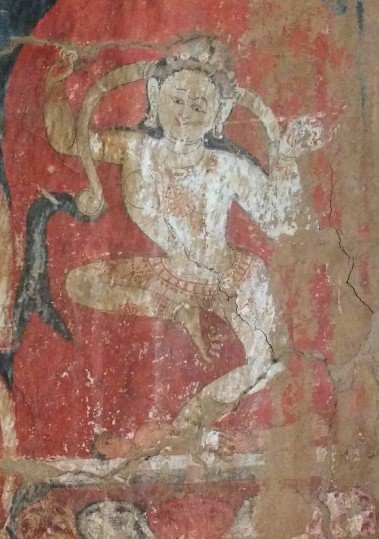
Figure 3.3: Ma gcig with five skull crown on corpse, Alchi Tsatsapuri mChod rten Lha khang, 13-14th centuries. Image by Rob Linrothe.
Firstly, surviving images of Ma gcig from the thirteenth to fifteenth centuries support the longevity of her recognition as a white-bodied ḍākinī, otherwise recorded in biographical sources.[1] However, in another lha khang of Alchi Tsatsapuri—constructed slightly earlier and adjacent to the location of fig. 3.2—an image of Ma gcig with rkang gling and ḍamaru dancing on a corpse rather than directly on a lotus platform suggests how her iconography and the practice of gcod were interpreted in relation to that of the greater Buddhist tantric corpus and its historical sources (figure 3.3).
Here, Ma gcig resembles the two-armed deities of yoginī tantra (see chapter 2), as in this thirteenth century central Tibetan image of Vajravārāhī in a six-pointed maṇḍala, an iconographic program popular in bKa’ brgyud liturgical and visual culture following the phyi dar (tenth to twelfth centuries).[2]
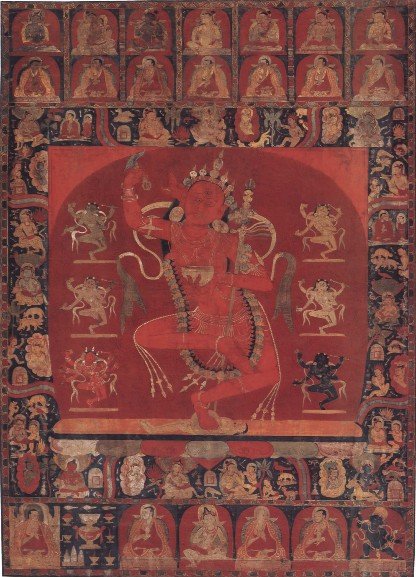
Figure 3.4: Vajravarāhī (rDo rje phag mo) and assembly of yoginī within the eight charnel grounds, 13th century; see Kossak and Singer 1998.
In the thang ka in fig. 3.4, Vajravārāhī is framed at top and bottom by representatives of bKa’ brgyud lineages and surrounded by an assembly of six yoginīs within the eight charnel grounds, shown as a red-bodied vajrayoginī with the skull and khaṭvāṅga on her left, chopper in the raised right hand, and wearing—similar to Ma gcig in fig. 3.3—a five-skull crown and ornaments on the ears, hips, chest, arms and legs.[3] A comparison of the iconography for these two figures suggests an implicit connection between historical modes of Buddhist tantra and gcod as a method for ritualized charnel asceticism: In the mahāyoga and yoginī tantra practices of gaṇacakra (Tbt. ‘khor lo’i tshogs) discussed in the previous chapter, ḍākinī are engaged through offerings presented or refined with the use of a skull, whereas in the tshogs of lus sbyin this offering is made with the practitioner’s own body and its recipients are summoned using an instrument which is also made with human remains.
The liturgical and iconographic connection between gcod and yoginī tantra is made more explicit in her biography, where her disciple Thod smyon recognizes Ma gcig not only as a ḍākinī but specifically as the deity Vajravārāhī.[4] Moreover, in many versions of the gcod sādhana—interpreted by a number of Tibetan religious scholars as an exceptional form of ma rgyud —the practitioner embodies this same tantric deity in order to perform the tshogs in which the ordinary body is offered as food.[5] Thus, illustrated as a ḍākinī and apotheosized as Vajravārāhī, Ma gcig’s iconography suggests the efficacy of her teachings and the practice of lus sbyin as well as their interpretation in relation to historically established visual and ritual precedents for Buddhist tantra in Tibet. And similarly to the observances of mahāyoga and Heruka deity yoga which are characteristic to the Tibetan rnal ‘byor bla na med (*anuttarayoga) corpus, this practice is facilitated through the use of charnel materials.
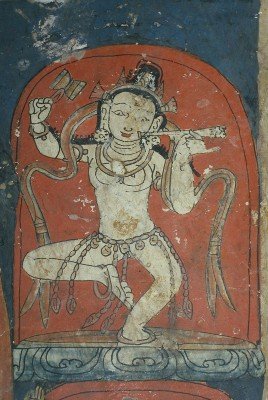
In the fourteenth century Lha khang So ma at the Alchi Chos ‘khor—another temple complex constructed by the local ‘Brig gung bKa’ brgyud community and not one kilometer away from the Tsatsapuri—the gcod founder is illustrated again as a ḍākinī with rkang gling and ḍamaru, here on the rear wall, opposite the entrance and under the central image of the historical Śākyamuni Buddha and to the upper right of an eight-armed, green Tārā (sGrol ma) vertically framed by representations of the eight dangers from which she protects (‘jigs pa brgyad las skyob pa) which include snake bite and drowning (figures 3.5 and 3.6).[6] According to the Phung po gzan skyur rnam bshad, Ma gcig’s empowerment as a teacher as well as a ḍākinī was recognized by the deity Tārā and in his nineteenth century commentary, ‘Jam mgon kong sprul specifies green Tārā as a source in a number of gcod lineages.[7] Another possible connection with this specific iconographic program is suggested in the Bon corpus of mother tantra, wherein a specific series of ritual methods otherwise strongly resembles the six dharmas of Nāropa (Na ro chos ‘drug) with the exception of a practice on the expediency of fear which resembles gcod, in which fear can be engaged as an object or demon to be cut off.[8]
 |
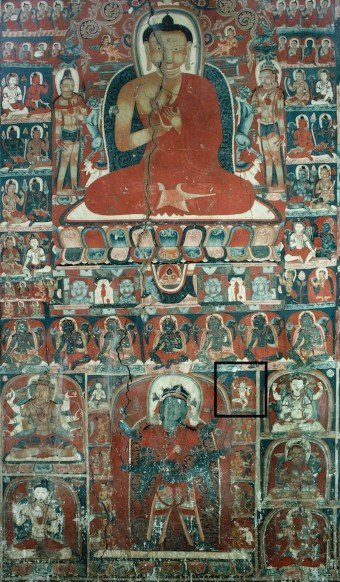 |
Figures 3.5 and 3.6: Ma gcig in the Lha khang So ma at Alchi Chos ‘khor, 14th century. Image by Christian Luczanits with detail and black square added by author to indicate the position of fig. 3.5.
In both the Tsatsapuri mChod rten Lha khang and sPyan ras gzigs Lha khang (figs. 3.3 and 3.2, respectively) and here again at the Alchi Chos ‘khor in the Lha khang So ma (fig. 3.5), Ma gcig is illustrated as a ḍākinī within iconographic programs that otherwise feature the Vajradhātu maṇḍala—related to the empowerments of the Sarvadurgatipariśodhana tantra, see figs. 3.23 and 3.24 below—and this apotropaic form of green Tārā, as well as the historical Buddha and buddha families, thus visually contextualizing Ma gcig’s tantric form and teachings within a broader Buddhist discourse and its sources.[9] Moreover, the two images of Ma gcig at Tsatsapuri are in identical positions relative to the overall visual program of the two lha khang, to the bottom right of a Vajradhātu maṇḍala on the wall to the proper left of the rear wall; in both spaces as well, the green, eight-limbed form of Tārā is nearby, to the right of Ma gcig on the same wall. Yet in these successively constructed yet related monuments at Alchi, despite stylistic and technical variations, the image of Ma gcig with rkang gling and ḍamaru—i.e. as a tantric practitioner of gcod —is repeated.
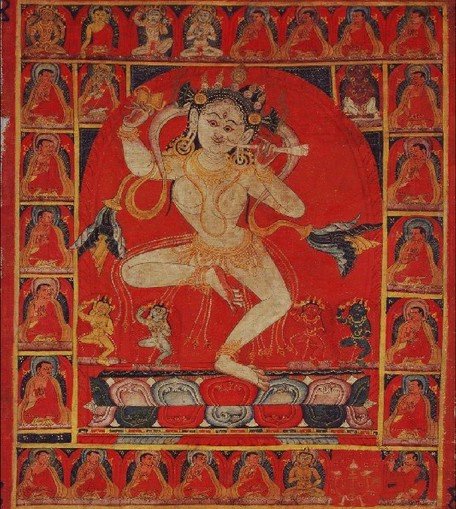
Figure 3.7: Ma gcig with Pha dam pa and Guru Rinpoche over her left and right shoulders, respectively, on a thang ka from central Tibet, 14th century, currently in a private collection.
While these images establish a consistent, local iconography for Ma gcig, other surviving examples suggest its circulation to other lineages and communities (figures 3.7 and 3.8). In each of these thang ka from the fourteenth and fifteenth centuries, Ma gcig is a white ḍākinī wearing ornaments, including the five skull crown, and holding the rkang gling and ḍamaru; in fig. 3.8, from the western Himalayas, this drum is shown as a thod rnga or skull drum.[10] As the central figure accompanied by an assembly of four ḍākinī, the gcod teacher again resembles a yoginī deity.[11] Figures in monastic dress and bKa’ brgyud lineage holders frame the central group in each painting: In fig. 3.7, Pha dam pa—with empty hands raised in dharmacakra mudrā—and Guru Rinpoche are to Ma gcig’s upper left and right, respectively. Alternatively, in fig. 3.8 Mi la ras pa (1040-1123) is just above Ma gcig’s head, with his ‘Brugs pa student Ras chung pa rdo rje grags pa (1085-1161) and the bKa’ brgyud lineage founder Gam po pa (1089-1153) at the far left and right respectively.

Figure 3.8: Ma gcig with rkang gling and ‘Brugs pa bKa’ brgyud lineage holders including Ras chung pa at left, western Himalayas (Guge or Kinnaur), 15-16th century. Ma gcig is accompanied by an assembly of four ḍākinī also holding rkang gling and ḍamaru. Published in Tucci 1949.
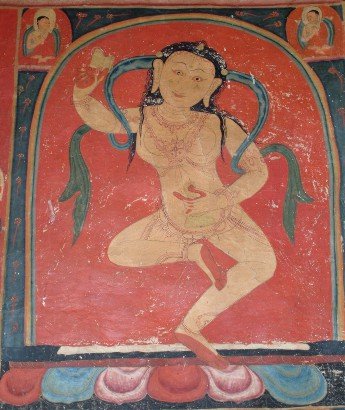
By the fifteenth century, there was a diversification of Ma gcig’s iconography, with increasing prominence of her representation as a ḍākinī with ḍamaru and bell, held low in the left hand (as in fig. 3.1) rather than the rkang gling. In the Guru Lha khang at Phyang (Phyi dbang), also in Ladakh and constructed under the patronage of local political authorities who supported the region’s ‘Bri gung bKa’ brgyud community in the thirteenth to early sixteenth centuries, Ma gcig is not wearing charnel ornaments (i.e. the five-skull crown) and is framed by a rainbow and long-stemmed flowers as something beneficial to see (mthong ba don ldan), accompanied by two unidentified monastic figures (figures 3.9 and 3.10).[12] Whereas in the various examples at Alchi Chos ‘khor and Tsatsapuri Ma gcig was a fairly minor figure incorporated into larger visual programs, in the Guru Lha khang she is shown with equal importance to the longevity buddha Uṣnīṣavijaya (gTsug gtor rnam rgyal ma) to her right and holding implements which have been rendered in gold and embossed.
 |
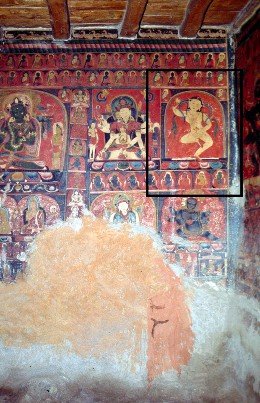 |
Figures 3.9 ad 3.10: Ma gcig with bell and ḍamaru in the Guru Lha khang in Phyang, 15th century. Images by Rob Linrothe (3.9) and Christian Luczanits (3.10) with black square added by author to indicate the position of the detail.
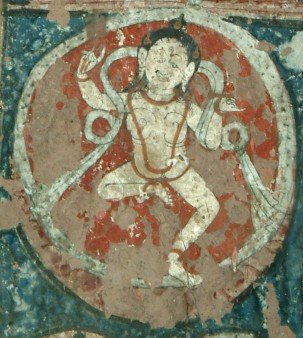
Ma gcig is found as well in the painted caves of Saspol (Sa spo la), fewer than ten kilometers from Alchi and dated to the fifteenth century like the Guru Lha khang.[13] In the largest of these caves, Ma gcig is to the left of the entrance just under an image of Pha dam pa of the same size (see figs. 3.27 and 3.28, below) ornamented, three-eyed and naked with a damaged rendering of an instrument being raised in the left hand, likely a rkang gling, as well as ḍamaru in the right (figure 3.11). However, in another cave at the same site, a faded painting of a two-armed ḍākinī might indicate the iconography of Ma gcig seen in in fig. 3.9 at the Guru Lha khang instead, with the left hand held lower against the body, though nothing of the implement is visible (figure 3.12).[14] Here she is again a minor figure, yet directly adjacent to the main image of Śākyamuni Buddha in dharmacakra mudrā in the center of the rear wall. These two examples at Saspol indicate how representations of Ma gcig and the practice of gcod had developed into diverse iconographies by this time.
 |
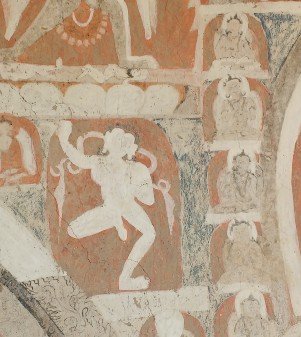 |
Figure 3.11 (left): Ma gcig with ḍamaru in the right hand and an unidentifiable instrument raised to the left, Saspol cave 3, 15th century. Image by Rob Linrothe.
Figure 3.12 (right): Damaged image of Ma gcig from Saspol cave 1 with left hand against the body and holding unspecified objects, 15th century. Image by Rob Linrothe.
Later images of Ma gcig would largely follow the convention seen in the Guru Lha khang of Phyang, showing her with a bell and ḍamaru. The rkang gling, on the other hand, would be incorporated into the iconography of Pha dam pa and later representations of siddhas, which is the focus of the next section in this chapter. In a nineteenth century thang ka illustrating her biography and the origins of her lineages, Ma gcig is depicted in her empowered form with bell and skull ḍamaru in the top register where she receives the teachings which would become gcod from Pha dam pa—with rkang gling, at top right—and another of his students, sKyo bsod rnams bla ma (n.d.) at top left (figure 3.13).[15] The narrative of this painting—including her training in the recitation of Prajñāparāmitā and marriage to the yogin Thod pa bha dra (n.d)—is generally coherent with ‘Gos lo tsā ba’s history of gcod as well as the fourteenth century Phung po gzan skyur rnam bshad and the thirteenth century Shangs pa gcod scholar brTson grus sengge.
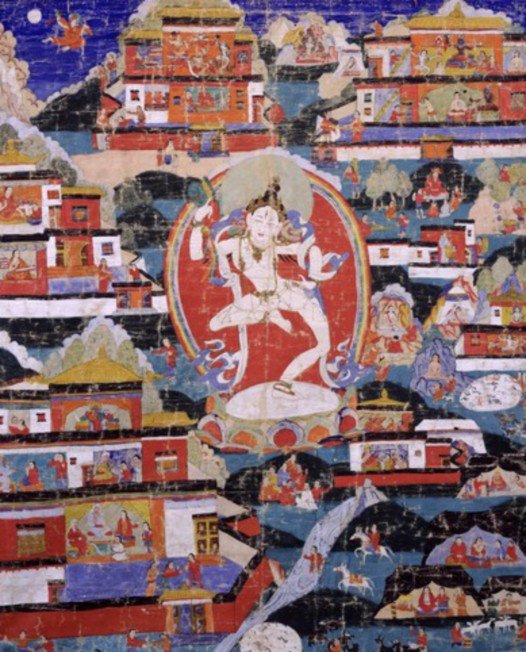
Figure 3.13: Ma gcig framed by scenes from her life story, including a meeting with Pha dam pa, dark-skinned and holding a rkang gling at top right, Tibet (provincial), 19th century, now at the Rubin Museum of Art (F1997.28.1).
However, ‘Gos lo tsā ba also indicates that Ma gcig’s tantric expertise and lay status were problematic to Buddhist monasticism, noting that she had been called jo mo bka’ logs ma, or a nun who has turned against her vows.[16] Yet in the Phung po gzan skyur rnam bshad Ma gcig’s marriage to Thod pa Bha dra—with whom she had several descendants that, like Thod smyon, would become active in the transmission of her teachings and lineage—is prophesied and thus sanctioned by Tārā.[17] Moreover, in the same biographical source, her empowerment through the conception of gcod as a nondual doctrine is expressed through the removal of her clothing, as suggested in fig. 3.13 where Ma gcig is a naked, dancing ḍākinī at top when she receives the teachings of Mahāmudrā from Pha dam pa and sKyo bSod rnams bla ma, and no longer wearing robes as in her early training or later teaching, seen below.
Nudity was understood as an expression of the accomplishment or comprehension of the nondual in Pha dam pa’s teachings on Mahāmudrā and Prajñāparāmitā, including as well amongst his many female disciples whom he encouraged to act in ways which were socially provocative in the late eleventh and twelfth century.[18] Another of his female students, Ma gcig Zha ma (b. 1062) was also a lay practitioner of tantra and sexual yoga, and a teacher of the bKa’ brgyud founder and patron Phag mo gru pa (1110-1170), as well as an important lineage holder of the Lam ‘bras tradition of Tibetan tantra which was cultivated by Sa skya institutions after the thirteenth century.[19] However, despite her work as a teacher, translator and Lam ‘bras innovator, surviving images of Ma gcig Zha ma are rare, whereas Ma gcig Lab sgron’s iconography would be developed through representations of gcod as an independent lineage, and primarily in bKa’ brgyud settings.
Though Ma gcig is credited with the formalization of lus sbyin as the characteristic sādhana of gcod practice, historic and biographical sources emphatically position her as Pha dam pa’s student: ‘Gos lo tsā ba, the Phung po gzan skyur rnam bshad and the writings of brTson grus sengge describe her meeting and being empowered by the Indian siddha and his teachings.[20] A fourteenth century thang ka from central Tibet shows Pha dam pa as the central figure with hands in dharmacakra mudrā while amongst his many students and lineage holders represented in the lower half, a woman in the top row, second from the right—naked from the waist up, with short hair and also with hands in dharmacakra mudrā—can be speculatively identified as Ma gcig or another of his female followers in the practice of Mahāmudrā (figure 3.14).[21] Rather than an independent lineage of tantra, here Pha dam pa’s female student indicates her accomplishment in Mahāmudrā by replicating his nudity as a practice or observance of the nondual.

Figure 3.14: Pha dam pa with unidentified lineage holders, central Tibet, 14th century, now in a private collection. Ma gcig (or another female student) is seated beneath her teacher in the top row, second from the right with short hair and naked from the waist up.
At the same time, the Karma pa Rang byung rdo rje’s thirteenth century commentary on gcod frames this practice as an expression of Prajñāparāmitā which, like Mahāmudrā, can be interpreted as a nondual doctrine.[22] ‘Gos lo tsā ba likewise introduces gcod through the study of Prajñāparāmitā as well as Hevajra tantra and Pha dam pa’s teachings on Mahāmudrā.[23] Moreover, the bKa’ brgyud commentarial corpus describes Ma gcig as an emanation of the deity Prajñāparāmitā—as Yum chen mo—who is moreover a source in gcod lineages of mantra and sūtra.[24]
This historically Buddhist foundation for the gcod tradition is reflected as well in what has come to be treated as its root text (rgya gzhung), a poem on Prajñāparāmitā by the brahmin Āryadeva (c. 9-10th c.) which was brought to Tibet by his student Pha dam pa:
… To cut off mind itself at the root,
To cut through the five poisons of mental afflictions,
To cut through extreme views and mental formations during meditation,
As well as anxiety, hope and fear in actions
And to cut through [ego-clinging]
Since all this is a matter of [cutting, gcod],
This is the real meaning of [gcod].[25]
Though the date of this text’s composition is uncertain, the articulation of gcod as the practice of cutting off demons (bdud) which represent historically Buddhist soteriological obstacles—e.g. ego-clinging, distractions, fear and mental objects—resonates with the commentarial corpus initiated by Rang byung rdo rje.[26]
After the thirteenth century, bKa’ brgyud traditions had expanded and established themselves through an emphasis on oral transmission and the practice of yoga tantra as well as the promotion of religious retreat: The monastery of gDan sa thil in central Tibet was established at a hermitage site in the twelfth century by bKa’ brgyud lineage founder Phag mo gru pa, coincidentally in a valley not 100 km from Ma gcig’s community of followers at Zang ri kang dmar.[27] And the ‘Brug pa teacher rGod tsang pa mgon po rdo rje (1189-1258)—a student of gcod, zhi byed and Mahāmudrā according to ‘Gos lo tsā ba—founded a retreat at Tsi bri nearby to Pha dam pa’s community at Ding ri, where he had settled in a cave and which was celebrated for its charnel grounds (dur khrod) as a setting for practice.[28] As a nondual ritual tradition, the gcod teachings of Ma gcig were not incompatible with these bKa’ brgyud projects of asceticism and ritual specialization.
After securing political and religious patronage from the Mongolian forces behind the Yuan dynasty (r. 1279-1368), the Sa skya monastic community came to dominate central Tibet after the thirteenth century, encouraging a westward expansion of bKa’ brgyud traditions.[29] Of these, the ‘Bri gung bKa’ brgyud lineage was established in central Tibet by ‘Jig rten mgon po rin chen dpal (1143-1217)—a student of Phag mo gru pa who had been briefly at gDan sa thil—and introduced to Zangskar and Ladakh soon after, where it was favored by local leaders as the largest monastic institutional presence in the region until the sixteenth century.[30] In the following section of this chapter, those ‘Bri gung sites of the western Himalayas which have been introduced above through their preservation of early images of Ma gcig will be further explored through representations of Pha dam pa as an Indian source for bKa’ brgyud religious authority as well as the teachings of gcod.
Footnotes and references:
[1]:
See note 10, above and Harding, op.cit., 57, for example, where Ma gcig is addressed as a ḍākinī in the first line of the Phung po gzan skyur rnam bshad.
[2]:
See English on the history of the Vajravārāhī tradition in Sanskrit commentaries of the Buddhist yoginī corpus and its preservation in Tibet by predominantly bKa’ brgyud authors, idem., Vajrayoginī, xxii-xxiii and 47-54. There is another thirteenth century Vajravārāhī maṇḍala below in fig. 3.16 and in chapter 4, section 3.
[3]:
This painting is discussed within the early stylistic traditions of Tibetan painting by Jane Casey Singer, who notes that many of the figures in the bKa’ brgyud lineages of the upper and lower register are unknown due to the condition of the inscriptions but they include prominent disciples of Phag mo gru pa (1110-1170), idem., Sacred Visions: Early Paintings from Central Tibet, (New York: Metropolitan Museum of Art, 1998), pl. 21. This iconography for Vajravārāhī was cultivated in sources for Tibetan Cakrasaṃvara as the consort of the deity Heruka and found in the Sādhanamālā, see Bhattacharya, The Indian Buddhist Iconography, 104-5. See also de Mallmann, Introduction à l’iconographie du tântrisme bouddhique, 425-429 on the various forms of this yoginī deity—including a white form in ālīḍha —and ibid., 349 for the connection between the aṣṭaśmaśāna and the maṇḍala of Vajravārāhī in the same twelfth century sources.
[4]:
This is in chapter 5 of the Phung po gzan skyur rnam bshad; c.f. Harding, op.cit., 137-139.
[5]:
Edou, op.cit., 85 and Harding, op.cit., 51-52. Depending on the specific teaching of gcod being followed, the yi dam is most often Vajravārāhī or Khros ba nag mo (see fig. 3.31 below). ‘Jam mgon kong sprul identifies the deity as Vajrayoginī, described as two-armed with skull, khaṭvāṅga and chopper, red-bodied and dancing on a corpse as seen in fig. 3.1.
[6]:
This iconographic program—as Aṣṭamahābhaya Tārā—is found in the Sādhanamālā (no. 99) where it features a white, two-armed form of Tārā, possibly the figure opposite Ma gcig on the top left in fig. 3.5; c.f. Bhattacharya, op.cit., 136 and de Mallmann, op.cit., 370. There is no eight-armed, green Tārā in either the Sādhanamālā or Niṣpannayogāvalī.
[7]:
This is in the second chapter of the Phung po gzan skyur rnam bshad, translated in Harding, op.cit., 86ff. ‘Jam mgon kong sprul lists green Tārā as a source in the close lineage of the mantra tradition (sngag lugs nye rgyud) which was also transmitted from Ma gcig by Thod smyon, op.cit., 18.
[8]:
Martin, Mandala Cosmogony, 33. See also Harding, op.cit., 55 on fear as an object or demon in the practice of gcod or note 53, below, on Prajñāparāmitā.
[9]:
For dates and an iconographic overview of these spaces see the work of Christian Luczanits, especially idem., “Beneficial to See”, 214-259. For documentation of the visual program at Tsatsapuri, see André Alexander, “Alchi Tsatsapuri Preliminary Report” (Leh: Tibet Heritage Fund International, 2005).
[10]:
My thanks to Dr. Luczanits for advising me on the provenance of these two thang ka. Fig. 3.8 is published—but not examined at length—in Giuseppe Tucci, Tibetan Painted Scrolls (Rome: La Libraria della Stato, 1949), pl. 45. Tucci photographed it in Kinnaur in the early-mid twentieth century.
[11]:
At a number of points in the Phung po gzan skyur rnam bshad, Ma gcig is attended by ḍākinīs who facilitate her activities and travels, even her (re)birth in Tibet; c.f. Harding, op.cit., 60 and passim. These assemblies may moreover suggest the development of specific gcod empowerments, see “gCod dbang brgya rtsa’i dbang gi tsak li”, an illustrated text with no colophon or publication record found on BDRC as no. W3JT13604, also discussed in chapter 4, sections 4 and 5. My thanks to Dan Martin for bringing this text—which includes representations of Ma gcig with assemblies of ḍākinī as well as the ritual implements of various gcod teachings—to my attention.
[12]:
On the rainbow halo in ‘Bri gung bKa’ brgyud iconography, see Luczanits, “Beneficial to see”, 256. On the construction of the Guru Lha khang and its iconographic program, see Ernesto Lo Bue, “The Gu ru lha khang at Phyi dbang: A mid-15th century temple in central Ladakh” in Proceedings of the Tenth Seminar of the IATS, 2003. Volume 8: Discoveries in Western Tibet and the Western Himalayas, eds. Amy Heller and Giacomella Orofino (Leiden: Brill, 2007), 175-196.
[13]:
For dates, see Luczanits, ibid., 247.
[14]:
My thanks to Dr. Rob Linrothe for sharing his images of Ma gcig and Pha dam pa at Saspol as well as Sreekumar Menon of the Courtauld Institute of Art for making available documentation produced by the Buddhist Architecture in the Western Himalaya research initiative at the Graz University of Technology; c.f. “FWF Research Project P22857”, https://archresearch.tugraz.at/results/Saspol (accessed 9 April 2020). Note that David L. Snellgrove and Tadeusz Skorupski identify the figure of Ma gcig in the largest cave at this site as standing Vajrapāṇi, idem., The Cultural Heritage of Ladakh, vol. 2 (Warminster: Aris and Phillips, 1980), 81.
[15]:
‘Gos lo tsā ba writes that the mother (mo) and father (pho) traditions of gcod are split according lineages starting with Pha dam pa’s students Ma gcig and sKyo bsod rnams bla ma, op.cit., 982.
[16]:
‘Gos lo tsā ba, ibid., 983.
[17]:
Harding, op.cit., 70-71.
[18]:
Dan Martin, “The woman illusion? Research into the lives of spiritually accomplished women leaders of the 11th and 12th centuries,” in Women in Tibet, eds. Hanna Havenik and Janet Gyatso (London: Hurst and Company, 2005), 74ff. Other methods for transgression included the abandonment of household duties and acts of incest. Pha dam pa’s high concentration of female disciples is also noted by ‘Gos lo tsā ba, op.cit., 915.
[19]:
‘Gos lo tsā ba records a more dynamic relationship between Ma gcig Zha ma and Pha dam pa than between the Indian siddha and Ma gcig Lab sgron, referring especially to Zha ma as Ma gcig and thus creating an ambiguity about their identities for later scholars, op.cit., 225-7. Zha ma was associated with Lam ‘bras by Ma gcig Lab sgron’s fourteenth century biographer Nam mkha’i rgyal mtshan as well, Harding, op.cit., 74. For a foundational study of Tibetan cultural history through Sa skya historiography, including its institutional cultivation of the tantric tradition of Lam ‘bras, see Ronald Davidson, Tibetan Renaissance: Tantric Buddhism in the Rebirth of Tibetan Culture (New York: Columbia University Press, 2002).
[20]:
See ‘Gos Lo tsā ba, op.cit., 983 and chapters 1 and 2 of the Phung po gzan skyur rnam bshad, translated in Harding, op.cit., 57-102; see also Edou, op.cit., 112. ‘Gos lo tsā ba’s treatment of Ma gcig and gcod is cursory compared to his descriptions of Pha dam pa’s activities throughout the Deb ther ngon po. In other sources, Ma gcig does not receive Pha dam pa’s teachings directly but instead by way of her primary guru sKyo bSod rnam bla ma, see Dan Martin, “Padampa Sangye: A history of representation of a south Indian siddha in Tibet,” in Holy Madness: Portraits of Tantric Siddhas, ed. Rob Linrothe (New York: Rubin Museum of Art, 2006), 116.
[21]:
My thanks to Christian Luczanits for bringing this figure to my attention and helping me read this painting.
[22]:
See note 6, above and Gyatso, “The development of the gcod tradition,” 325.
[23]:
’Gos lo tsā ba, op.cit., 980.
[24]:
‘Jam mgon kong sprul, op.cit., 16-17 and Lama Lödö Rinpoche, “Life of Machig Labdron”, in ibid., 13. See also Edou, op.cit., 25ff.
[25]:
Translated by Edou, op.cit.,19 with my own adjustments in brackets. The Tibetan version—Ā rya de was mdzad pa'i shes rab kyi pha rol du phyin pa'i tshigs su bcad pa chen mo—is given as the root text (rgya gzhung) in the nineteenth century edition gCod kyi Chos 'khor, op.cit., fols. 1-9, which also includes the Phung po gzan skyur rnam bshad. See also below on “cut[ting] off mind itself at the root” in sources for the Pāśupata tradition and the iconography of Pha dam pa.
[26]:
Āryadeva is acknowledged as Pha dam pa’s teacher in the lineages recorded by Nam mkha’i rgyal mtshan in the Phung po gzan skyur, though there is no root text cited in this fourteenth century source; c.f. Harding, op.cit., 98. On Āryadeva’s contributions to the Buddhist nondual practices of Mahāmudrā and the Guhyasamaja tantra, and Tibetan—especially dGe lugs—historiography of this figure, see Christian K. Wedemeyer, Āryadeva’s Lamp that Integrates the Practices (Caryāmelāpakapradīpa) (New York: Columbia University Press, 2007).
[27]:
‘Gos lo tsā ba, op. cit., 560-3.
[28]:
Barbara Nimri Aziz, “Introduction” in The Tradition of Pha Dampa Sangyas: A Treasured Collection of his Teachings Transmitted by T[h]ug[s] sras Kun dga’, ed. Barbara Nimri-Aziz (Thimphu: Druk Sherik Parkhang, 1979), ii. See also David Molk, Lion of Siddhas: The Life and Teachings of Padampa Sangye (Ithaca: Snow Lion Publications, 2008) in which sections of The Tradition of Pha Dampa Sangyas —found under the Tibetan title of Zhi byed sngar bar phyi gsum gyi skor (BDRC no. W23911)—have been translated. On ibid., p.179, Pha dam pa recommends isolation and remote locations for practice.
[29]:
Kapstein, The Tibetan Assimilation of Buddhism, xix-xx. Kapstein refers to “an age of Sa skya hegemony” in central Tibet from the thirteenth to sixteenth centuries. Another source records that “in some years nearly half of the Yuan national income was spent on Tibetan Buddhism and art”, preferentially from Sa skya sources, c.f. Jing Anning, “Financial and material aspects of Tibetan art under the Yuan Dynasty,” Artibus Asiae 64, no. 2 (2004): 239.
[30]:
See Christian Luczanits, “The early Buddhist heritage of Ladakh reconsidered”, in Ladakhi Histories. Local and Regional Perspectives, ed. John Bray (Leiden: Brill, 2005), 65-96.