
On the use of Human remains in Tibetan ritual objects
by Ayesha Fuentes | 2020 | 86,093 words
The study examines the use of Tibetan ritual objects crafted from human remains highlighting objects such as skulls and bones and instruments such as the “rkang gling” and the Damaru. This essay further it examines the formalization of Buddhist Tantra through charnel asceticism practices. Methodologies include conservation, iconographic analysis, c...
Go directly to: Footnotes.
Introduction: The use of skulls and bone ornaments
This chapter draws on a diversity of historical texts and iconographic sources to describe the ritual use of charnel materials within the formalization of Buddhist tantra. Specifically, the following explores how skulls and bone ornaments were cultivated as ritual instruments through the methodologies of mahāyoga and yoginī tantra as Buddhist forms of ritualized charnel asceticism.[1] This work will moreover examine evidence for the exchange of charnel methods with other religious traditions and communities active across south and central Asia during the first millennium CE, including brahmanical and Śaiva ascetic practices like the observance of the kāpālika, or skull-bearers. Moreover, this discussion investigates sources for the Tibetan iconography of siddhas, yoginī/ḍākinī, and the deity Heruka and these figures’ consistent, prominent depiction with ritual objects made with human remains.[2]
In one of the oldest preserved painted representations of a transmission lineage on the top floor of the early thirteenth century Alchi gSum brtsegs in Ladakh (figure 2.1), the Indian siddhas Tilopa (988-1069) and Nāropa (b.1012) are dark-skinned and naked wearing charnel ornaments on their heads, ears, necks, arms, wrists and ankles, and around the waist as a girdle or belt (Skt. mekhalā, Tbt. ska rags), indicating the fundamental prestige of these materials. Each holds a skull in the left hand with a musical instrument—a horn and ḍamaru, respectively —in the right. Between them is the blue figure of Vajrasattva (or Vajradhara) and, on the ground, a maṇḍala with skulls placed at the four corners. The two yogins turn toward one another, illustrating the oral transmission of teachings between them while, to the left, the founding bKa’ brgyud translator and student of Nāropa, the white-robed Marpa (1012-1097), rotates towards them as the source for his tantric knowledge.[3]
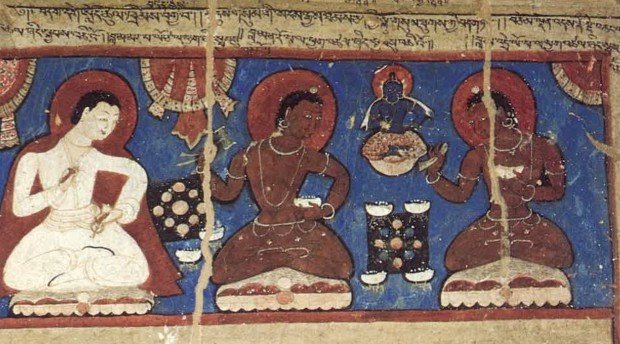
Figure 2.1: First three figures in the founding lineage of the ‘Bri gung bKa’ brgyud from the top floor of the Alchi gSum brtsegs, c.1220, from right to left, Tilopa, Nāropa and Marpa. Image from Tsering 2009. Each has a small single skull in their hair, indicating that these ornaments are charnel materials.
In images such as this, skulls and charnel ornaments are prominent features of the siddhas’ appearance, thus associated with the Indian and revelatory sources for Buddhist tantra as well as its transmission to local and/or Tibetan religious leaders.[4] However, the collective identity of these figures as mahāsiddha and the refinement of their iconography in the Himalayas was established only after the twelfth century through the consolidation and translation of earlier sources and teachings on Buddhist tantra.[5] Earlier, generic representations of Buddhist charnel ascetic yogins are found in two twelfth century maṇḍala, for example, in which are also illustrated the use and visualization of corpses or human remains as ritual method, the feast-gathering of gaṇacakra (Tbt. tshogs kyi ‘khor lo) and the iconographic program of the eight charnel grounds (Skt. aṣṭaśmāśana, Tbt. dur khrod chen po brgyad) (figures 2.2-2.3).[6] These are two of the oldest surviving painted examples of Buddhist maṇḍala and, like the transmission lineage at the Alchi gSum brtsegs, suggest the ways in which charnel materials had become important to the visual culture of deity yoga in Buddhist tantra during the twelfth and thirteenth centuries.
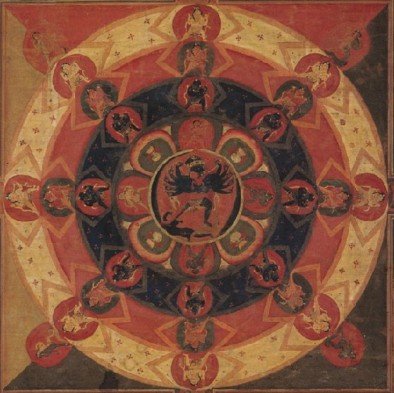
In each of these maṇḍala, the central deities—Saṃvara in figs. 2.2 and 2.4 and Vajraḍāka as Saptākṣara in figs. 2.3 and 2.5, each embracing the consort Vajravārāhī—are represented as a form of Heruka with a skull and khaṭvāṅga and, like the siddhas in fig. 2.1 above, wearing bone ornaments on the head, waist, limbs, etc. (figures 2.4 and 2.5). These two maṇḍala and the iconography of their figures reflect sources compiled during or previous to this period: The triple-wheel assembly and twelve-armed form of Saṃvara in fig. 2.2 corresponds to a description from the Niṣpannayogāvalī of Abhayākaragupta (d.1125) as well as the textual sources which would form the basis of the Tibetan Cakrasaṃvara iconography.[7] The six-armed Saptākṣara, on the other hand, is one of many forms of the deity Heruka taken by the buddha Akṣobhya in the Sādhanamāla, the earliest surviving copies of which also date from the twelfth century.[8] Each deity is moreover surrounded by a retinue or network of ḍākinī and/or their consorts as well as protectors. The following chapter examines the origins of their wrathful (Skt. krodha, Tbt. khro ba) characterization through their association with charnel materials as well as evidence for historical exchanges between Buddhist and Śaiva or brahmanical iconographic traditions.[9]
The work of the Indian Buddhist tantric scholar Abhayākaragupta—including the Niṣpannayogāvalī cited above—was highly valued by Tibetan scholars in the period after the phyi dar during the (re)establishment of the region’s religious institutions and gSar ma monastic lineages.[10] This includes as well the Vajravāli (Tbt. rDo rje phreng ba), a compendium of Buddhist texts and commentaries which include the description of a yogic vow to hold a skull and khaṭvāṅga and wear charnel ornaments in a practice identified as vajrakāpālikacaryāvrata.[11] This represents the result of a Buddhist re-contextualization for the kāpālika observance which had been adapted in the preceding centuries by Vajrayāna authors, most explicitly and consistently in the visual and liturgical modes of Saṃvara tantra.[12] This chapter will examine surviving evidence for this process and the emergence of a Buddhist yoginī tradition after the eighth century, defined in part by its prominent use of charnel materials.

Figure 2.2: Triple-wheel Cakrasaṃvara maṇḍala surrounded by the eight charnel grounds with a form of Heruka and Vajravārāhī at the center of an oath-bound network of ḍākinī, central Tibet, c. 1100, now in a private collection.
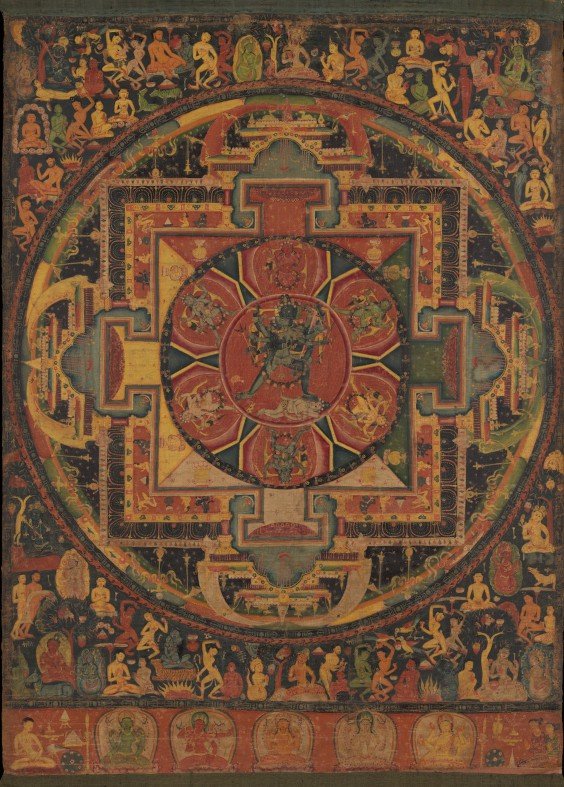
Figure 2.3: Maṇḍala of Heruka as Vajraḍāka in the form of Saptākṣara in union with Vajravārāhī within the eight charnel grounds, central Tibet, c. 1100, now at the Metropolitan Museum of Art (1995.233).
 |
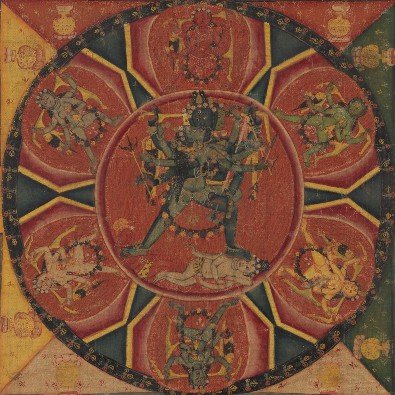 |
Figures 2.4 and 2.5: Detail of the central assembly of figs. 2.2 (above) and 2.3 (below) with forms of Heruka and Vajravarahī (as vajrayoginī) in union trampling their non-Buddhist adversaries within a circular network of ḍākinī. Note also the skulls positioned on top of vases with offerings in the corners of fig. 2.5.
Drawing from the writings of Abhayākaragupta as well as the textual corpus of Buddhist tantra, the Sa skya scholar Grags pa rgyal mtshan (1147-1216) would further develop the yoga of ritualized charnel asceticism in his He ru ka’i chas ‘drug, which describes the skull vessel, khaṭvāṅga and bone ornaments as the implements of one who assumes the form of the deity Heruka.[13] This thirteenth century text on Heruka deity yoga would form an early textual precedent for the Tibetan tradition of brtul zhugs spyod pa (Skt. vratacaryā), or practice of observance.[14] Grags pa rgyal mtshan moreover developed narratives which associated the adaptation of charnel methodologies from non-Buddhist sources with the origins of the Saṃvara corpus and the characteristic appearance of Heruka as its central deity.[15]
Grags pa rgyal mtshan’s description of deity yoga in the form of Heruka and its application of charnel materials is reflected in the early thirteenth century image of the siddhas Nāropa and Tilopa seen in fig. 2.1, including as well their use of musical instruments and seat of animal skins.[16] At the same time, the Sa skya scholar’s contribution to the exegesis of these practices was informed by his knowledge and study of mahāyoga texts also found at Dunhuang and authored before the eleventh century, such as those describing subjugation through sgrol ba, or liberatory ritual killing, in the tradition of Vajrakīlaya (rDo rje Phur pa) and which are also characteristic to the rNying ma corpus.17 This chapter will also explore the contribution of these mahāyoga sources to the formalization of Buddhist tantra in Tibet through their evidence for ritualized charnel asceticism.
Therefore, it can be seen that by the twelfth and thirteenth centuries there was a comprehensive historiographic, iconographic and practical interpretation for the ritual use of charnel materials in Tibet. Moreover, these objects were given emphatically Indian origins by Tibetan religious authorities of the gSar ma traditions through representations of siddhas as tantric innovators, and were primarily cultivated in the mahāyoga and yoginī tantras. This chapter will examine evidence for how these materials came to be valued as ritual objects by the patrons, authors and practitioners who would formalize the ritual methodologies of Buddhist tantra. Furthermore, this work will describe the development of iconographic programs—particularly in the Saṃvara corpus—which feature the use of skulls and bone ornaments, including the wrathful deity forms of Heruka and the yoginī or ḍākinī, and how these representations existed in conversation with adjacent, non-Buddhist traditions.
Footnotes and references:
[1]:
[2]:
Yoginī and ḍākinī are largely treated as synonymous entities in Buddhist tantra though the latter name (mkha’ ‘gro ma) is preferred in Tibetan sources; their iconography is derived from common sources (see below).
[3]:
See Christian Luczanits, “Beneficial to see: Early Drigung painting”, in Painting Traditions of the Drigung School, ed. David P. Jackson (New York: Rubin Museum of Art, 2014), 214-259. For an extended discussion of the historiographic importance of this lineage painting see idem., “Art historical aspects of dating Tibetan art,” in Dating Tibetan Art: Essays on the Possibilities and Impossibilities of Chronology from the Lempertz Symposium, Cologne, ed. Ingrid Kriede-Damani (Wiesbaden: Dr. Ludwig Reichert Verlag: 2003), 25-57. See also chapter 3 for additional discussion of siddha iconography in the thirteenth and fourteenth century monuments of Alchi Chos ‘khor.
[4]:
Geoffrey Samuel, “The siddha as a cultural category,” in Holy Madness: Portraits of Tantric Siddhas, op.cit, 45. Samuel suggests that Tibetan authors and lineage founders in the phyi dar (c. tenth to twelfth centuries) particularly emphasized the extremity of siddhas’ ritual methodologies in order to support their local authority.
[5]:
See the introduction in chapter 1, notes 34 and 35. Wedemeyer notes that Abhayadatta’s twelfth century collective biography Grub chen brgyad bcu rtsa bzhi’i rnam thar, is a compendium of historical and hagiographic material and “almost certainly a Tibetan apocryphon”, idem., Making Sense of Tantric Buddhism, 175. See also Matthew T. Kapstein, “An inexhaustible treasury of verse: The literary legacy of the mahāsiddhas,” in Holy Madness: Portraits of Tantric Siddhas, ed. Rob Linrothe (New York: Rubin Museum of Art, 2006), 22-35.
[6]:
Christian Luczanits, “The eight great siddhas in early Tibetan paintings,” in Holy Madness: Portraits of Tantric Siddhas, op.cit., 77-91. Luczanits observes that the siddhas in the two twelfth century maṇḍala included here do not necessarily correspond to the collective biography of the 84 mahāsiddhas nor the ‘Bri gung conventional grouping of eight, but rather represent variations in a general type drawn from other sources which will be explored here.
[7]:
This description is number 12 in the Niṣpannayogāvalī; see Marie-Thérèse de Mallmann, Introduction à l’iconographie du tântrisme bouddhique (Paris: Librarie d’Amérique et d’Orient, 1986), 50-52. This triple-wheel maṇḍala assembly is also described in the root tantra for the Tibetan Saṃvara corpus, the eighth century Laghusaṃvara (see below).
[8]:
Benoytosh Bhattacharya, The Indian Buddhist Iconography (London: Oxford University Press, 1924), 64-65. This form of Heruka is described as the deity Vajraḍāka in union with his consort in sādhana numbers 250 and 251.
[9]:
See Rob Linrothe, Ruthless Compassion: Wrathful Deities in Early Indo-Tibetan Esoteric Buddhist Art (London: Serindia Publications, 1999), 299-304 for an iconological summary of Saṃvara as a Buddhist re-contextualization for Śaiva imagery. My field of inquiry roughly corresponds to the third phase of Linrothe’s periodization for the development of krodhavignāntaka (wrathful protectors) in Vajrayāna iconography, after the tenth century.
[10]:
According to ‘Gos lo tsā ba gZhon nu dpal (1392-1481), Abhayākaragupta is most prominently associated with the composition of the Vajravāli, idem., The Blue Annals (Deb ther ngon po), trans. George Roerich, (Delhi: Motilal Banarsidass, 1949), 1048. See also David B. Gray on support for Abhayākaragupta’s interpretation of the Saṃvara tradition by Tibetan political and religious leaders after the twelfth century, idem., “Introduction” in The Cakrasamvara Tantra: The Discourse of Śrī Heruka (Śrīherukābhidhāna), trans. David B. Gray (New York: Columbia University Press, 2007), 69-71.
[11]:
Cited in Alexis Sanderson, “Vajrayāna: Origin and function,” in Buddhism into the Year 2000: International Conference Proceedings (Bangkok and Los Angeles: Dhammakāya Foundation, 1994), 91.
[12]:
Sanderson (ibid.) has effectively demonstrated the intertextuality of Śaiva and Buddhist sources that incorporate the charnel methodologies of the kāpālika vow, most prominently in the Saṃvara corpus; see below and idem., “The Śaiva age -The rise of dominance of Śaivism during the early medieval period,” in Genesis and Development of Tantrism ed. by Shingo Einoo (Tokyo: Institute of Oriental Culture, University of Tokyo, 2009), 145ff.
[13]:
Grags pa rgyal mtshan, “He ru ka’i chas drug”, 267. His iteration of bone ornaments is taken from chapter 6 of the first part of the Hevajra tantra, see below.
[14]:
This description of the six implements of the Heruka yogin would be repeated by the seventeenth century rNying ma teacher Lha btsun nam mkha’ ‘jigs med, for example, in his own “He ru ka’i chas kyi rnam bshad”, included as “Lha btsun nam mkha' 'jigs med dpal gyi rig pa brtul zhugs spyod pa'i rnam thar” in gSang rnying rgyan dang rol mo’i bstan bcos, ed. bKra shis rgya mtsho (Lha sa: Bod ljongs bod yig dpe rnying dpe skyun khang, 1996); available at the Buddhist Digital Resource Center (BDRC), no. W22300, 105-116. My thanks to Westin Harris for sharing his unpublished translation and knowledge of this text with me; see also chapter 3 on the integration of gcod and the brtul zhugs practice.
[15]:
[16]:
Nāropa’s bone ornaments—now at Hemis Monastery in Ladakh—are dated locally to the eleventh century when the bKa’ brgyud translator Marpa (b.1012) received them directly from the siddha in Bihar with teachings of Buddhist tantra; see Loseries-Leick, Tibetan Mahayoga Tantra, 126 and chapter 4, section 3. According to Grags pa rgyal mtshan and his sources, the six implements of the Heruka yogin are bone ornaments, skull vessel, ritual implements (including khaṭvāṅga), a garment (of animal skin) and an appropriate seat. The use of musical instruments by these ascetics includes a double-sided hand drum or ḍamaru, which can be made of wood or skulls according to the Grags pa rgyal mtshan and based on descriptions from the Samputa tantra (see chapter 4, section 5).